



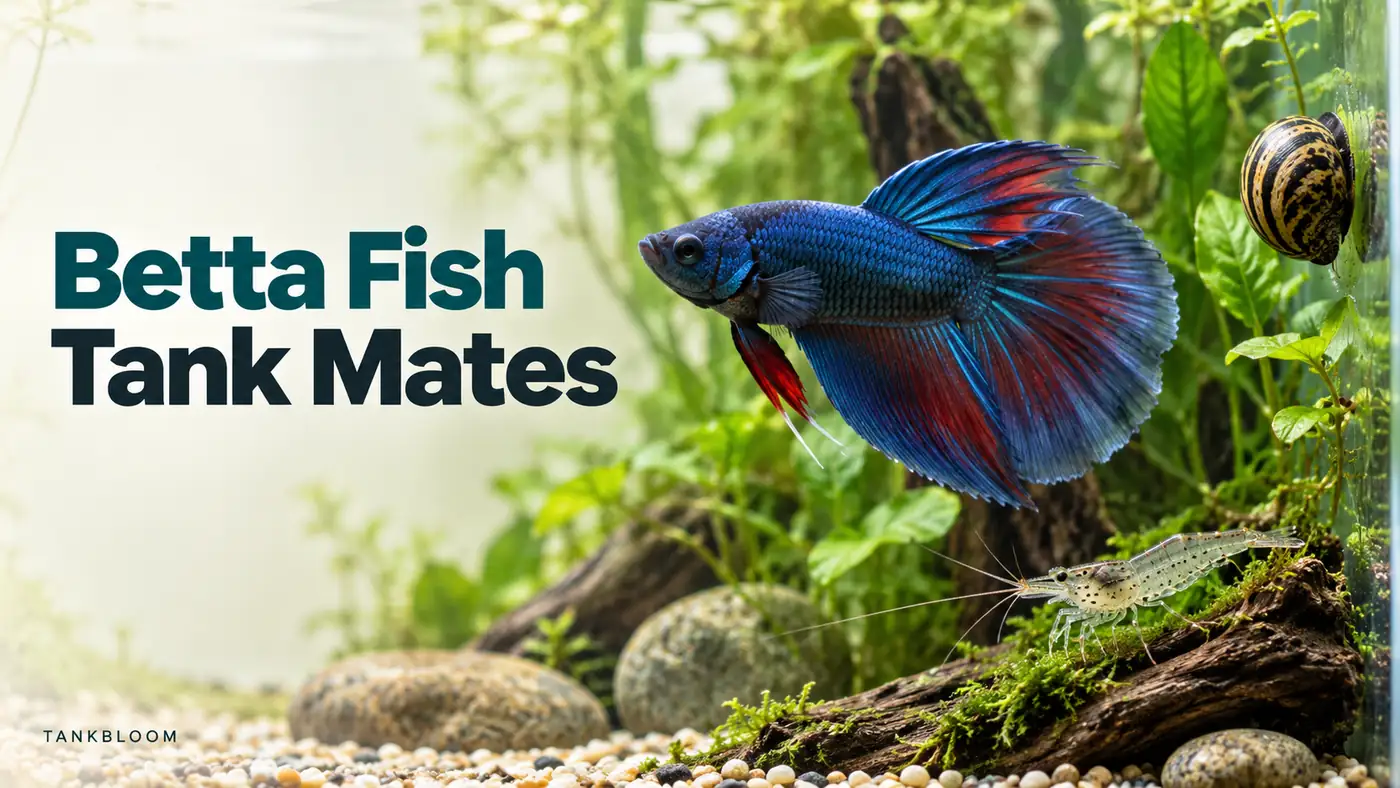
Betta fish can sometimes live with selected snails, shrimp, and peaceful community fish. However, no tank mate is guaranteed to be compatible with every betta. Individual temperament, aquarium dimensions, water conditions, and the behavior of both animals all influence whether a pairing works.
For a smaller aquarium, keeping one betta without additional fish is usually the more practical choice. Larger, established aquariums can offer more possibilities, but they still need to meet the needs of every species in the community.
The goal is not to find a companion at any cost. It is to create an aquarium where every animal can feed, swim, hide, and behave normally without persistent stress or aggression.
Key Takeaways
- Snails: Nerite and mystery snails may be suitable, but they need appropriate food, water conditions and protection from harassment.
- Shrimp: Amano and cherry shrimp may coexist with some bettas, although predation remains possible.
- Community fish: Selected tetras, rasboras and Corydoras require species-specific checks for group size, space and water conditions.
- Tank size: A 5-gallon aquarium is generally best used for one betta. Larger tanks offer more possibilities, not guaranteed compatibility.
- Have a backup: Prepare suitable alternative housing before introducing another animal.
Which Tank Mates May Be Suitable for Betta Fish?
The most suitable potential tank mate depends on the aquarium and the individual betta. A snail may be easier to accommodate than a school of fish in some setups, while shrimp and community fish introduce different risks and care requirements.

Use this table to compare possible candidates. These are options to investigate, not guaranteed pairings. For a preliminary screen, use the Fish Compatibility Checker, then verify each species’ adult size, group requirements, water conditions, and temperament.
| Potential tank mate | Why consider it? | Main concern |
|---|---|---|
| Nerite snail | May suit an established freshwater aquarium without requiring a group of its own species. | A betta may nip its antennae or exposed body. The snail needs suitable food and water conditions. |
| Mystery snail | A larger, visible invertebrate that may suit an aquarium with enough room and food. | Adds to the aquarium’s waste load and may be harassed by a betta. |
| Amano shrimp | Larger than many commonly kept dwarf shrimp. | A betta may still chase, injure, or eat it. |
| Cherry shrimp | May suit a mature, planted aquarium with suitable cover. | Small shrimp and juveniles are vulnerable to predation. |
| Selected small tetras | Some species can suit carefully planned community aquariums. | May require a school, adequate swimming space, and compatible water conditions. Some fish may nip fins. |
| Selected rasboras | Some species are peaceful community candidates. | Group size, activity level, adult size, and aquarium dimensions must fit the setup. |
| Corydoras catfish | May use the lower part of a suitable aquarium. | Need appropriate social conditions, floor space, substrate, and access to food. |
A peaceful reputation does not guarantee compatibility. Check the exact species’ adult size, group needs, water parameters, and behavior before buying it. Also consider whether you can separate the animals if the pairing fails.
Snails That May Live With Bettas
Nerite and mystery snails are two possibilities when their care requirements fit the aquarium. Neither needs a school of its own species, which can make a suitable snail easier to accommodate than a group of fish in some setups.
Nerite Snails
Nerite snails are often considered for established freshwater aquariums. They still need suitable water conditions and enough food, including access to appropriate natural algae or other suitable nutrition.
A betta that repeatedly bites at a snail’s antennae or exposed body can make the pairing unsuitable. A snail that remains withdrawn or cannot feed normally should not simply be left in the tank in the hope that the animals will eventually adjust.
Mystery Snails
Mystery snails are larger and may be easier to observe, but they also need adequate food, space, and appropriate water conditions. Their size does not make them immune to harassment, and they contribute to the aquarium’s overall waste load.
Before adding a snail, check three things:
- Can the aquarium support the snail’s feeding and water-quality needs?
- Does the betta repeatedly attack or bite it?
- Can you move the snail to another suitable aquarium if the pairing fails?
Do not treat a snail as a maintenance tool that automatically keeps an aquarium clean. It is another animal with its own requirements.
Shrimp That May Coexist With Bettas
Amano shrimp and cherry shrimp are common candidates for planted freshwater aquariums, but their compatibility with bettas is unpredictable.
Amano Shrimp
Amano shrimp are relatively large compared with many dwarf shrimp. Their size may make them less vulnerable than tiny shrimp, but it does not guarantee safety. A betta may still chase or attack them.
Cherry Shrimp
Cherry shrimp and their young can be especially vulnerable because small individuals are easy for some fish to catch. Dense plants, moss, and other suitable hiding places can provide refuge, but they cannot eliminate predation.
Keeping adult shrimp alive is also different from successfully breeding a shrimp colony. A betta might tolerate adult shrimp while eating their young. If breeding a shrimp colony is the priority, a separate shrimp aquarium is the more predictable choice.
Before adding shrimp, consider:
- Cover: Are there suitable places for shrimp to retreat?
- Water quality: Can the aquarium support both animals without excessive waste?
- Feeding: Can the shrimp obtain suitable food rather than relying on leftovers?
- Individual behavior: Does the betta chase or hunt the shrimp?
- Backup housing: Can you separate the animals quickly if necessary?
If you want to maintain a shrimp colony, do not treat the shrimp as expendable while testing a betta’s temperament.
Peaceful Schooling Fish and Small Community Fish
Some small tetras and rasboras may be candidates for a community aquarium containing a betta. However, suitability depends on the exact species, not simply its size or reputation for being peaceful.
Ember tetras and certain rasboras are examples sometimes considered for planted community aquariums. Before choosing either, confirm the species’ adult size, preferred water conditions, activity level, and required group size.
Many schooling fish need companions of their own species. Keeping just one or two individuals to make room for a betta can create a welfare problem, even if the fish do not fight.
Fin-nipping is another concern. Some fish may repeatedly bite a betta’s fins, while a betta may attack or harass smaller companions. A peaceful reputation does not remove these risks.
Before selecting a schooling fish, ask:
- Can the aquarium accommodate the full group at adult size?
- Do the betta and the school have compatible water and temperature requirements?
- Is there enough horizontal swimming space for active fish?
- Can all the fish feed without constant competition?
- Are there suitable hiding places without overcrowding the aquarium?
A larger aquarium can make these requirements easier to meet, but the exact species and complete stocking plan still determine suitability.
Bottom-Dwelling Fish and Other Potential Companions
Corydoras catfish are sometimes considered because they spend much of their time near the substrate, while bettas often use the middle and upper parts of the aquarium. Occupying different areas may reduce some direct interactions, but it does not guarantee compatibility.
Corydoras are social fish and generally need an appropriate group. They also require suitable substrate, adequate bottom space, good water quality, and access to their own food. An aquarium that cannot meet these needs is not suitable simply because the catfish stay near the bottom.
Plecos need even more careful species selection. Different types vary greatly in adult size, and some become far too large for a small community aquarium. Do not choose a pleco based only on its juvenile size or its reputation as an algae eater.
Choose tank mates for their own welfare first. Their appearance, usefulness to the aquarium, or tendency to occupy a different swimming level should come second.
What Tank Mates Can Live With a Betta in a 5-, 10-, or 20-Gallon Tank?

Aquarium size places practical limits on which combinations can work. Gallon capacity alone cannot determine compatibility; the tank’s footprint, usable swimming space, filtration, and the full adult group also matter.
| Aquarium size | Practical guidance | Main limitation |
|---|---|---|
| 5 gallons | Generally best used for one betta without additional fish. | Limited room for schooling fish or animals that need substantial space. |
| 10 gallons | Some invertebrate pairings may be possible; community fish require closer evaluation. | A school plus a betta may need more swimming space than the aquarium provides. |
| 20 gallons | Some carefully planned community arrangements become more realistic. | The exact species, adult group size, temperament, water conditions, and tank footprint still determine suitability. |
The Aquarium Stocking Calculator can help you review a proposed fish population, but it cannot confirm behavioral compatibility or replace checking each species’ adult size, group needs, and space requirements.
Betta Tank Mates in a 5-Gallon Aquarium
A 5-gallon aquarium is generally best used for one betta rather than a community of fish. It offers limited room for additional animals that need to swim in groups, establish territories, or use different parts of the tank.
A suitable snail or shrimp may be possible, but adding an invertebrate still increases the aquarium’s care requirements. The tank must maintain stable water conditions, and the betta must not continually attack the new animal.
If your goal is to keep several species together, upgrading the aquarium is usually more practical than trying to fit additional animals into a small space.
Betta Fish Tank Mates in a 10-Gallon Aquarium
A 10-gallon aquarium offers more room, but it is not automatically large enough for every proposed betta community.
A suitable invertebrate may be a reasonable option. A school of fish is more complicated because the aquarium must support the group’s full size, social needs, and swimming behavior as well as the betta.
Check the exact species’ space and group requirements before deciding. Do not keep a schooling fish alone or in an undersized group simply to fit the aquarium.
Betta Tank Mates in a 20-Gallon Aquarium
A 20-gallon aquarium can make some community arrangements more realistic by providing additional swimming space and room for plants, hiding places, and visual barriers.
An appropriately planned aquarium might accommodate a betta alongside a suitable school of small community fish. Whether that arrangement works still depends on the exact species, its group size, compatible water conditions, and the individual betta’s behavior.
A 20-gallon tank does not guarantee peaceful cohabitation. A territorial betta can still attack other fish, and a peaceful companion can still have incompatible care requirements.
Choose the aquarium around the needs of the complete adult community, not around a target number of species.
Which Fish Should Not Live With Betta Fish?
Some combinations are poor choices because of aggression, fin-nipping, predation, or conflicting environmental requirements. Avoiding these problems is more reliable than trying to manage an unsuitable pairing after the animals are together.
Fish That May Nip Fins or Harass a Betta
Fish known for persistent fin-nipping or boisterous behavior are poor candidates for a betta aquarium. Tiger barbs are a commonly cited example because they may nip at other fish’s fins.
The risk also works in the other direction. A betta may attack a companion that it perceives as a threat or that repeatedly enters its territory.
Long-finned fish, including some fancy guppies, also deserve caution. A betta may attack another fish’s flowing fins, while some companions may damage the betta’s fins in return. Not every betta reacts the same way, but the possibility of injury makes these combinations poor default recommendations.
Avoid selecting companions based only on size or color. Consider behavior, swimming speed, social requirements, and their tendency to interact with other fish.
Goldfish and Species With Conflicting Care Needs
Goldfish are not suitable routine companions for bettas. Their preferred environmental conditions and long-term space requirements differ, and goldfish can grow considerably larger than many people expect.
A combination that forces one species to live outside its appropriate temperature range or limits its adult space is unsuitable even if the animals appear peaceful.
Other fish may also be poor matches because they need very different water conditions, grow too large, prey on smaller tank mates, or require an aquarium designed around their behavior.
Shared freshwater habitat does not mean shared aquarium requirements.
Very Small or Vulnerable Animals
Small shrimp, shrimp juveniles, and tiny fish can become prey for a betta. Even when an adult animal survives, its young may be much more vulnerable.
Suitable plants, moss, caves, and other cover can give smaller animals places to hide. However, cover does not guarantee protection if the betta actively hunts them.
If you would not be comfortable with the possibility of predation, choose a separate aquarium rather than relying on hiding places alone.
Can Betta Fish Live With Other Betta Fish?
Keeping two male bettas together is generally unsafe because they can fight and cause severe injuries. House them separately rather than relying on aquarium size or decoration to prevent aggression.
Keeping a male and female together is not a routine companionship arrangement either. They may be brought together for controlled breeding, but breeding requires specialist preparation and a plan to separate them. A female should not be added simply to keep a male company.
Female bettas may sometimes be kept in groups known as sororities. However, this is not a beginner-friendly shortcut to a peaceful community. Females can also display aggression, and a group needs suitable space, cover, careful monitoring, and the ability to separate individuals when necessary. A 5-gallon aquarium should not be treated as a suitable default for a sorority.
A female betta may also be considered for a community aquarium with carefully selected non-betta species, but her temperament and the needs of the other animals still matter. Female bettas are not automatically compatible with every community fish.
For most people who want one betta, a well-maintained single-fish aquarium is a reasonable choice. A betta does not need another betta to justify its place in the aquarium.
How to Introduce Tank Mates to a Betta Safely
Preparation matters more than the introduction itself. The aim is to reduce foreseeable risks, not to guarantee a peaceful outcome.
- Confirm the match first. Research the exact species, adult size, social-group requirements, water parameters, and behavior. Do not rely on a generic list of compatible fish.
- Prepare a suitable aquarium. Establish biological filtration, confirm stable water conditions, and make sure the tank has enough space for the complete group. Test the water rather than relying on its appearance.
- Provide cover and open swimming space. Use suitable plants and hiding places to create refuge and reduce direct visual contact. Avoid filling the aquarium so densely that active fish cannot swim normally.
- Quarantine new arrivals when feasible. Use a separate, appropriately equipped setup to observe new animals and reduce the risk of introducing disease. Follow species-appropriate acclimation procedures before moving animals into the intended aquarium.
- Plan the introduction carefully. Avoid sudden changes in water conditions and monitor the fish closely afterward. A calm first few minutes do not establish long-term compatibility.
- Prepare a separation option in advance. Have suitable alternative housing or a reliable return arrangement ready before introducing the new animal.

Do not wait for a serious injury before deciding that a pairing has failed. If either animal faces persistent harassment, cannot feed normally, or develops injuries, separate them promptly.
Adding animals also increases the aquarium’s biological load. A tank that previously maintained stable conditions may need closer monitoring after its stocking changes.
How Can You Tell Whether a Betta and Its Tank Mate Are Compatible?
A successful pairing requires more than an absence of fighting. Both animals must be able to behave normally, access food, use the aquarium comfortably, and remain in good condition.
| Warning sign | What it may indicate | Recommended response |
|---|---|---|
| Persistent chasing or repeated attacks | Territorial conflict or harassment. | Separate the animals if the behavior continues or threatens either animal. |
| Damaged fins or other injuries | Physical aggression or an environmental hazard. | Separate promptly and assess the injured fish. |
| A companion repeatedly misses meals | Feeding competition or restricted access to food. | Review feeding access and separate the animals if the problem continues. |
| One animal hides constantly or avoids normal activity | Harassment, unsuitable conditions, illness, or another stressor. | Check water quality and behavior; intervene when needed. |
| Ammonia or nitrite becomes detectable | A water-quality problem that can harm fish. | Take prompt corrective action and reassess biological filtration and stocking. |
These observations are warning signs, not automatic diagnoses. Hiding, for example, may result from insufficient cover, poor water conditions, illness, or harassment. Investigate the cause rather than assuming every behavioral change is a compatibility problem.
A brief period of exploration or a short chase does not necessarily prove that a pairing will fail. Repeated pursuit, injury, restricted feeding, and ongoing avoidance are more concerning. Monitor water quality as well as behavior, particularly after adding animals.
The Best Betta Tank Mate Is One Your Aquarium Can Support
Betta fish can sometimes coexist with selected snails, shrimp, and peaceful fish, but compatibility depends on more than a species name. Aquarium dimensions, social-group requirements, water conditions, temperament, and the ability to separate animals all influence the outcome.
For a 5-gallon aquarium, keeping one betta is generally the most practical starting point. Larger tanks can offer more options, especially when they provide enough room for a complete school of fish and suitable habitat for every species.
Before adding a companion, ask: Can every animal live well in this aquarium if the pairing turns out to be less peaceful than expected?
If the answer is no, wait until you can provide a more suitable setup. A healthy aquarium for one betta is better than a crowded community that cannot meet everyone’s needs.

Ethan Caldwell
Freshwater Fish Care Writer
Ethan writes about freshwater fish care, aquarium setup, water quality, and choosing compatible tank mates.
View Author Profile
6 Comments
Pingback: Ember Tetra Care Guide: Tank Size, Food & Tank Mates - tankbloom.com
Pingback: Betta Fish Care: Tank Setup, Water, Food & Health - tankbloom.com
Pingback: Cory Catfish Care: Tank Size, Food, Temperature & Tank Mates - tankbloom.com
Pingback: Mystery Snail Care Guide: Tank Setup, Diet and Behavior - tankbloom.com
Pingback: 10 Best Aquarium Fish for Beginners: Freshwater Guide - tankbloom.com
Pingback: Rummy Nose Tetra Care: Tank Size, Schooling & Tank Mates - tankbloom.com