



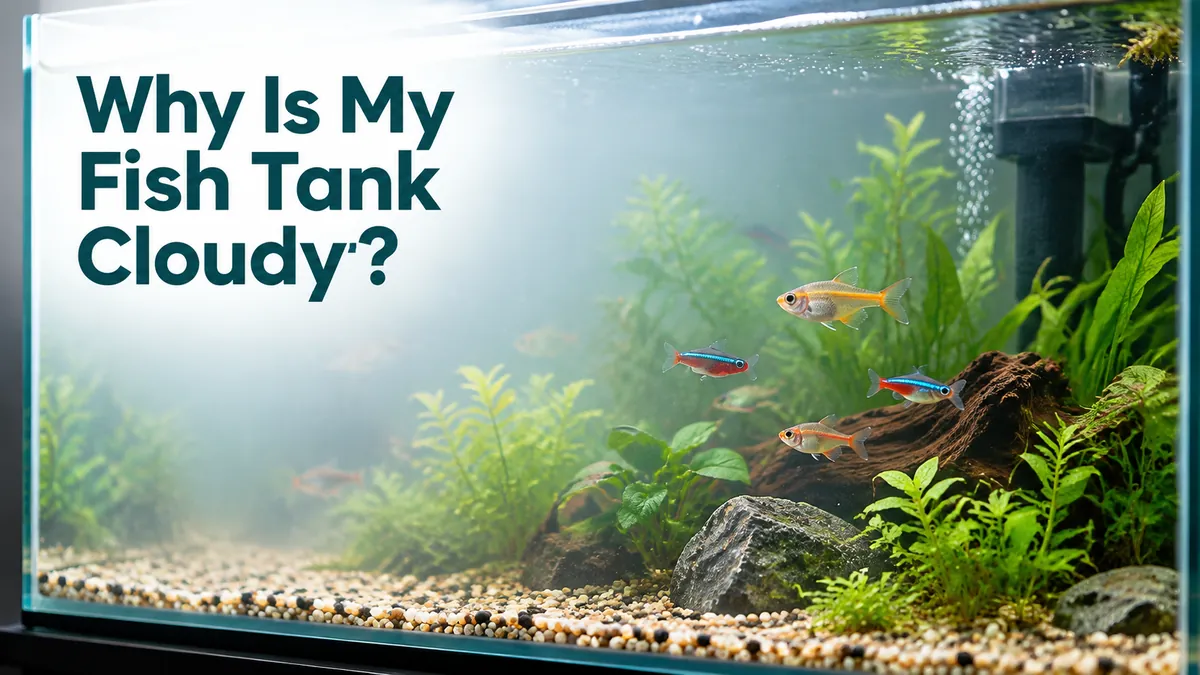
Cloudy aquarium water can look white, milky, gray, green, brown, or dusty. The cause may be a bacterial bloom, suspended substrate particles, free-floating algae, or minerals coming out of solution. Each problem needs a different response.
The timing, color, and condition of your fish can help you narrow down the cause. A new aquarium with milky water needs a different check from an established tank that turns cloudy after a water change.
Start by checking your fish and water quality. Then use the clues below to choose the safest way to clear the water.
Key takeaways
- White or milky water: A bacterial bloom is one possibility, especially in a new aquarium.
- Dusty water: Fine particles from substrate, decorations, or filter media may be suspended.
- Green water: Free-floating algae can make the entire aquarium look green.
- Brown but transparent water: Driftwood and botanicals may release tannins that tint the water.
- Fish safety comes first: Check ammonia and nitrite, maintain filtration, and respond promptly to signs of distress.
First, check whether your fish are safe
Cloudiness alone does not tell you whether aquarium water is toxic. Some causes are mainly cosmetic, while others can occur alongside poor water quality.
Look for these warning signs:
- Fish gasping at the surface or breathing rapidly.
- Unusual lethargy, loss of appetite, or erratic swimming.
- Several fish showing distress at the same time.
- A sudden change in water appearance after maintenance or adding a product.
If you see these signs, check that the filter is running and that water is moving across the surface. Increase aeration if needed, and test ammonia and nitrite as soon as possible.
In an established, stocked freshwater aquarium, ammonia and nitrite should normally read 0 ppm. Any detectable reading deserves attention, particularly when fish are distressed. The Merck Veterinary Manual’s guidance on aquarium fish management explains why water testing and adequate biological filtration matter when fish become unwell.
If water tests indicate a problem, use an appropriate water-quality response. A partial water change with conditioned, temperature-matched water may be necessary. Retest afterward and follow the results rather than relying on the appearance of the water.
Do not wait for cloudiness to clear before addressing an ammonia or nitrite problem.
What does your cloudy aquarium water look like?
Use this table to identify the most likely cause and the first thing to check. Color is a clue, not a definitive diagnosis.

| What you see or when it started | Possible cause | First check or action |
|---|---|---|
| White or gray haze in a new tank | Bacterial bloom | Test ammonia and nitrite; keep filtration running. |
| Milky water after heavy feeding or filter disturbance | Increased organic waste or a bacterial bloom | Remove uneaten food and check water quality. |
| Dusty cloud immediately after adding substrate | Suspended particles | Allow settling and check mechanical filtration. |
| Green water throughout the tank | Free-floating algae | Review lighting, direct sunlight, and nutrient inputs. |
| Brown or amber water that remains transparent | Tannins from wood or botanicals | Check recent additions and water clarity. |
| Cloudiness after adding a buffer or mineral supplement | Possible mineral precipitation | Review the dose and relevant water chemistry. |
| Cloudiness after a water change or cleaning | Disturbed particles or another maintenance-related cause | Check what changed, filter flow, and water quality. |
Once you have a likely cause, follow the relevant guidance below.
How to clear cloudy aquarium water safely
Follow these steps in order. The aim is to correct the cause without creating another water-quality problem.
1. Test the water before treating it
Check ammonia and nitrite first, especially if the aquarium is new or the fish are acting differently.
If both readings are 0 ppm and the fish appear healthy, you can investigate suspended particles, algae, or a bacterial bloom based on the appearance and timing.
If either reading is detectable, investigate the cause and take appropriate corrective action. Reduce feeding temporarily if excess waste is suspected, and perform a suitable partial water change when needed. Use a conditioner appropriate for your source water and retest.
2. Keep the filter running
Your filter removes suspended particles and supports the microorganisms that process fish waste.
Check that water is flowing normally. If the filter contains clogged mechanical media, clean or replace the affected material according to the filter’s instructions. Preserve established biological media and avoid replacing or thoroughly cleaning every filter component at once.
Fine mechanical filter media, such as suitable filter floss, can trap small suspended particles. Check it regularly because collected debris can restrict water flow.

3. Remove visible waste and adjust feeding
Remove uneaten food, dead plant material, and other decaying debris. Feed only what your fish can consume without leaving excess food behind.
Excess food and organic waste can support bacterial growth and contribute to poor water quality. Overfeeding is especially risky in a new aquarium whose biological filter is still developing.
4. Match the treatment to the cause
- Substrate dust: Allow particles to settle and use suitable mechanical filtration. Follow the substrate manufacturer’s rinsing instructions before future use.
- Bacterial bloom: Keep the filter running, monitor ammonia and nitrite, and avoid unnecessary cleaning or major changes to the aquarium.
- Green water: Review lighting duration, direct sunlight, and nutrient sources. Make measured adjustments rather than changing several conditions at once.
- Possible mineral precipitation: Review recently added products and the relevant water parameters before making further additions.
- Tannin discoloration: Decide whether the tint needs to change based on your aquarium’s requirements. Clear amber water is not the same as suspended cloudy particles.
5. Avoid blind chemical treatments
Do not keep adding water clarifiers, pH adjusters, or other products without identifying the cause. A clarifier may help certain particles clump together so filtration can remove them, but it does not correct every cause of cloudy water.
Follow product instructions if a treatment is appropriate for your aquarium. Never exceed the recommended dose, and make sure the filter can handle the resulting particles.
If the water becomes cloudier, fish develop symptoms, or the problem keeps returning, reassess the diagnosis rather than repeating the same treatment.
Common causes of cloudy aquarium water
1. Bacterial bloom
A bacterial bloom can make aquarium water look milky white, gray, or slightly yellow. It often appears in a new aquarium or after a change that increases available organic waste or disturbs the biological filter.
Microscopic bacteria can multiply rapidly when dissolved organic material becomes abundant. The resulting cloudiness may be visible even when the particles themselves cannot be seen individually.
Possible triggers include:
- Excess fish food or accumulated waste.
- Decaying plant material or a dead fish.
- A filter that has been heavily cleaned or disturbed.
- An aquarium that has not developed stable biological filtration.
What to do: Test ammonia and nitrite, remove obvious waste, feed carefully, and keep the filter operating. Avoid adding more fish until the aquarium is stable.
A bacterial bloom may clear as conditions settle. Clear water alone does not prove that the biological filter is mature, so continue testing a new aquarium.
2. Substrate dust and suspended particles
If the water turns cloudy immediately after setting up the tank, planting, moving decorations, or cleaning the gravel, fine particles are a likely explanation.
New substrate can release dust when disturbed. Filter media and decorations can also shed small particles. The water may look gray, white, or generally murky, depending on the material.
What to do: Give the particles time to settle, check that the filter is working, and use suitable fine mechanical media if needed. If the filter flow slows, inspect the media and clean or replace it as appropriate.
For future setups, prepare the substrate according to its manufacturer’s instructions and fill the aquarium gently to limit the amount of material stirred into the water.
3. Green water from free-floating algae
Green aquarium water usually indicates suspended algae. The water may appear pale green, bright green, or opaque enough to obscure fish and decorations.
Excessive light, direct sunlight, and available nutrients can contribute to algal growth. Green water is different from green algae attached to glass or decorations.
What to do: Review the lighting schedule, check whether sunlight reaches the aquarium, and investigate excess food or accumulated waste. Correct the conditions gradually.
Avoid treating all green water as a filtration failure. A filter can be running normally while free-floating algae remain suspended in the water.
4. Mineral precipitation
Mineral precipitation can cause sudden cloudiness after adding certain buffers, supplements, or mineral products. It occurs when dissolved substances form particles that no longer remain in solution.
This is a more specific possibility than bacterial cloudiness and may be associated with high mineral concentrations or incompatible dosing.
What to do: Check which products were added, review their instructions, and test the relevant water parameters. Avoid adding another chemical in an attempt to cancel out the first one without understanding the reaction.
5. Tannins and other water discoloration
Driftwood, leaves, and other botanicals can release tannins that tint aquarium water yellow, tea-colored, or brown. If the water remains transparent, the tint may not be cloudiness at all.
Look through the aquarium from front to back. If you can see fish and decorations clearly through the colored water, suspended particles may not be the problem.
What to do: Decide whether the color is acceptable for your aquarium and livestock. If you want clearer-looking water, review the source of the tint and choose an appropriate method. Do not assume that every brown or amber aquarium needs a clarifier.
Why is my new fish tank cloudy?
Cloudy water is common during the early stages of aquarium setup. The main possibilities include substrate dust and a bacterial bloom, and the timing helps distinguish them.
- Cloudiness immediately after filling: Fine substrate particles or disturbed debris are likely possibilities.
- Milky water developing after setup: A bacterial bloom may be developing as organic waste and the biological filter change.
- Cloudiness with distressed fish: Test ammonia and nitrite promptly. A new aquarium can have a developing biological filter that does not yet process waste reliably.
Keep the filter running and avoid adding more fish while water quality remains uncertain. Feed carefully and test ammonia and nitrite regularly until the aquarium is stable.
Do not repeatedly dismantle or deep-clean the filter to make the water look clearer. That can disrupt the biological filtration you need to establish.
Why did my aquarium turn cloudy after a water change?
The timing of the change gives you a useful starting point.
If cloudiness appears immediately after a water change, consider whether the gravel was disturbed, debris entered the water, or a recently added product affected water chemistry. If the cloudiness develops later, investigate waste buildup, filtration, and the condition of the aquarium.
Check these points:
- Was the substrate stirred up during siphoning?
- Was the filter cleaned or its media replaced at the same time?
- Was a buffer, mineral supplement, or other water-treatment product added?
- Is the filter still producing normal flow?
- Are ammonia and nitrite at 0 ppm, and are the fish behaving normally?
If fish show distress, treat the situation as a possible water-quality problem. If the fish appear normal and the water is simply dusty, mechanical filtration and time may be enough.
Avoid making several more changes at once. You need to identify what caused the cloudiness before deciding whether further maintenance is necessary.
How long does cloudy aquarium water take to clear?
The time depends on the cause, the amount of suspended material, and the aquarium’s filtration.
| Cause | What to expect |
|---|---|
| Fine substrate dust | Often settles within hours, although some particles may take longer to remove. |
| Bacterial bloom | May take several days and sometimes around 1–2 weeks as conditions stabilize. |
| Green water | May persist until light and nutrient conditions are addressed. |
| Mineral precipitation | Depends on the material, water chemistry, and filtration. |
| Tannin discoloration | May remain while the source continues releasing tannins. |
These are rough expectations, not deadlines. A tank that remains cloudy, becomes progressively worse, or develops recurring cloudiness needs further investigation.
Never use clear water as the only measure of aquarium health. Test the water and observe the fish.
Why does my fish tank keep getting cloudy?
Recurring cloudiness usually means the original cause remains or the same trigger keeps returning.
Use this short checklist:
- After feeding: Reduce excess food and remove leftovers.
- After every water change: Review substrate disturbance, filter cleaning, and products added to the water.
- After cleaning the filter: Check whether too much established filter media was disturbed or replaced.
- During bright lighting periods: Review direct sunlight, lighting duration, and nutrient buildup if the water turns green.
- In a heavily stocked aquarium: Check whether the filter and maintenance routine can handle the waste produced.
- After adding a new product: Review the ingredients, dose, and compatibility with your water chemistry.
If the same problem returns, record when it happens, what maintenance was performed, and the latest water-test results. That information is more useful than repeatedly buying treatments.
How to prevent cloudy aquarium water
Consistent maintenance reduces the chances of suspended debris, excess organic waste, and unstable water quality.
- Feed an appropriate amount and remove uneaten food.
- Keep the filter running and maintain normal water flow.
- Clean mechanical filter media when it becomes clogged, while protecting established biological media.
- Remove decaying leaves and other waste before it accumulates.
- Prepare new substrate and decorations according to their instructions.
- Avoid unnecessary deep cleaning and major changes to the aquarium.
- Monitor ammonia and nitrite in new tanks and after significant disruptions.
- Keep lighting appropriate for your plants and aquarium setup.
- Test the water when cloudiness appears or returns.
The goal is stable water quality and healthy fish, not just a clear view through the glass.
Sources and further reading

Ethan Caldwell
Freshwater Fish Care Writer
Ethan writes about freshwater fish care, aquarium setup, water quality, and choosing compatible tank mates.
View Author Profile
4 Comments
Pingback: Community Fish Tank: Peaceful Fish, Setup & Stocking Guide - tankbloom.com
Pingback: Aquarium Nitrogen Cycle: How Bacteria Keep Fish Safe - tankbloom.com
Pingback: Aquarium Filtration Guide: Types, Media, & Flow Rate Explained - tankbloom.com
Pingback: How to Cycle a New Fish Tank Properly (Step-by-Step) - tankbloom.com