



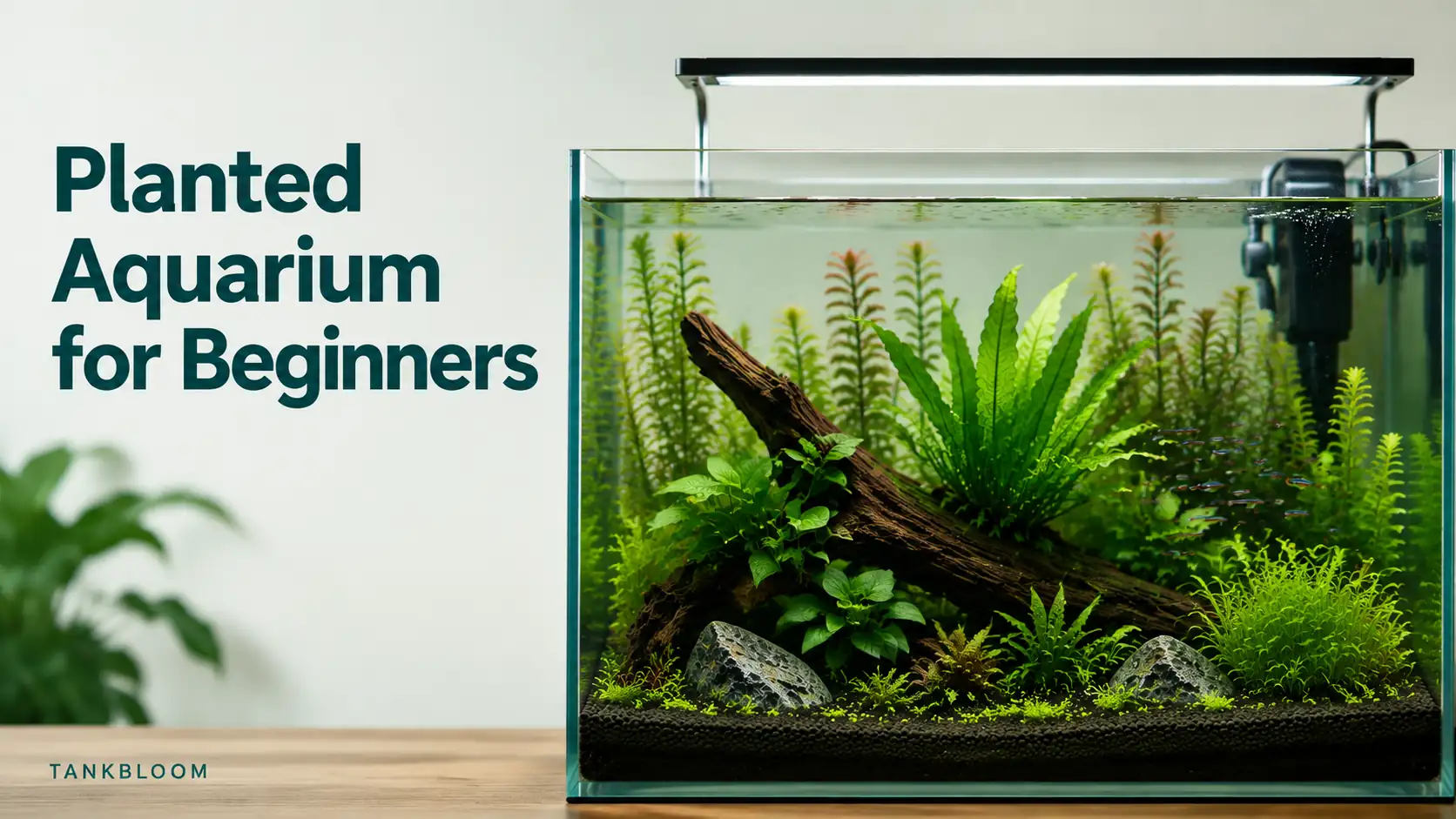
A planted aquarium for beginners does not need pressurized CO₂, expensive aquasoil, or a complicated fertilizer routine. Start with a suitable tank, reliable filtration, plant-capable lighting, a substrate strategy that matches your plants, and a few forgiving species. Plant them correctly, establish the aquarium before adding fish, and adjust the system according to healthy new growth and water conditions instead of following rigid hobby rules.
For most first-time aquarists, the simplest route is a low-tech planted freshwater aquarium. Plant growth may be slower than in a high-tech aquascape, but the system is easier to understand because there are fewer variables to manage at once.
The Simplest Beginner Strategy: Start Low-Tech
A low-tech planted aquarium is usually the most practical first setup because it can support many attractive plants without pressurized CO₂ injection.
“Low-tech” does not mean neglected or maintenance-free. The aquarium still needs appropriate light, nutrients, filtration, stable water conditions, and regular care. The difference is that you deliberately choose plants that can grow under simpler conditions instead of designing the system around maximum growth.
That approach gives you time to understand how the aquarium behaves before adding more demanding equipment or plants.
Do You Need CO₂ for a Beginner Planted Aquarium?
No. Pressurized CO₂ injection is not required for many beginner-friendly aquarium plants.
Aquatic plants use carbon dioxide during photosynthesis, but a low-tech aquarium receives dissolved CO₂ naturally through gas exchange and biological activity. Pressurized systems increase carbon availability and can support faster growth or more demanding plants, but they also introduce another variable that must remain balanced with lighting and nutrient availability.
For a first planted aquarium, choosing plants that match a non-injected system is usually simpler than trying to force demanding plants to grow with extra equipment.
| Feature | Low-Tech Planted Tank | High-Tech Planted Tank |
|---|---|---|
| Pressurized CO₂ | No | Usually |
| Growth Potential | Slower | Faster |
| Plant Selection | More limited | Broader |
| Lighting | Usually moderate | Often higher |
| Management | Simpler | More demanding |
| Best Fit for a First Tank | Usually yes | Optional later |
If you eventually want carpeting plants, faster growth, or more demanding species, you can learn about advanced carbon supplementation separately. You do not need it to build a healthy first planted aquarium.
What You Actually Need for Your First Planted Aquarium
You need fewer specialized products than many planted-tank shopping lists suggest.
The more useful question is:
What is essential, what depends on my setup, and what can I safely skip for now?
| Item | Beginner Status | Why It Matters |
|---|---|---|
| Aquarium | Essential | Provides stable growing and living space. |
| Plant-Capable Light | Essential | Supplies usable light for plant growth. |
| Filter | Essential for a typical beginner fish-bearing tank | Supports biological and mechanical filtration. |
| Water Conditioner | Essential when tap water contains chlorine or chloramine | Makes treated tap water suitable for aquarium use. |
| Substrate | Essential decision | Anchors rooted plants and may provide nutrients. |
| Live Plants | Essential | The foundation of the planted setup. |
| Water Test Kit | Strongly recommended | Helps assess cycling and livestock safety. |
| Heater | Conditional | Depends on livestock, plants, and room temperature. |
| Root Tabs | Conditional | Useful for some rooted plants, especially in inert substrate. |
| Liquid Fertilizer | Conditional | Supplies nutrients through the water column. |
| Driftwood or Rocks | Optional | Adds structure and plant attachment surfaces. |
| Pressurized CO₂ | Optional | Useful for higher-demand planted systems. |
| Specialized Aquascaping Tools | Optional | Helpful, but not necessary to begin. |
This distinction matters because beginners are often encouraged to buy several products before they understand what those products actually solve.
For example, a heater is not automatically required simply because an aquarium contains live plants. Temperature should be chosen around the species you intend to keep and the conditions in your home.
Likewise, a beginner does not automatically need root tabs, liquid fertilizer, nutrient soil, and injected CO₂ at the same time.
Are Planted Aquarium Kits Worth It?
A planted aquarium kit can simplify the shopping process, but “complete” does not always mean complete for live plants.
Check whether the kit includes:
- an aquarium large enough for your intended livestock;
- a light suitable for live plants;
- reliable filtration;
- a heater if your chosen species need one;
- a practical lid;
- equipment that can be replaced or upgraded later.
The light deserves particular attention. Some starter kits include fixtures designed mainly to illuminate fish rather than support substantial plant growth.
Choose the Tank Before You Choose the Plants
Choose your aquarium around the complete system you want to keep, not around whichever plant or fish looks appealing first.
Very small tanks can be planted successfully, but they give you less room for:
- plant groups;
- hardscape;
- equipment;
- fish movement;
- maintenance;
- beginner mistakes.
For many first setups, a tank somewhere around 10 to 20 gallons is practical, provided its dimensions suit the intended livestock and plants. This is a useful starting range, not a universal rule.
A 20-gallon aquarium generally gives you more flexibility than a tiny desktop tank because you can create plant groups, leave open swimming space, and choose from a wider range of community fish.
Tank shape matters too. Two aquariums with similar volume can have very different footprints, depths, and lighting requirements.
If you are still choosing a tank, see the Aquarium Sizes Guide before buying equipment.
Choose the Right Substrate for the Plants You Want
A planted aquarium does not always need expensive nutrient-rich soil.
Your substrate should match the plants you want to grow and the way you plan to supply nutrients.
Nutrient-Rich Planted Substrate
Planted aquarium soils and other nutrient-rich substrates can provide nutrients around plant roots.
They are especially useful in layouts containing many strongly rooted plants. Some active substrates can also influence water chemistry, so follow the manufacturer’s instructions rather than assuming all planted substrates behave the same way.
Nutrient substrate is useful.
It is not mandatory.
Gravel or Sand Can Also Work
Inert gravel and sand can support healthy aquarium plants.
Because these materials usually provide little nutrition themselves, strongly rooted plants may need additional root-zone nutrition such as root tabs.
Other plants can obtain much of their nutrition from compounds dissolved in the water.
| Substrate Route | Useful For | Main Consideration |
|---|---|---|
| Nutrient-Rich Planted Substrate | Root-heavy planted layouts | Higher cost and possible effects on water chemistry depending on the material. |
| Gravel | Flexible beginner setups | Some strongly rooted plants may need additional root-zone nutrition. |
| Sand | Natural-looking planted setups | Plant anchoring and root nutrition need to be planned around the species. |
The important distinction is not:
“good substrate versus bad substrate.”
It is:
“Does this substrate work with the plants and nutrient strategy I have chosen?”
Some Plants Do Not Need to Be Buried
This is one of the easiest beginner mistakes to prevent.
Plants such as Anubias and Java fern are epiphytes, meaning they commonly grow attached to surfaces rather than depending on ordinary substrate planting.
Both grow from a thick horizontal structure called a rhizome.
Do not bury that rhizome deeply in the substrate. Instead, attach the plant to aquarium-safe:
- driftwood;
- rock;
- other hardscape.
The roots can grow around the surface while the rhizome remains exposed.
That means substrate choice matters much less for an aquarium built mainly around attached Anubias and Java fern than for one filled with heavy root-feeding plants.
Choose Plants by How They Grow, Not Just by How They Look
A useful beginner plant list should teach you more than species names.
When you understand how a plant grows, you also understand:
- where to place it;
- how to plant it;
- where it obtains much of its nutrition;
- how fast it may grow;
- what kind of maintenance it may require.

Epiphytes and Rhizome Plants
Anubias and Java fern are popular beginner choices because many varieties tolerate modest lighting and can grow without pressurized CO₂ in an appropriate low-tech aquarium.
Attach them to hardscape rather than burying their rhizomes.
They are especially useful when you want a planted aquarium that does not depend heavily on nutrient-rich substrate.
Rooted Rosette Plants
Many Cryptocoryne species can work well in beginner aquariums.
They grow from the substrate and often benefit from access to nutrients around their roots.
Larger plants such as Amazon swords can also be manageable, but their eventual size and nutrient demand deserve more planning. A plant can be easy to grow and still be a poor choice for a small aquarium.
Stem Plants
Stem plants grow upward from individual stems planted in the substrate.
Many beginner-friendly species can grow faster than Anubias or Java fern, making them useful for creating plant mass relatively quickly.
Faster growth also means more trimming.
Instead of buying one stem of many unrelated species, plant several stems of the same species together. Groups usually look more natural and are easier to maintain.
Floating Plants
Floating plants remain at the surface and obtain nutrients directly from the water.
They can provide shade and cover, but fast-growing floaters may eventually block too much light from reaching plants below.
Thin them as needed rather than allowing them to cover the entire surface.
Do Not Make a Difficult Carpet Your First Priority
A dense carpet across the front of an aquarium can look impressive, but some carpeting plants become much easier when they receive stronger light, supplemental CO₂, or more intensive maintenance.
A first planted aquarium does not need a carpet to look complete.
Learn to grow forgiving plants consistently first. More demanding species can come later.
For deeper species selection, the Aquatic Plants and Planted Tanks hub can guide you toward plant-specific care information as TankBloom’s library expands.
Plan a Simple Layout Before You Plant
A beginner aquascape usually looks better when plants are grouped intentionally instead of scattered across every empty space.
A simple three-zone layout works well:
Foreground: low plants or open substrate near the front.
Midground: medium-height plants, rocks, driftwood, and focal pieces.
Background: taller plants that create height and can help hide equipment.
Leave some open swimming space if you plan to keep fish, and leave enough room to reach the substrate during maintenance.
Three beginner-friendly approaches are enough to create a good-looking first tank:
- Wood and epiphytes: driftwood with Anubias, Java fern, and moss.
- Simple planted community: taller plants behind, mid-height plants through the center, and open swimming space.
- Natural planted jungle: groups of stem and rooted plants allowed to grow more freely.
You do not need advanced aquascaping theory to make a beginner planted aquarium look deliberate and balanced.
Lighting: Start Moderate and Stay Consistent
Use an aquarium light designed to support live plants, then keep its schedule consistent.
More light is not automatically better.
Increasing light can increase plant growth potential, but plants still need adequate carbon, nutrients, and suitable growing conditions. Stronger lighting can therefore make an unbalanced aquarium harder to manage.
For many low-tech beginner tanks, roughly 6 to 8 hours of light per day can be a reasonable starting schedule. Treat that as a starting point, not a biological rule or a guarantee against algae.
Use a timer.
Then judge the aquarium by what happens:
- Are plants producing healthy new leaves?
- Is growth reasonably compact for the species?
- Are slower plants being shaded?
- Is algae increasing faster than plant growth?
If plants are growing well, there is no reason to increase the light simply because the fixture can become brighter.
If algae begins spreading quickly, lighting is one of the easiest variables to review first—but it is only one part of the system.
Avoid outdated rules such as choosing modern LED fixtures based only on “watts per gallon.” Different lights can produce very different usable output from the same electrical wattage.
Fertilizer Without the Confusion
Aquarium plants need nutrients, but not every planted aquarium needs the same fertilizer strategy.
Plant nutrient uptake is not divided into perfect categories. Many aquatic plants can absorb nutrients through both roots and other plant tissues. However, some plants rely more heavily on root-zone nutrition, while others are commonly managed through nutrients available in the water column.
That difference is useful when deciding how to fertilize.
When Root Tabs Make Sense
Root tabs place nutrients directly into the substrate.
They can be particularly useful for strongly rooted plants growing in inert sand or gravel.
Large swords and other substantial root-feeding plants are common examples.
A root tab underneath Java fern attached to driftwood, however, would not solve the same problem.
When Liquid Fertilizer May Help
Liquid fertilizer supplies nutrients to the water column.
It can be useful in tanks containing:
- stem plants;
- epiphytes;
- floating plants;
- growing plant mass that exceeds the nutrients naturally available in the aquarium.
Follow the fertilizer manufacturer’s instructions rather than assuming that more fertilizer means faster or healthier growth.
Also avoid the common oversimplification that:
fertilizer automatically causes algae.
Algae can be influenced by light, plant health, nutrient availability, organic waste, maintenance, stocking, and other interacting conditions. Treat it as a system problem rather than blaming one product or nutrient immediately.
How to Set Up a Planted Aquarium Step by Step
Once the tank, substrate, plants, and equipment are selected, build the aquarium in an order that makes planting easier and prevents unnecessary disturbance.

1. Position the Aquarium and Main Equipment
Place the aquarium on a level, stable surface designed to support its filled weight.
Leave enough space around it to reach:
- the filter;
- electrical cords;
- the back glass;
- equipment that will eventually need maintenance.
Arrange the equipment before the tank becomes difficult to move.
2. Add the Substrate
Add the substrate chosen for your plant strategy.
A slight rise toward the rear can create more visual depth, but elaborate sculpting is not necessary in a first planted tank.
Follow the substrate manufacturer’s preparation instructions.
Some materials should be rinsed.
Others should not.
3. Position Rocks and Driftwood
Place the main hardscape before planting.
Make sure rocks and wood are stable and cannot shift easily after the aquarium is filled.
Use materials known to be appropriate for aquarium use.
4. Prepare the Plants
Inspect each plant before adding it.
Depending on how it was sold, preparation may include removing:
- plastic pots;
- rock wool;
- plant weights;
- damaged or decaying leaves;
- packaging material.
Separate densely packed stems when appropriate so individual plants have room to establish.
Species-specific plant-care guidance should override generic instructions whenever the plant has unusual requirements.
5. Plant According to Growth Type
This step matters more than creating a perfect layout.
Rooted plants: Insert the roots into the substrate while keeping the crown or growing point positioned appropriately for the species.
Rhizome plants: Attach Anubias and Java fern to wood or rock. Keep the rhizome exposed.
Stem plants: Insert the lower portion of individual stems into the substrate with enough spacing for future growth.
Floating plants: Add them to the surface after the aquarium is filled.
Keep exposed plants moist while you work so leaves do not dry unnecessarily.
6. Fill the Aquarium Slowly
Pour water slowly onto a clean plate, plastic bag, or similar barrier placed over the substrate.
This helps reduce:
- substrate disturbance;
- uprooted plants;
- excessive initial cloudiness.
If your tap water contains chlorine or chloramine, treat it with an appropriate aquarium water conditioner according to the product label.
7. Start the Equipment
Once the aquarium is filled:
- start the filter;
- set the heater if your chosen species require one;
- check the tank and connections for leaks;
- confirm suitable water flow;
- set the lighting timer.
Do not worry if the aquarium does not look polished immediately. Recently moved plants, tiny air bubbles, and disturbed substrate can make a brand-new setup look rough at first.
8. Begin a Deliberate Fishless Cycle
A newly filled aquarium is not automatically ready for fish.
Fish and other livestock produce nitrogen waste. An established aquarium contains microorganisms that convert toxic ammonia through the ammonia through the nitrogen cycle so it does not accumulate at harmful levels.
For a beginner setup, use a fishless cycling method rather than adding hardy fish as a source of ammonia.
A proper cycle requires more than simply leaving the filter running for a certain number of days. The system must be given a controlled ammonia source and shown to process that waste reliably before livestock is added.
Follow TankBloom’s fish tank cycling guide for the complete process rather than relying on an abbreviated explanation.
9. Observe the Aquarium Before Stocking
Before adding fish, confirm that:
- the filter is operating reliably;
- temperature is suitable if the aquarium is heated;
- plants remain secure;
- the aquarium has completed an appropriate cycling process;
- ammonia and nitrite are not accumulating;
- the water conditions suit the livestock you intend to keep.
Stock the aquarium because the biological system is ready—not because a date on the calendar has arrived.
Do Not Add Fish Just Because a Certain Number of Days Has Passed
A planted aquarium does not become safe for fish automatically after one, two, or three weeks.
Cycling speed can vary with:
- the ammonia source;
- biological material already present;
- temperature;
- filtration;
- plant mass;
- other conditions inside the aquarium.
One important detail is often missed:
A brand-new aquarium can show zero ammonia and zero nitrite simply because meaningful waste has not yet been introduced.
Zero readings alone therefore do not prove that the biological filter can process livestock waste.
Use a deliberate fishless cycling process and confirm that the aquarium can handle its ammonia source without ammonia or nitrite accumulating before normal stocking.

Plants Help, but They Do Not Make the Tank Instantly Safe
Live plants influence nutrient cycling and can take up nitrogen compounds.
That is beneficial.
It does not mean:
“A planted aquarium does not need cycling.”
Think of live plants, biological filtration, water quality, and maintenance as interacting parts of the same aquarium rather than substitutes for one another.
Add Livestock Gradually
Once the aquarium is biologically ready, add fish in a planned way rather than introducing the complete future population at once.
Gradual stocking gives you time to watch:
- water quality;
- fish behavior;
- compatibility;
- filtration performance;
- plant response to the changing nutrient load.
If you need help choosing livestock, see Best Aquarium Fish for Beginners. Plant cover can improve habitat, but fish still need appropriate tank size, water conditions, social groups, and swimming space.
What to Expect During the First Few Weeks
A newly planted aquarium does not always look better every day.
The plants have been transported, handled, trimmed, replanted, and placed into different light, water, and nutrient conditions. The aquarium itself is also biologically changing.
Do not judge plant success only by the appearance of the leaves that arrived from the store.
A more useful question is:
Is the plant producing healthy new growth?
Some Older Leaves May Decline
Some aquarium plants are commercially produced with leaves exposed to air or under growing conditions different from permanent submersion.
After they are moved underwater, older leaves may yellow, soften, or deteriorate while the plant adapts and produces new submerged growth.
Aquarists commonly call this plant melt.
Melt is not automatically harmless, however.
Use the pattern of growth to decide what to investigate.
| What You See | What It May Mean | First Thing to Check |
|---|---|---|
| Older leaves declining while healthy new leaves appear | Adaptation may be occurring | Keep conditions stable and remove badly deteriorated material. |
| New growth also deteriorates | Conditions may be unsuitable | Review light, nutrition, planting method, and water conditions. |
| Anubias or Java fern rhizome becomes soft | Possible planting or plant-health problem | Check whether the rhizome has been buried. |
| Plants repeatedly float loose | Poor anchoring | Replant or attach the plant correctly. |
| Algae increases rapidly | Several variables may be out of balance | Review light, plant growth, organic waste, nutrients, and maintenance. |
The goal is not to rescue every old leaf.
The goal is to support healthy future growth.
Early Algae Does Not Have One Single Cause
Some algae or brown diatom growth may appear while a new aquarium develops.
Do not immediately react by:
- doubling fertilizer;
- stopping fertilizer completely;
- dramatically increasing or reducing light;
- adding several chemical treatments.
First review the aquarium as a whole.
Check:
- lighting duration and intensity;
- whether plants are actively growing;
- decaying leaves;
- excess food or other organic waste;
- maintenance;
- nutrient availability;
- livestock load.
The visible algae is the symptom.
Your job is to understand the conditions allowing it to expand.
Change One Variable at a Time
This is one of the most useful habits in planted-aquarium troubleshooting.
If you change the light, fertilizer, water-change routine, flow, and carbon strategy simultaneously, you will not know which change helped or which created another problem.
Make one justified adjustment.
Then observe the response.
That approach gives you information instead of guesswork.
A Simple Maintenance Routine for a Beginner Planted Tank
A low-tech planted aquarium can be manageable, but it is not maintenance-free.
A consistent routine is more useful than waiting until the tank visibly looks neglected.
During regular maintenance:
- perform partial water changes appropriate to your aquarium;
- remove decaying plant material;
- trim plants that shade other plants or block swimming space;
- remove visible algae when necessary;
- check that filter flow remains normal;
- service filter media according to the filter manufacturer’s instructions while preserving established biological filtration;
- confirm that the light timer is operating correctly;
- fertilize according to plant demand and product instructions;
- observe the color and form of new plant growth.
A weekly maintenance check is convenient for many beginner aquariums, but the exact amount of water changed, fertilizer used, and trimming required depends on the individual system.
Stocking, feeding, substrate, growth rate, and fertilization method all affect maintenance needs.
Use consistency as your default—not somebody else’s exact formula.
Common Beginner Mistakes to Avoid
Most early problems come from mismatched choices rather than from a lack of expensive equipment.
Avoid these common mistakes:
- Buying plants before planning the aquarium. Choose plants that fit the light, substrate, tank size, and maintenance level you can provide.
- Burying every plant in substrate. Epiphytes such as Anubias and Java fern require different placement.
- Starting with demanding carpeting plants. Learn to grow forgiving plants consistently first.
- Using excessive light because plants need light. More light can increase the demands placed on the rest of the system.
- Assuming injected CO₂ is mandatory. Many low-tech beginner plants can grow without pressurized injection.
- Using every fertilizer product at once. Supply nutrients according to plant needs rather than product availability.
- Adding fish after an arbitrary number of days. Confirm cycling and biological readiness instead.
- Changing several variables simultaneously. Troubleshoot methodically.
- Blaming every algae problem on fertilizer. Algae is influenced by several interacting conditions.
- Assuming every deteriorating leaf means the plant is dead. Pay attention to healthy new growth.
- Choosing fish simply because they are described as community fish. Adult size, social behavior, water requirements, activity level, and tank dimensions still matter.
Can You Keep Fish in a Beginner Planted Aquarium?
Yes. A properly established planted aquarium can provide an excellent environment for suitable freshwater fish.
Live plants can provide cover, visual barriers, resting areas, and environmental complexity.
They do not change the fundamental requirements of the fish.
Choose livestock according to:
- adult size;
- social-group requirements;
- water temperature;
- water chemistry;
- temperament;
- activity level;
- available swimming space;
- feeding behavior.
Some fish dig, uproot plants, or eat certain vegetation, so not every freshwater species is equally convenient in a planted setup.
Use plants to improve the habitat.
Do not use them to justify unsuitable stocking.
Quick Beginner Planted Aquarium Checklist
Before adding fish, make sure you have:
- chosen the aquarium before choosing livestock;
- decided whether you are building a low-tech or high-tech system;
- matched the substrate to the plants;
- chosen forgiving plant species;
- installed suitable filtration and lighting;
- planted rooted, stem, floating, and rhizome plants correctly;
- conditioned tap water when required;
- placed the light on a consistent timer;
- completed a deliberate fishless cycling process;
- confirmed that ammonia and nitrite are not accumulating before stocking;
- matched future fish to the tank and water conditions;
- accepted that newly planted aquariums may need time to settle and adapt.
Start Simple and Let the Aquarium Mature
Your first planted aquarium does not need to prove how advanced you are.
Choose plants that match the tank. Use enough light rather than the most light. Provide nutrients where they are useful. Keep pressurized CO₂ optional. Plant each species correctly, complete the cycling process before adding fish, and judge progress by stable conditions and healthy new growth rather than instant perfection.
The more you understand the relationships between light, nutrients, carbon, substrate, water, plants, and livestock, the less you need to rely on rigid formulas.
A good planted aquarium becomes easier when you stop chasing universal rules and start responding to the aquarium in front of you.

Ethan Caldwell
Freshwater Fish Care Writer
Ethan writes about freshwater fish care, aquarium setup, water quality, and choosing compatible tank mates.
View Author Profile
9 Comments
Pingback: Ember Tetra Care Guide: Tank Size, Food & Tank Mates - tankbloom.com
Pingback: Aquarium CO₂ Systems: Setup, Types & Safety | TankBloom - tankbloom.com
Pingback: How to Cycle a New Fish Tank Properly (Step-by-Step) - tankbloom.com
Pingback: Java Fern: Planting, Growing, and Propagation - tankbloom.com
Pingback: Aquarium Nitrogen Cycle: How Bacteria Keep Fish Safe - tankbloom.com
Pingback: How Often to Change Water in a Fish Tank (Schedule & Testing) - tankbloom.com
Pingback: Rummy Nose Tetra Care: Tank Size, Schooling & Tank Mates - tankbloom.com
Pingback: Aquarium Light: How to Choose the Right Light for Your Tank - tankbloom.com
Pingback: Best Substrate for Planted Aquarium: Soil, Sand & Gravel - tankbloom.com