



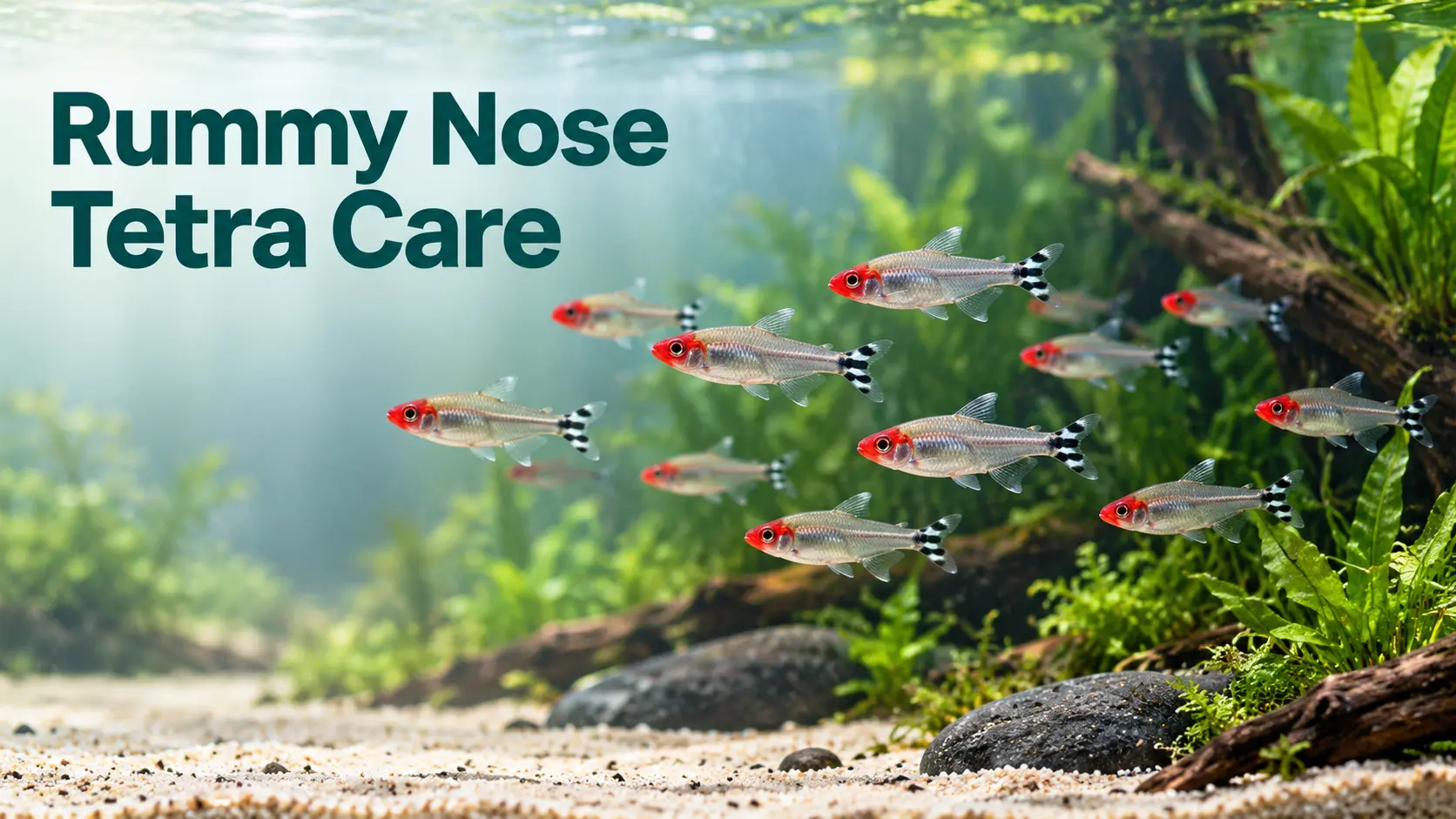
The rummy nose tetra is a small, peaceful freshwater fish recognized by its bright red head, silver body, and black-and-white striped tail. Native to South America, it is especially popular for the coordinated swimming behavior of a well-established school.
These fish do best in a mature aquarium with stable water conditions, enough horizontal swimming space, and a group of around 10 or more. Although they grow to only about 2 inches, their active nature makes them better suited to a longer community aquarium than a small desktop tank.
They can be rewarding for prepared beginners and experienced aquarists alike. The important part is understanding their needs before bringing them home.
Rummy Nose Tetra Care at a Glance
| Care factor | General guidance |
|---|---|
| Scientific identity | Three closely related Petitella species |
| Adult size | Approximately 2 inches (5 cm); measurements vary by method |
| Typical lifespan | Around 5 years with good care; some live longer |
| Temperament | Peaceful and social |
| Care difficulty | Moderate; best in established, stable aquariums |
| Recommended group | Around 10 or more |
| Aquarium size | A 20-gallon long is a common starting option; at least 36 inches of swimming length is preferable |
| Temperature | Approximately 75–79°F (24–26°C) as a shared range |
| pH | Generally 5.5–7.0 |
| Water hardness | Species-reference ranges vary from approximately 1–15 dGH |
| Diet | Omnivorous; small flakes, micro pellets, and suitable frozen or live foods |
| Swimming level | Primarily midwater |
| Suitable companions | Peaceful fish with compatible water and space requirements |
These are general guidelines for the South American fish commonly sold as rummy nose tetras. The three species have similar needs, but their temperature and hardness ranges are not identical.
What Is a Rummy Nose Tetra?
Rummy nose tetras are small South American fish with streamlined silver bodies, reddish heads, and distinctive striped tail fins. Their markings make them easy to recognize as a group, even when the exact species is uncertain.
They occur in river systems associated with the Amazon and Orinoco basins. Their habitats include blackwater rivers and tributaries, as well as some clearwater environments, depending on the species.
In an aquarium, their most striking feature is often their movement. A group may travel across open water in a coordinated school, turn together, and regroup as conditions change.
These tetras are peaceful, but peaceful does not necessarily mean hardy. They can be sensitive to unstable water conditions, stressful introductions, and unsuitable tank mates.
Their lifespan is commonly around five years with good care, although individual fish may live longer. Specialist species descriptions generally report a maximum standard length of about 2 inches (5 cm). Standard length measures the fish from the snout to the base of the tail, excluding the tail fin, so total-length measurements can be slightly greater.
Which Rummy Nose Tetra Species Are Sold in Aquariums?
The name rummy nose tetra refers to three closely related species that look remarkably similar.
| Common name | Scientific name | Useful identification features |
|---|---|---|
| Brilliant or firehead rummy nose | Petitella bleheri | Stronger red extending behind the gill covers toward the shoulder; lower dark marking near the tail base |
| True rummy nose | Petitella rhodostoma | Red generally limited to the head; lower dark blotch near the tail base |
| False rummy nose | Petitella georgiae | Less extensive head coloration; lacks the lower dark blotch found in the other two species |
The firehead tetra, P. bleheri, is especially common in aquarium shops.
The three species were historically placed in different genera, which explains why older aquarium books and retailer descriptions may use Hemigrammus bleheri or Hemigrammus rhodostomus. A 2020 taxonomic revision helped establish their current placement in Petitella.
Their differences become clearer when the head and tail markings are examined together.
In P. bleheri, red pigmentation typically extends farther behind the gill covers than in the other two species. Both P. bleheri and P. rhodostoma have a dark marking on the lower rear portion of the caudal peduncle—the narrow part of the body immediately before the tail. That lower marking is absent in P. georgiae.
However, these clues are not infallible in everyday aquarium conditions. Stress, lighting, age, and the fish’s general condition can affect how clearly the markings appear.
You may also encounter platinum or golden rummy nose tetras. These are trade names for color forms rather than additional recognized species, and a retailer’s variety label does not always establish the fish’s exact identity.
The Asian rummy-nose rasbora is a different fish altogether. It should not automatically be given the same care requirements as the South American Petitella species.
For routine fishkeeping, the three South American species have broadly similar requirements. Identifying the exact species is still useful when choosing water conditions or comparing husbandry information.
How Many Rummy Nose Tetras Should You Keep, and What Tank Size Do They Need?
A suitable aquarium needs to accommodate the entire school, not just the body size of an individual fish.
Rummy nose tetras spend much of their time moving through the middle of the tank. They need enough room to swim together, turn naturally, and move between open areas and shelter.
How Large Should the School Be?
Aim for around 10 or more rummy nose tetras, provided the aquarium has adequate space and filtration.
Some general care guides describe six as a minimum group for small tetras. However, six should not automatically be treated as the ideal number for this species.
A larger group allows more natural social interaction and gives the fish opportunities to display the coordinated movement for which they are known. Keeping just one or two is not an appropriate substitute for a school.
Schooling behavior also changes throughout the day.
Fish may spread out while feeding or exploring, then gather more closely when startled or responding to movement nearby. Constantly tight schooling is not necessarily a sign that the fish feel exceptionally secure; it can sometimes reflect vigilance or perceived danger.
The goal is not to make the group swim in perfect formation at all times. It is to provide conditions in which the fish can behave normally.
Why Tank Length Matters as Much as Gallons
A longer aquarium gives an active school more usable swimming distance.
Consider two aquariums that hold approximately the same volume of water. One is tall and narrow, while the other is longer and shallower.
Both may contain 20 gallons, but the longer aquarium provides more room for the fish to travel horizontally.
For this reason, tank dimensions matter alongside water volume.
A 20-gallon long aquarium is a commonly recommended starting option. However, a typical US 20-gallon long tank measures approximately 30 inches from end to end.
More conservative species-specific guidance favors a swimming length of at least 36 inches (90 cm).
Those are different recommendations, not interchangeable measurements. If you are planning an aquarium from scratch, choosing the longer footprint is preferable when practical.
Tank size also affects stocking decisions beyond the tetra school itself. Other fish, plants, feeding habits, filtration, and maintenance all contribute to the aquarium’s overall capacity.
A rule such as two gallons per tetra cannot account for those differences.

Can Rummy Nose Tetras Live in a 10- or 20-Gallon Tank?
A typical 10-gallon aquarium is too short to recommend as a permanent home for a properly sized, active school.
A 20-gallon long provides more practical swimming room and may accommodate a modest group with careful stocking, but it still falls short of the more generous 36-inch recommendation.
| Aquarium | Practical assessment |
|---|---|
| Standard 10-gallon | Not recommended for a full, active school |
| Standard 20-gallon high | Greater volume, but limited horizontal swimming space |
| 20-gallon long | A common starting option, with careful stocking and maintenance |
| Aquarium at least 36 inches long | Preferable swimming length for a group of 10 or more |
A 30- or 40-gallon aquarium may provide an excellent environment, but check its dimensions rather than relying on the gallon label alone.
The best stocking decision considers whether the fish have space to behave naturally and whether the aquarium can maintain suitable water quality with its complete livestock population.
Planning your rummy nose tetra community?
What Water Conditions Do Rummy Nose Tetras Need?
These fish thrive when water chemistry, filtration, temperature, and maintenance remain consistent.
Their natural environments often contain soft, acidic water, although the exact conditions vary by species and location. Captive-bred or long-established aquarium populations may tolerate somewhat different conditions, but tolerance should not be confused with an ideal target.
Temperature, pH, and Water Hardness
For the three commonly traded South American species, approximately 75–79°F (24–26°C) is a conservative shared temperature range.
Their broader reported ranges differ:
| Species | Temperature | pH and general hardness |
|---|---|---|
| Petitella bleheri | 73–79°F (23–26°C) | pH 5.5–7.0; 2–15 dGH |
| Petitella rhodostoma | 75–81°F (24–27°C) | pH 5.5–7.0; 2–15 dGH |
| Petitella georgiae | 72–79°F (22–26°C) | pH 5.5–7.0; 1–12 dGH |
These are published husbandry ranges, not proof that every fish will perform equally well at either extreme.
If you do not know which species you have, maintaining suitable, stable conditions within their overlapping requirements is more sensible than targeting the widest possible limits.
Water hardness deserves particular attention because two different measurements are often confused.
- GH (general hardness) measures dissolved calcium and magnesium. It indicates how mineral-rich the water is.
- KH (carbonate hardness) measures buffering capacity, largely associated with bicarbonates and carbonates. It influences how strongly the water resists changes in pH.
GH and KH answer different questions. A tank may have low mineral hardness but also have little buffering capacity, making its pH more vulnerable to change.
If your tap water is substantially harder or more alkaline than the fish’s appropriate range, investigate whether the species is a sensible match before attempting major adjustments.
Where water modification is necessary, a planned approach using consistently prepared water is more dependable than repeatedly adding chemicals to chase a particular pH number.
Filtration, Water Quality, and Stability
A mature biological filter is one of the foundations of successful care.
Fish release ammonia as they process food. Uneaten food, waste, and decomposing organic material add to the same load.
Beneficial microorganisms living on filter media and other aquarium surfaces convert ammonia into nitrite and then nitrate. This is part of the aquarium’s nitrogen cycle.
Ammonia and nitrite can be harmful to fish. Nitrate also requires management through appropriate maintenance, plant uptake, and water changes.
Before introducing a school, the aquarium should have an established filter capable of processing its expected waste load. Under normal operation, routine testing should show no detectable ammonia or nitrite within the limits of the test kit.
That last detail matters: clear water is not necessarily safe water, and a fish’s appearance cannot tell you the concentration of dissolved waste.
A dependable maintenance routine includes monitoring temperature, checking water parameters, removing accumulated debris, and performing appropriate partial water changes with conditioned replacement water.
For example, imagine an aquarium normally maintained at 77°F with consistent pH and hardness. A large replacement using much colder water with very different chemistry may stress the fish, even if the new water falls somewhere within a published tolerance range.
The goal is not to achieve a perfect number through constant intervention. It is to maintain appropriate conditions without unnecessary fluctuations.
How Should You Set Up a Rummy Nose Tetra Aquarium?
The best layout combines open swimming space with planted or sheltered areas.
Rummy nose tetras generally use the middle of the aquarium. Keeping a clear route along its longer dimension allows the school to move naturally without weaving through decorations every few inches.
Plants, roots, and driftwood can provide cover along the back and sides. This arrangement creates a balance between shelter and open water.
A practical setup includes live plants or other suitable cover, aquarium-safe decorations, a stable heater, dependable filtration, gentle-to-moderate circulation, and a secure lid.
Water movement should support oxygenation without creating a current that forces the fish to struggle continuously.
Substrate color is largely a design choice. Darker substrates and backgrounds can make the fish’s silver bodies and red markings stand out, but they are not essential to their biological health.
The more important question is whether the finished layout supports the fish’s behavior.
A heavily decorated aquarium may look natural while offering little uninterrupted swimming space. In contrast, a balanced layout can provide both security and freedom of movement.
Do They Need a Blackwater Aquarium?
Not necessarily.
Blackwater environments contain dissolved organic compounds, including tannins released from leaves and wood. These compounds often give the water a brown or tea-colored appearance.
Some rummy nose species occur in blackwater rivers and tributaries. However, P. georgiae is also associated with clearwater streams and tributaries.
A carefully maintained blackwater-style aquarium can be an appropriate environment, but tannin-stained water is not mandatory for every captive fish sold under this common name.
Many aquarium-kept rummy nose tetras can do well in established planted tanks with clear water, provided their temperature, chemistry, and other requirements are suitable.
Adding botanicals is not a shortcut to good water quality. Leaves and wood contribute organic material, and their effects depend on the aquarium’s buffering capacity, biological activity, and maintenance.
If you want a blackwater-inspired setup, establish the system carefully and monitor how its chemistry responds.
If you prefer a planted community aquarium, prioritize stable conditions, shelter, and open swimming room rather than trying to reproduce a specific water color.
What Tank Mates Can Live With Rummy Nose Tetras?
Rummy nose tetras generally coexist well with peaceful community fish, but compatibility depends on more than whether two species are described as nonaggressive.
Instead of asking only whether two species are peaceful, ask whether both can feed, swim, shelter, and remain healthy under the same conditions. Use the Fish Compatibility Checker as a preliminary screen, then verify that each species’ adult size, temperature, social needs, and temperament fit the entire aquarium.
Instead of asking only whether two species are peaceful, consider whether both can feed, swim, shelter, and thrive under the same conditions. Use the Fish Compatibility Checker as a preliminary screen, then verify each species’ adult size, temperature, social needs, and temperament against the needs of the entire aquarium.
| Potential tank mate | Compatibility | What to consider |
|---|---|---|
| Peaceful small tetras and rasboras | Generally suitable | Match temperature and chemistry; allow space for each group |
| Corydoras catfish | Generally suitable | Choose a species suited to the same temperature and provide appropriate bottom space |
| Discus | Conditional | Temperature, water conditions, feeding, and aquarium size need careful planning |
| Bettas | Conditional | Individual temperament varies; territorial behavior is possible |
| Angelfish | Caution | Large adults may prey on smaller tetras |
| Guppies | Conditional | Their preference for harder, more alkaline water may create a mismatch |
| Freshwater shrimp | Conditional | Adult shrimp may coexist, but small shrimplets can be eaten |
| Large predatory or aggressive fish | Generally unsuitable | Predation, chasing, and persistent stress are significant risks |
A peaceful community containing an appropriate group of Corydoras and rummy nose tetras can work well because the fish usually occupy different areas of the aquarium.
That does not remove the need to consider total stocking, food competition, and shared water requirements.
Discus present a different situation. They are sometimes housed with rummy nose tetras because their environmental preferences can overlap. However, some discus aquariums run warmer than the preferred range for certain Petitella species.
Bettas require another kind of judgment. One individual may ignore a tetra school, while another may chase fish entering its territory. The aquarium’s size, cover, and the betta’s behavior all matter.
Shrimp compatibility also depends on size. Adult shrimp may remain largely undisturbed, while newly hatched shrimplets are vulnerable to many small omnivorous fish.
Instead of asking only whether two species are peaceful, ask whether both can feed, swim, shelter, and remain healthy under the same conditions.
What Do Rummy Nose Tetras Eat?
Rummy nose tetras are omnivores that accept a variety of appropriately sized aquarium foods.
A good-quality small flake or micro pellet can form the basis of their diet. Suitable frozen or live foods, including daphnia and brine shrimp, provide variety.
Their mouths are relatively small, so food size matters. Even a nutritionally suitable pellet is of little use if the fish cannot swallow it comfortably.
Offer small portions once or twice daily, adjusting the amount to what the school actually eats. Observe whether food reaches the entire group rather than assuming every fish receives an equal share.
Overfeeding creates unnecessary waste. Uneaten food breaks down, increasing the load on the aquarium’s biological filtration.
A varied diet, appropriate portions, and consistent observation are more useful than a complicated feeding schedule or a long list of specialty products.
How Do You Choose and Introduce Healthy Rummy Nose Tetras?
Start by evaluating the aquarium, not the fish at the store.
Before buying, make sure your tank is biologically established, has stable water conditions, provides adequate horizontal swimming room, and can accommodate the intended school alongside existing residents.
When selecting fish, observe the group as a whole.
Healthy-looking specimens should swim normally, maintain their balance, and show no obvious sores, ragged fins, or unusual breathing. Look for fish that respond to their surroundings rather than remaining isolated and inactive.
Color alone is not enough to judge health. A recently handled or transported fish may appear paler than one that has already settled into familiar surroundings.
However, marked paleness accompanied by rapid breathing, loss of balance, or other abnormal behavior deserves caution.
- The aquarium is fully cycled and shows no detectable ammonia or nitrite on routine tests.
- The tank offers adequate horizontal swimming space for the intended group.
- Temperature, pH, and hardness are suitable and reasonably stable.
- Existing fish will not crowd, chase, or prey on the school.
- A quarantine and acclimation plan is ready before purchasing.
Introducing a New School Safely
Acclimation means helping fish adjust to differences between their transport water and the receiving aquarium.
The correct procedure depends partly on how long the fish have been transported and how different the two water environments are.
For fish brought home from a local store:
- Confirm that the receiving tank or quarantine aquarium is ready and has suitable water parameters.
- Allow the sealed transport bag to approach the receiving water’s temperature without exposing its contents to contamination.
- If the water chemistry differs meaningfully, use a controlled acclimation method that avoids abrupt changes.
- Transfer the fish gently, keeping unnecessary transport water out of the aquarium.
- Reduce disturbances and observe the group as it settles.
For fish shipped over long distances:
Transport-water chemistry may require a different approach. As fish travel, carbon dioxide and ammonia can accumulate in the shipping bag.
Carbon dioxide tends to lower pH. Once the bag is opened and carbon dioxide escapes, pH can rise. At a higher pH, a greater proportion of the accumulated ammonia exists in its more toxic un-ionized form.
That creates an important trade-off: fish should not be exposed to abrupt water-chemistry changes, but leaving them in deteriorating, opened shipping water for an extended drip acclimation can also be harmful.
Have the receiving aquarium prepared before opening the bag. Follow a reputable shipper’s species-appropriate procedure that accounts for transport time, temperature, water chemistry, and the condition of the shipping water. Do not automatically use a prolonged drip method for every shipment.
Quarantining new fish in a separate, established aquarium is a valuable precaution, particularly before adding them to a mature community containing other livestock.
A quarantine system allows closer observation of appetite, swimming behavior, and possible disease signs while reducing the risk of introducing pathogens into the main aquarium. It should have appropriate filtration, temperature control, and water conditions of its own.
During the first several days, keep disturbances low. Watch whether the group begins swimming normally, responds to food, and gradually settles into its surroundings.
These fish can be suitable for a beginner who understands aquarium cycling, water testing, and stocking requirements. They are a poor choice for someone planning to introduce fish into a newly filled, uncycled tank.
Why Is My Rummy Nose Tetra Losing Its Red Color?
A fading red nose can indicate stress or changing conditions, but it is not a diagnosis.
The intensity of the red coloration varies with the fish’s condition and surroundings. A newly transported tetra may look considerably paler than a settled fish swimming comfortably in an established aquarium.
A temporary change is not automatically an emergency. Persistent fading, especially when accompanied by unusual behavior, deserves closer attention.
What Can a Pale or Faded Nose Mean?
Possible explanations include transport stress, recent handling, sudden environmental changes, unsuitable water conditions, or illness.
Lighting and normal changes in activity can also influence how intense the coloration appears.
The important distinction is between a fish that temporarily loses color but otherwise behaves normally and one showing additional concerning symptoms.
For example, a newly introduced tetra that gradually regains its color and begins feeding normally presents a different situation from an entire school that suddenly becomes pale, breathes rapidly, and stops swimming actively.
The red nose may provide a useful visual clue, but it cannot measure ammonia, establish nitrate levels, or identify a particular disease.
Even brightly colored fish can be exposed to unsafe water conditions.
What Should You Check First?
Look at the fish’s behavior, recent aquarium changes, and conditions you can actually measure.
| Observation | What to investigate | Practical first response |
|---|---|---|
| Pale color soon after introduction | Transport and acclimation stress | Minimize disturbances and confirm suitable water conditions |
| Sudden fading across the school | Temperature, ammonia, nitrite, oxygenation, recent changes | Test water promptly and inspect equipment |
| Pale fish hiding or being chased | Aggression, crowding, inadequate shelter | Observe interactions and review stocking |
| Fading with rapid breathing | Water quality, oxygen availability, possible illness | Check temperature, circulation, aeration, and water parameters immediately |
| Fading with white spots, sores, or abnormal swimming | Possible illness or injury | Isolate affected fish when appropriate and seek reliable fish-health guidance |
When an unexpected change occurs, use this order of checks:
- Test ammonia and nitrite. Both should normally be undetectable within the limits of a suitable aquarium test kit.
- Check temperature and equipment. Confirm that heating, filtration, and water circulation are functioning correctly.
- Review recent changes. Consider water replacements, new livestock, equipment cleaning, chemical additions, or possible contamination.
- Observe the entire group. Look for rapid breathing, loss of appetite, clamped fins, unusual swimming, or persistent chasing.
- Correct confirmed problems carefully. Unsafe readings may require an appropriately conditioned partial water change, improved aeration, or other targeted action.
If fish are gasping, losing balance, or showing severe distress, treat the situation as urgent. Do not wait for the red color to return before investigating.
For persistent or unexplained symptoms, seek advice from an aquatic veterinarian or qualified fish-health professional rather than medicating on the assumption that fading color identifies a particular disease.
The most dependable approach is to observe the fish, test the water, and assess the aquarium as a complete system.
Can Rummy Nose Tetras Be Bred at Home?
Breeding is possible, but successfully raising fry generally requires more specialized care than maintaining a healthy adult school.
Rummy nose tetras are egg scatterers. Females release eggs that males fertilize externally, rather than giving birth to live young.
Males and females can be difficult to distinguish, especially when young. Mature females are often fuller-bodied, while males tend to look slimmer.
Body shape is only a clue. A swollen abdomen may have other causes and should not automatically be interpreted as a sign that a female is carrying eggs.
Successful breeding usually involves a separate spawning aquarium with carefully controlled water conditions, subdued lighting, and structures that help protect the eggs.
Adults may eat exposed eggs, while newly hatched fry require suitably small food and stable conditions.
Breeding difficulty varies with the species, the condition of the adults, spawning conditions, and the breeder’s ability to care for the young.
Keeping a healthy mixed-sex school in a community aquarium does not guarantee successful reproduction.
For most aquarists, the better first goal is to maintain a stable environment in which the adults can display normal schooling, feeding, and social behavior.
Choosing the Right Environment for Your School
Rummy nose tetras are an excellent choice for aquarists who appreciate coordinated schooling behavior and can provide consistent freshwater conditions.
Their everyday care becomes much more manageable once the aquarium is mature and properly stocked. The most important decisions happen before problems arise: choosing enough swimming space, keeping an appropriate group, maintaining reliable filtration, and selecting compatible companions.
With those foundations in place, these distinctive little fish can become one of the most engaging parts of a peaceful freshwater aquarium.

Ethan Caldwell
Freshwater Fish Care Writer
Ethan writes about freshwater fish care, aquarium setup, water quality, and choosing compatible tank mates.
View Author Profile