



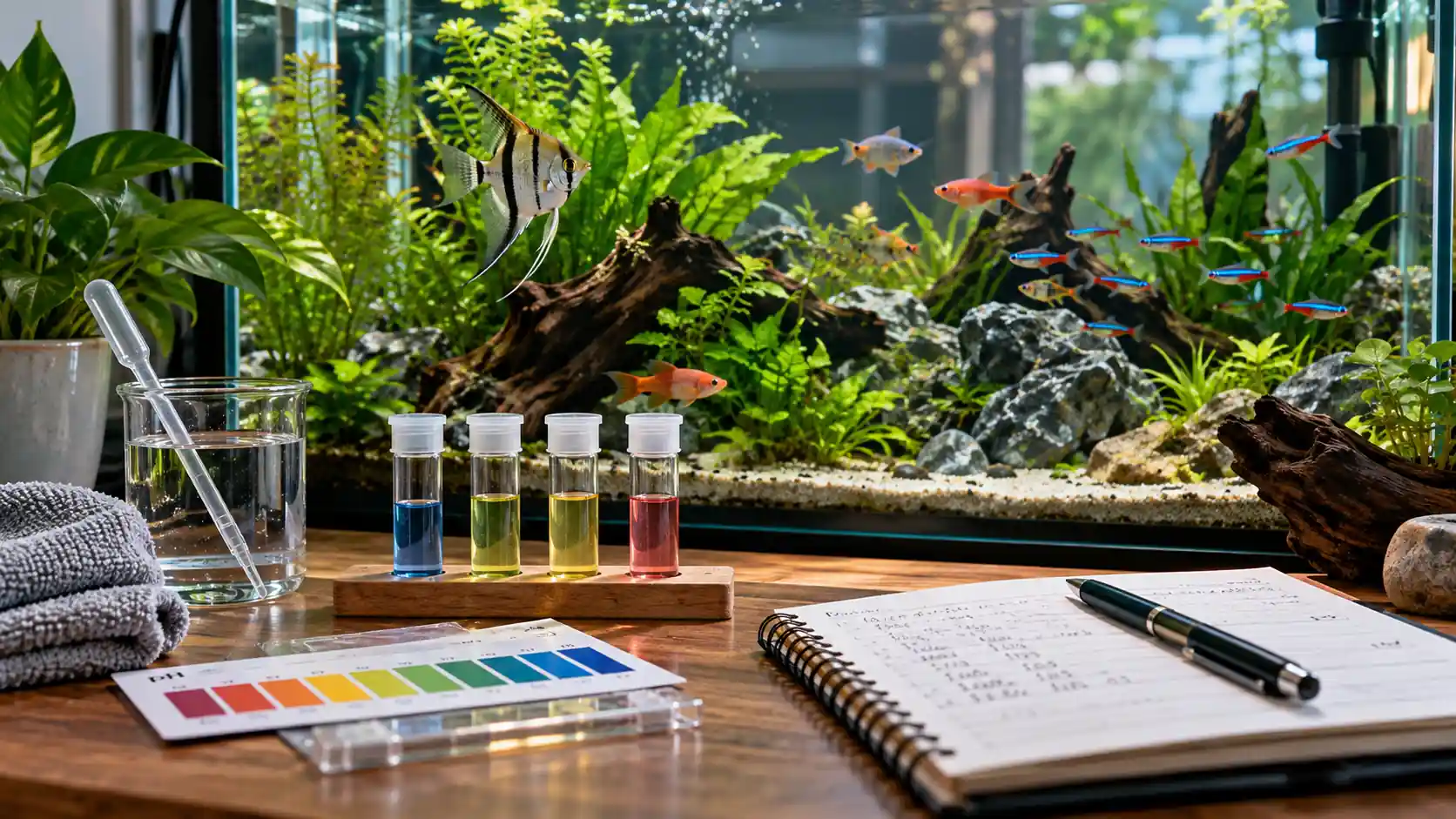
If you’re wondering how to lower pH in an aquarium, start by testing the water and checking its carbonate hardness (KH). The right method depends on your source water, the materials in your tank, and the needs of your fish. Properly prepared reverse-osmosis (RO) water, removing a source of excess alkalinity, or using suitable natural materials may help, depending on the cause.
Key takeaways
- Test aquarium pH, KH, and source water before choosing a treatment.
- Check whether your fish actually need a lower pH.
- Identify what keeps the pH high or causes it to rise again.
- Choose a method that suits your water chemistry and livestock.
- Make changes cautiously and retest the water after treatment.
How to lower aquarium pH safely: a step-by-step plan
Follow these steps in order. Each one helps you decide what to do next and reduces the risk of unnecessary changes.
Step 1: Confirm that your pH needs to change
Test your aquarium water and check the recommended conditions for the species you keep. Different fish have different water-chemistry requirements, so use species-specific care information when deciding whether a change is necessary.
If your fish are healthy and the pH suits their needs, leave the water chemistry alone. A reading outside a general care guide’s preferred range does not automatically require treatment.
Step 2: Test KH and your source water
Measure the pH and KH of your aquarium water. Then test the water you use for water changes.
Compare the results:
- High source-water KH: Consider whether blending in properly prepared RO water would suit your aquarium.
- Lower source-water KH but persistently high aquarium pH: Investigate rocks, substrate, decorations, and other tank-specific factors.
- pH that drops after treatment and rises again: Check KH and look for an ongoing source of alkalinity.
- pH that changes during the day: Check whether dissolved carbon dioxide (CO₂) is affecting the readings, especially in planted tanks.
These results point toward possible causes. They don’t prove the cause on their own.
Step 3: Identify what is causing the high pH
Check your source water, substrate, rocks, shells, and decorations. If you use CO₂ injection, review the timing of your readings and your system’s operation.
Look for a cause you can address. Repeatedly adding a pH reducer without investigating the water chemistry can lead to recurring changes and unnecessary treatment.
Step 4: Choose a method that fits the problem
| Your situation | Method to consider | Main precaution |
|---|---|---|
| Source water has high KH | Blend appropriately prepared RO water with source water | Check mineral content and livestock requirements |
| Certain rocks or shells contribute to alkalinity | Remove or replace the confirmed source | Avoid unnecessary disruption to the aquarium |
| Fish need softer, more acidic conditions | Consider suitable driftwood, botanicals, or peat | Effects vary with KH and material |
| pH changes with CO₂ levels | Review planted-tank CO₂ management | Excessive CO₂ can harm fish |
| A commercial reducer seems necessary | Select an aquarium-specific product and follow its instructions | Test the water and avoid repeated blind dosing |
Step 5: Prepare the water before making changes
When using RO water or changing source-water composition, prepare replacement water separately whenever possible. Treat tap water for chlorine or chloramine as required, and check the prepared water’s pH, hardness, and mineral content.
If you use a commercial pH reducer, follow its label. Avoid pouring household acids or concentrated acids directly into a stocked aquarium.
Step 6: Retest and monitor the fish
After making a change, test the water again and record the result. Keep track of pH and KH, especially when changing the source water or using acidifying materials.
Watch for unusual swimming, rapid breathing, reduced appetite, or other signs of distress. If the pH returns to its previous level, revisit the cause before treating the water again.
There is no single daily pH-change limit that suits every aquarium. The appropriate approach depends on the species, starting conditions, and extent of the change.
What should you test before lowering aquarium pH?

Understanding three basic measurements makes it easier to choose a method and interpret the results.
| Parameter | What It Measures | Why It Matters |
|---|---|---|
| pH | How acidic or alkaline the water is | Shows the current acid-base condition |
| KH | Carbonate hardness; a common indicator of buffering capacity | Helps explain resistance to pH changes |
| GH | General hardness, mainly associated with calcium and magnesium | Helps assess whether mineral content suits the livestock |
KH and alkalinity are closely related, although they are not identical in every water system. The USGS guide to alkalinity and water explains how alkalinity helps water neutralize acids and resist changes in pH.
KH is especially useful when investigating pH rebound. Water with higher buffering capacity generally resists acidification more strongly, so adding a reducer may change the reading temporarily while the underlying conditions remain.
Test your source water as well as the aquarium. Its pH can change after collection as dissolved CO₂ escapes, so record when each sample was tested and use a consistent procedure.
Why is your aquarium pH high or rising again?
The cause often determines which treatment will work.

Source water has high pH or KH
Your tap water may contain dissolved minerals and carbonate compounds that contribute to alkalinity. Water changes can introduce more of these compounds into the aquarium.
Compare the pH and KH of your source water with the aquarium’s readings. If the source water has high buffering capacity, consider whether properly prepared and blended RO water would suit your fish.
Rocks, shells, or substrate affect water chemistry
Some materials contain calcium carbonate or other compounds that dissolve into the water and increase hardness or alkalinity.
Potential contributors include:
- Limestone and certain carbonate-rich rocks.
- Shells and coral-based materials.
- Calcium-carbonate-containing gravel or substrate.
- Decorations made from materials that release alkaline compounds.
Only some materials have this effect. Check the composition of the items in your tank before removing them. If a material is contributing to the problem, replacing it may help, although source-water chemistry still needs attention.
pH rebounds after treatment
A pH reducer can change the immediate reading without resolving the underlying buffering conditions. Carbonate and bicarbonate compounds react with acids, which can limit the lasting effect of a treatment.
For example, if pH falls after dosing and rises again after a water change, test KH and source water before adding more product. The results may point to high source-water alkalinity or a material inside the aquarium that continues to affect the water.
CO₂ changes pH in planted aquariums
Dissolved carbon dioxide affects water chemistry. In planted tanks, pH may rise as plants consume CO₂ during photosynthesis and fall as CO₂ accumulates through respiration.
Compare readings taken at consistent times of day. If you use CO₂ injection, review the system and its effect on livestock before adjusting it. CO₂ management is a specific consideration for planted aquariums, not a general solution for every high-pH problem.
Which methods can lower aquarium pH?
The following methods can help in different circumstances. Their results depend on the aquarium’s chemistry and how the method is used.

Use properly prepared RO/DI water
Reverse-osmosis (RO) and deionized (DI) water contain fewer dissolved minerals than many untreated water sources. Blending prepared RO/DI water with source water can reduce mineral content and buffering capacity.
This can help when high source-water KH is the main issue. The appropriate blend depends on the starting water, the needs of your fish, and the mineral content required in the aquarium.
Pure RO/DI water has very little buffering and mineral content. Prepare and remineralize it as needed before use. Don’t assume that untreated RO/DI water is suitable for every fish or plant.
Remove materials that contribute to alkalinity
If rocks, shells, or substrate are contributing to high alkalinity, removing or replacing the confirmed source may reduce the problem.
Plan changes carefully in an established aquarium. Large-scale substrate removal can disturb beneficial bacteria and the habitat of your livestock. Check the suspected material first and avoid unnecessary disruption.
Use driftwood, leaves, or peat
Suitable driftwood, leaf litter, and aquarium-grade peat can release tannins and other organic compounds that affect water chemistry. These materials may suit aquariums intended for fish that live in softer, more acidic conditions.
Their effects vary with the type and amount of material and the water’s buffering capacity. High KH may limit the pH change.
Keep these points in mind:
- Driftwood and botanicals may tint water amber or brown.
- Use leaves collected from areas free of pesticides and other contaminants.
- Choose peat intended for aquarium use and follow its instructions.
- Monitor pH and other water parameters after adding natural materials.
Natural materials work gradually and unpredictably. Start cautiously and assess the results in your own aquarium.
Use commercial pH reducers carefully
Aquarium products marketed as pH Down can change water chemistry. Their effects depend on the product, the water’s buffering capacity, and the way the treatment is used.
Read the label and follow the recommended procedure. Test the water before and after treatment, and avoid adding extra doses because the initial result seems too small.
If the pH rebounds, investigate KH and the source of alkalinity. Repeated treatment without testing can create unwanted fluctuations.
Manage CO₂ in planted tanks
CO₂ injection can lower pH while additional carbon dioxide remains dissolved in the water. The reading may rise as CO₂ levels fall.
Manage CO₂ for plant growth and livestock safety. Excessive concentrations can harm fish, so don’t use CO₂ injection simply to force the pH downward.
Common mistakes to avoid
- Repeatedly dosing pH reducers: Check KH and source water before repeating a treatment.
- Chasing an arbitrary target: Use the requirements of your fish to decide whether a change is necessary.
- Adding household acids directly to the tank: Their effects are difficult to control in a stocked aquarium.
- Expecting botanicals to work the same way everywhere: Their effects depend on the material and water chemistry.
- Using RO/DI water without checking minerals: Prepare replacement water for your livestock’s needs.
- Ignoring CO₂ fluctuations: Check the timing of readings in planted tanks before treating a changing pH.
When high aquarium pH needs urgent attention
High pH can increase the toxicity risk from ammonia, a waste compound processed by biological filtration as part of the aquarium’s nitrogen cycle. Aquarium water contains ammonia in different chemical forms, and the proportion present as un-ionized ammonia (NH₃), the more toxic form, increases as pH and temperature rise.
If your fish are breathing rapidly, becoming lethargic, refusing food, or behaving abnormally, test ammonia and other relevant water-quality parameters promptly. A high pH reading alone does not establish ammonia poisoning.
If ammonia is elevated or fish show serious distress, address the water-quality problem promptly and seek advice from a qualified aquatic veterinarian or fish-health professional. Avoid an improvised, rapid pH correction that could create another dangerous change.
Conclusion
Start with pH, KH, and source-water tests. Identify the cause, choose a method suited to your aquarium, and monitor the results.
Properly prepared RO water, removal of a contributing carbonate-rich material, and suitable natural materials can each help in the right conditions. Your fish’s needs and the aquarium’s water chemistry should determine which method you use.

Ethan Caldwell
Freshwater Fish Care Writer
Ethan writes about freshwater fish care, aquarium setup, water quality, and choosing compatible tank mates.
View Author Profile
2 Comments
Pingback: Rummy Nose Tetra Care: Tank Size, Schooling & Tank Mates - tankbloom.com
Pingback: Betta Fish Care: Tank Setup, Water, Food & Health - tankbloom.com