



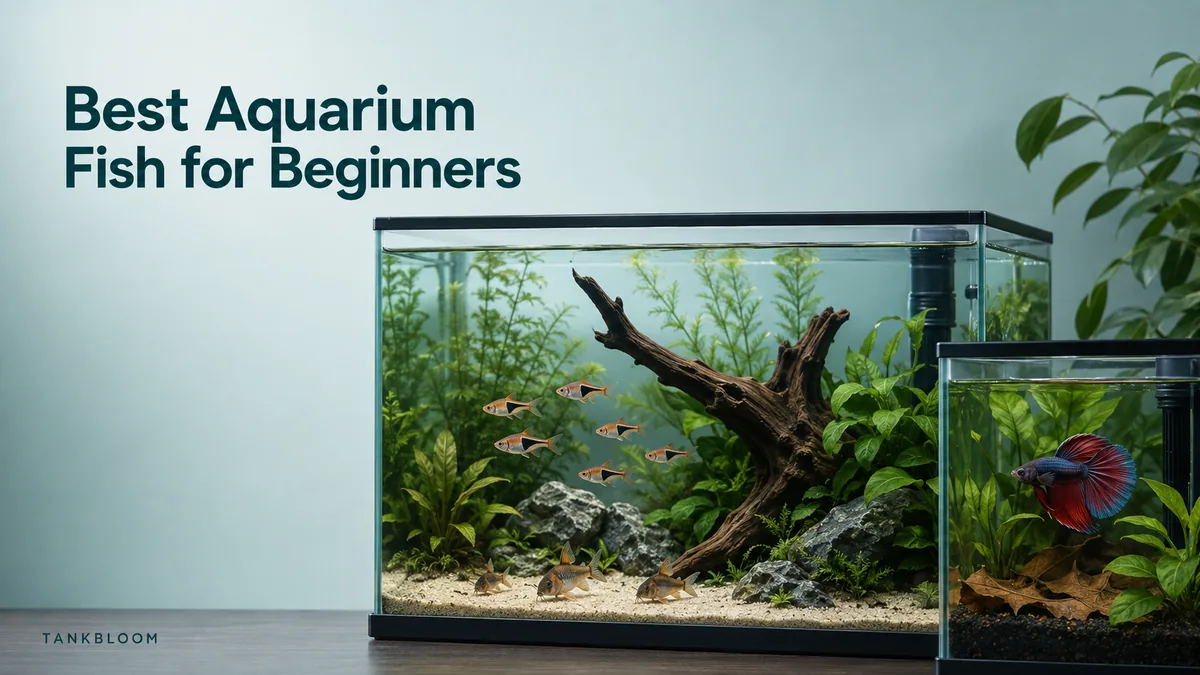
The best aquarium fish for beginners are not simply the fish with the toughest reputation. They are fish whose adult size, behavior, social needs, water preferences, and long-term care fit the aquarium you can realistically maintain.
For many new fishkeepers, platies, zebra danios, harlequin rasboras, bronze corydoras, bettas, and cherry barbs are strong starting points. But they suit very different tanks. A betta can make an excellent solo centerpiece, while zebra danios need a group and plenty of swimming room. Guppies are easy to feed, but their ability to reproduce quickly can make the tank harder to manage later.
The better question is not simply, “Which fish is hardy?”
It is:
Does this fish fit my tank, give me some room to learn, and remain manageable once it is fully grown?
That is the approach used throughout this guide.
Best Beginner Aquarium Fish at a Glance
These are practical beginner recommendations, not the smallest containers in which a fish may technically survive. Tank shape, group size, activity level, filtration, adult size, and other livestock all affect how much space a fish really needs.
| Fish | Best For | Adult Size | Practical Beginner Tank | Social Need | General Water Fit | Biggest Catch |
|---|---|---|---|---|---|---|
| Platy | Easy community livebearer | ~2.5–3 in | 20 gal | Small group; manage sexes | Neutral to alkaline; soft-medium to moderate hardness | Breeding |
| Zebra Danio | Active schooling tank | ~2 in | 20 gal long preferred | 6+ preferred | Broadly adaptable; cooler than many tropical fish | Activity and jumping |
| Harlequin Rasbora | Peaceful community | ~2 in | 20 gal | 8+ preferred | Soft to moderately hard tropical water | Needs a proper group |
| Bronze Corydoras | Bottom-dwelling community | ~2.5–3 in | 20 gal | 6+ preferred | Broad tropical range | Group needs and feeding |
| Betta | Solo centerpiece | ~2.5–3 in | 5–10 gal | Usually solo | Warm, stable freshwater | Tank-mate compatibility |
| Cherry Barb | Colorful peaceful community | ~2 in | 20 gal long | 6–8+ | Fairly adaptable | Needs a group |
| White Cloud Mountain Minnow | Cooler-water aquarium | ~2 in | 15+ gal | 6+ preferred | Cooler freshwater | Poor fit with warm tropical fish |
| Black Neon Tetra | Beginner community tetra | ~1.25–1.5 in | 20 gal | 8+ preferred | Soft to moderately hard; stable water | School size and swimming room |
| Honey Gourami | Peaceful centerpiece | Small gourami; published maximum ~5.4 in | 20 gal | Often kept as a single centerpiece | Warm, soft-medium freshwater | Social and territorial nuance |
| Guppy | Colorful livebearer | ~2 in | 15–20 gal | Small group; manage sexes | Neutral to alkaline; medium-hard | Rapid reproduction |
The quick decision rule
FIT → FORGIVENESS → FUTURE
Fit: Does it suit your tank, water, temperature, and community?
Forgiveness: Is routine care manageable while you learn?
Future: What changes when the fish grows up, breeds, or settles into the tank?
That framework is more useful than choosing whichever fish has the strongest “hardy” label at the store.

What Actually Makes a Fish Beginner-Friendly?
A beginner-friendly fish should be reasonably straightforward to care for under the right conditions. Hardiness helps, but it does not compensate for the wrong tank, poor water quality, an undersized social group, or incompatible tank mates.
Fit: Does the Fish Suit Your Tank and Water?
Start with the adult fish, not the small juvenile sitting in a store tank.
A two-inch fish may still need considerable swimming room if it spends all day racing from one end of the aquarium to the other. A tiny tetra may require eight companions. A bottom-dwelling species may benefit more from floor space than extra tank height.
This is why body length alone is a poor way to choose fish.
Instead of asking:
“How small is this fish?”
ask:
“How much room does the whole group need to behave normally as adults?”
Water matters too. A species that already fits your source water is usually simpler for a beginner than one that requires regular chemistry adjustment.
Forgiveness: Is It Manageable While You Learn?
Good beginner fish generally accept readily available foods, have manageable behavior, and tolerate normal variation within an appropriate range.
That does not mean they belong in poor water.
A fish should not earn a beginner recommendation because it supposedly tolerates ammonia or nitrite better than another species. A new fishkeeper should learn maintenance in a cycled aquarium, not by using livestock to test whether a new tank is ready.
Hardy should mean reasonably manageable under proper husbandry—not resistant to preventable neglect.
Future: Will It Still Be Easy Six Months From Now?
This is the part many beginner lists miss.
The fish that is easy to buy today may create a completely different problem later. Livebearers can produce more young than the aquarium can support. A small juvenile can become a substantial adult. One fish may turn out to need five or more companions. An “algae eater” may still require its own diet and produce considerable waste.
A good first fish should make sense for its adult life, not just its first few weeks in your aquarium.
The 10 Best Aquarium Fish for Beginners
1. Platy: Best All-Around Beginner Livebearer
Platies are one of the easiest community fish to recommend to a new keeper. They are colorful, generally peaceful, straightforward to feed, and most specimens in the aquarium trade are captive-bred.
Adults commonly reach around 2.5–3 inches. They do well in neutral-to-alkaline freshwater and are not especially demanding about chemistry within an appropriate range. They should not, however, be described as strictly “hard-water fish”; their accepted husbandry range extends into softer and moderately hard water too.
A 20-gallon tank is a comfortable beginner starting point for a small group. It gives you more stability and more room to manage the population than squeezing several livebearers into the smallest possible aquarium.
Platies eat common prepared aquarium foods and usually work well with peaceful fish of similar size.
Best for: A colorful, uncomplicated community aquarium.
Biggest beginner catch: Breeding.
If males and females are kept together, fry are very likely. That can quickly turn a lightly stocked aquarium into a population-management problem.
TankBloom verdict: An excellent first community fish, especially when you plan for reproduction before bringing them home.
2. Zebra Danio: Best Hardy Active Schooling Fish
Zebra danios are excellent first schooling fish for someone who wants an aquarium that always looks active.
They stay around two inches but behave like much larger fish when it comes to swimming space. They move constantly, interact with their group, and use the length of the aquarium.
That is why I prefer a 20-gallon long-style footprint for a beginner group rather than choosing a tank purely because the fish themselves are small. Keep at least a proper social group; six or more is a sensible practical target.
Danios also tolerate cooler temperatures than many traditional tropical community fish. A general range around 63–81°F (17–27°C) is often given for the group, although individual danio species can differ.
Best for: Someone who wants an energetic, highly visible school.
Biggest beginner catch: Activity.
Their speed can overwhelm very timid or slow-moving tank mates, and a lid is a smart precaution because active fish can jump.
TankBloom verdict: One of the strongest beginner schooling fish when the group has enough horizontal swimming room.
3. Harlequin Rasbora: Best Peaceful Beginner Community School
Harlequin rasboras are a better fit than danios when you want a calmer community aquarium.
Adults reach around two inches. They are peaceful midwater fish, readily accept normal aquarium foods, and generally mix well with other calm community species.
The important word is group.
Do not buy two or three simply because each fish is small. Harlequins are social. While smaller minimum groups appear in husbandry references, I prefer eight or more when the tank can comfortably support them because a larger group better reflects how these fish naturally use the aquarium.
A 20-gallon aquarium gives a beginner enough room for a meaningful group without turning stocking into a puzzle.

Best for: A quiet, peaceful freshwater community.
Biggest beginner catch: Underestimating how much space the whole shoal needs.
TankBloom verdict: One of the safest all-around choices for a properly sized beginner community.
4. Bronze Corydoras: Best Beginner Bottom-Dwelling Fish
If you want fish moving around the bottom of the aquarium, bronze corydoras are a much better starting point than buying a random catfish labeled as a “cleaner.”
Corydoras include many species, so it is better to choose a specific one. Bronze corydoras (Corydoras aeneus) are a practical beginner option because they are peaceful, social, and widely kept.
Adults are commonly around 2.5–3 inches. For a beginner, a 20-gallon aquarium with six or more is a sensible way to plan the group.
They also need their own food.
A cory may pick up edible material from the bottom, but it should not be expected to survive on whatever other fish leave behind. Use appropriate sinking foods and make sure food reaches the group.
For the bottom, choose clean sand, fine rounded gravel, or another smooth substrate that supports natural foraging without unnecessary sharp edges.

Best for: Adding a peaceful bottom-dwelling group to a community aquarium.
Biggest beginner catch: Thinking “bottom feeder” means “doesn’t need feeding.”
TankBloom verdict: Excellent beginner fish when you have room for the group and feed them intentionally.
5. Betta: Best Solo Fish for a Beginner
A betta fish can be one of the best first fish when you want one centerpiece animal rather than a school or a busy community.
Adult Betta splendens are usually around 2.5–3 inches in body length. A 5–10 gallon aquarium provides a much more useful beginner setup than the tiny containers in which bettas are sometimes displayed.

Bettas need stable, clean, warm water. A temperature around 76–81°F is appropriate for most, along with a properly sized heater, gentle filtration, a lid, and places to rest or hide.
Their labyrinth organ allows them to breathe air at the surface. It does not remove the need for filtration, cycling, temperature control, or routine maintenance.
The main difficulty appears when betta tank mates enter the picture. Individual temperament varies, and male bettas can be territorial.
Best for: A heated, filtered solo centerpiece setup.
Biggest beginner catch: Compatibility.
A betta can be an excellent first fish without being the easiest first community fish.
I would also avoid making a female betta sorority a beginner project. Managing multiple bettas introduces social complexity that defeats the purpose of choosing a simple first setup.
TankBloom verdict: Excellent for a well-planned single-fish aquarium.
6. Cherry Barb: Best Peaceful Colorful Barb
Cherry barbs give beginners bright color without much of the reputation for fin-nipping associated with some other barbs.
Adults stay around two inches and work well in peaceful community tanks when kept socially. A group of six to eight or more is a sensible target.
For a beginner, a 20-gallon long gives the group useful swimming space while still leaving room for plants, cover, and carefully chosen tank mates.
They are uncomplicated feeders and usually accept good-quality flakes, granules, and appropriately sized frozen or live foods.
Plants and other cover help create a more comfortable environment without requiring an advanced aquascape.
Best for: A colorful community school with moderate activity.
Biggest beginner catch: Buying only one or two.
TankBloom verdict: An underrated beginner fish that deserves more attention than it usually gets.
7. White Cloud Mountain Minnow: Best Beginner Fish for Cooler Water
Not every beginner aquarium needs to run at standard tropical temperatures.
White Cloud Mountain Minnows are small, active, social fish that do particularly well in cooler freshwater. They reach around two inches and are commonly maintained around 63–73°F (17–23°C).
That makes them useful for an appropriately cool aquarium where the room and tank remain within their preferred range.
Keep a social group; six or more is a practical starting point. A 15-gallon or larger tank gives them more swimming space than a tiny desktop aquarium.
They accept ordinary prepared foods and are not especially difficult fish when their temperature needs are respected.
Best for: A cooler freshwater aquarium.
Biggest beginner catch: Temperature mismatch.
A White Cloud can be peaceful and a tropical tank mate can be peaceful, yet the two may still be a poor combination if their preferred temperatures do not overlap well.
TankBloom verdict: Excellent beginner fish when the aquarium is planned around cooler conditions.
8. Black Neon Tetra: TankBloom’s Preferred First Tetra
Classic Neon Tetras are much more famous, but I would seriously consider Black Neon Tetras (Hyphessobrycon herbertaxelrodi) for a first tetra school.
That is an editorial preference, not a claim that Black Neons are scientifically proven to outperform regular Neons in every aquarium.
Black Neons stay around 1.25–1.5 inches and should be kept socially. FishBase lists groups of at least five, while experienced aquarium keepers commonly recommend larger schools. For a beginner, I prefer eight or more in a 20-gallon aquarium when stocking allows.
They are peaceful, active community fish and have a reputation among experienced aquarium keepers for being robust and adaptable.
That combination makes them a useful alternative to selecting Neon Tetras purely because Neons are the name everyone recognizes.
Best for: A peaceful beginner community built around a small tetra school.
Biggest beginner catch: Tiny fish still require space for the whole school and stable water.
TankBloom verdict: My preferred beginner tetra when healthy stock is available and the setup suits them.
9. Honey Gourami: Best Peaceful Beginner Centerpiece
Honey gouramis can work well when you want something larger and more visually dominant than a small schooling fish but still want a relatively calm community.
One point needs more care than many aquarium profiles give it: reported adult size varies.
Aquarium hobby descriptions often portray Honey Gouramis as very small gouramis, while FishBase records a published maximum total length of about 5.4 inches (13.7 cm). Maximum records do not mean every aquarium specimen will reach that size, but they are a good reason not to plan around a tiny adult estimate.
For a beginner, I would therefore use a 20-gallon aquarium as the more comfortable starting point for a centerpiece Honey Gourami community.
They prefer warm water, plant cover, and calm tank mates. Gouramis also have social and territorial behavior that can become more complicated when multiple individuals are added.
Best for: A peaceful centerpiece in a planted or well-covered community.
Biggest beginner catch: “Peaceful” does not mean socially simple.
TankBloom verdict: A good beginner centerpiece when the tank is planned around the fish rather than squeezed around a minimum number.
10. Guppy: Best Colorful Livebearer for Medium-Hard Water
Guppies remain famous beginner fish because they are small, colorful, widely available, and straightforward to feed.
Traditional guppies reach around two inches, with females generally larger than males. They are particularly well suited to neutral-to-alkaline, medium-hard freshwater, making them a useful choice when your source water naturally matches those conditions.
A small group can be maintained in relatively modest tanks, but a 15–20 gallon aquarium gives a new keeper considerably more room to handle social dynamics and, more importantly, offspring.
And offspring are the big issue.
If males and females are kept together, breeding is very likely.
That sounds fun until the aquarium contains far more fish than originally planned. More fish mean more feeding, more waste, more demand on filtration, and eventually a decision about where the young will go.
Best for: A colorful livebearer aquarium where the source water already suits them.
Biggest beginner catch: Population growth.
TankBloom verdict: Very good beginner fish, provided reproduction is part of the plan rather than a surprise.
Which Beginner Fish Is Best for Your Setup?
There is no honest universal #1. The right fish depends on what kind of aquarium you are building.
| Your Goal | Strong Starting Choice | Why |
|---|---|---|
| One centerpiece fish | Betta | No school required; ideal for a dedicated setup |
| Peaceful community school | Harlequin Rasbora | Calm behavior and straightforward community role |
| Active schooling fish | Zebra Danio | Robust, energetic, easy to observe |
| Bottom-dwelling group | Bronze Corydoras | Peaceful social catfish |
| Easy livebearer community | Platy | Straightforward care and peaceful behavior |
| Medium-hard water livebearer | Guppy | Naturally suits more mineral-rich water |
| Cooler-water aquarium | White Cloud Mountain Minnow | Comfortable below typical tropical temperatures |
| Beginner tetra | Black Neon Tetra | Peaceful schooling fish with a robust hobby reputation |
| Peaceful centerpiece | Honey Gourami | Gives a community one larger focal fish |
Tank size changes the answer too.
A 5-gallon aquarium offers very limited fish choices. At 10 gallons, social and swimming requirements quickly restrict what can be kept correctly. Around 20 gallons, beginners gain much more flexibility because there is room for proper groups and water conditions tend to be easier to keep stable.
That is why:
Small fish and small-tank fish are not the same thing.
Can Beginner Fish Live Together?
Yes. Many beginner-friendly fish can share an aquarium, but being individually easy to keep does not automatically make two species compatible.
A good combination needs overlap in temperature, water chemistry, adult size, temperament, and activity level. The aquarium also has to accommodate each species’ social group and the space those groups actually use.
For example, a peaceful midwater school and a properly sized bronze corydoras group can make sense in a community fish tank because they occupy different areas of the tank and have compatible community behavior.
An extremely active danio school may be a poorer partner for slow, easily intimidated fish.
The same principle applies to bettas. A betta appearing on this list does not mean you should automatically combine it with guppies, gouramis, barbs, danios, tetras, and corydoras.
Compatibility is a property of the whole aquarium, not a label attached to one fish.
Not sure your fish can live together? Check their compatibility before stocking your tank.
Check Fish Compatibility →Choose Fish for the Water You Already Have
If two species both appeal to you, the easier one is often the fish that already suits your source water.
That does not mean your tap water has to perfectly reproduce a wild river. Many aquarium fish are captive-bred and can adapt to a reasonable range.
The goal is to avoid unnecessary chemistry chasing.
Guppies are a good example. They fit neutral-to-alkaline, medium-hard water well. Platies also favor neutral-to-alkaline conditions but are generally less tightly associated with hard water than guppies.
Rasboras and many tetras are commonly associated with softer water, although captive-bred populations can be less demanding than wild fish.
So before buying bottles designed to raise or lower pH, ask:
“Is there a fish I like that already fits the water coming from my tap?”
That is often the simpler route.
If pH, GH, KH, ammonia, nitrite, and nitrate still feel like alphabet soup, read Aquarium Water Parameters before trying to adjust anything.
Popular “Beginner Fish” That Need More Context
These species are not bad beginner fish. They simply become much easier when the setup matches their needs.
| Fish | Why Beginners Like It | What Needs More Context | TankBloom Take |
|---|---|---|---|
| Neon Tetra | Small, peaceful, colorful | Schooling and stable-water requirements | Good community fish; Black Neon is my preferred first tetra |
| Molly | Hardy in suitable water | Medium-hard water, size, breeding | Good when your source water fits |
| Bristlenose Pleco | Smaller than many plecos | Diet, waste, hiding places, adult size | Good secondary community fish, not a cleaning tool |
| Kuhli Loach | Peaceful and unusual | Social group, cover, bottom habitat, shy behavior | Better once basic community care feels familiar |
| Swordtail | Hardy livebearer | Larger adult size, activity, breeding | Easy fish, but a more demanding setup than a platy |
Neon Tetra
Neon Tetras are popular for good reasons. They are peaceful, attractive, and widely available.
I would not tell a beginner to avoid them. I simply prefer Black Neon Tetras as a first tetra when both species are healthy and suitable for the aquarium.
Molly
Mollies can be straightforward fish when their water fits them, particularly in neutral-to-alkaline, mineral-rich conditions.
The problem comes when a beginner buys them for very soft water and then starts repeatedly changing chemistry to make the fish fit the tank.
Bristlenose Pleco
Bristlenose Plecos are far more manageable than the giant plecos that sometimes arrive in beginner tanks, but they still need real food, hiding places, adequate filtration, and enough room for an adult catfish.
Buying one does not eliminate aquarium cleaning.
Kuhli Loach
Kuhli loaches are peaceful but more specialized than their temperament suggests. They are social, spend much of their time around the bottom and in cover, and may be harder for a new keeper to observe.
They can be excellent fish later, but they are not my first choice for teaching someone basic fish behavior.
Swordtail
Swordtails are hardy livebearers, but they are larger and more active than platies. Reproduction also adds another layer of management.
They are easy fish in an appropriate setup, which is different from being the easiest possible first fish.
Beginner-Friendly Does Not Mean “Use This Fish to Cycle the Tank”
No fish on this list should be treated as a disposable test of whether a new aquarium is ready.
A cycled aquarium has established biological filtration capable of processing normal fish waste without allowing ammonia and nitrite to accumulate to harmful levels.
Zebra danios, platies, or other species may sometimes be described as “hardy enough” for a new tank. That is not how I recommend starting.
The better sequence is:
Cycle the aquarium → confirm safe water → choose appropriate fish → stock gradually.
TankBloom’s How to Cycle a Fish Tank: Complete Beginner Guide covers that process in detail.
Your first fish should teach you how a healthy aquarium behaves—not how much poor water quality an animal can tolerate.
What to Check Before Buying Your First Fish
Before the fish goes into a bag, answer these questions:
- Is the aquarium fully cycled?
- How large will this species become as an adult?
- Does it need a school, shoal, pair, or other companions?
- Does the aquarium have enough usable swimming or bottom space for the whole group?
- Does your source water reasonably match the species?
- Does its temperature requirement match the aquarium?
- Will its behavior work with your planned tank mates?
- If it breeds easily, what will happen to the offspring?
- What is most likely to make this fish harder to manage six months from now?
If you cannot answer one of those questions, that is the point to research before the fish comes home.
The Best Beginner Fish Is the One That Fits Your Aquarium
Do not choose your first fish only because it is cheap, colorful, popular, or small at the store.
Choose it because its adult size, social behavior, water needs, temperature, and long-term care make sense in the aquarium you can provide.
A betta may be the simplest option for someone who wants one centerpiece fish. A group of platies may make more sense for a beginner community. Harlequin rasboras and bronze corydoras can fill very different roles in a larger peaceful setup. White Clouds may be a better choice than tropical species when the aquarium is deliberately kept cooler.
That brings the decision back to three things:
FIT — Can you provide the environment this fish actually needs?
FORGIVENESS — Is routine care manageable while you’re learning?
FUTURE — Will its adult size, breeding, behavior, and social needs still make sense later?
The easiest fish to keep long term is usually not the one that can tolerate the most mistakes.
It is the one whose normal needs already fit the aquarium you can realistically maintain.

Ethan Caldwell
Freshwater Fish Care Writer
Ethan writes about freshwater fish care, aquarium setup, water quality, and choosing compatible tank mates.
View Author Profile
1 Comment
Pingback: Neon Tetra Care Guide: Tank Size, Diet & Tank Mates - tankbloom.com