



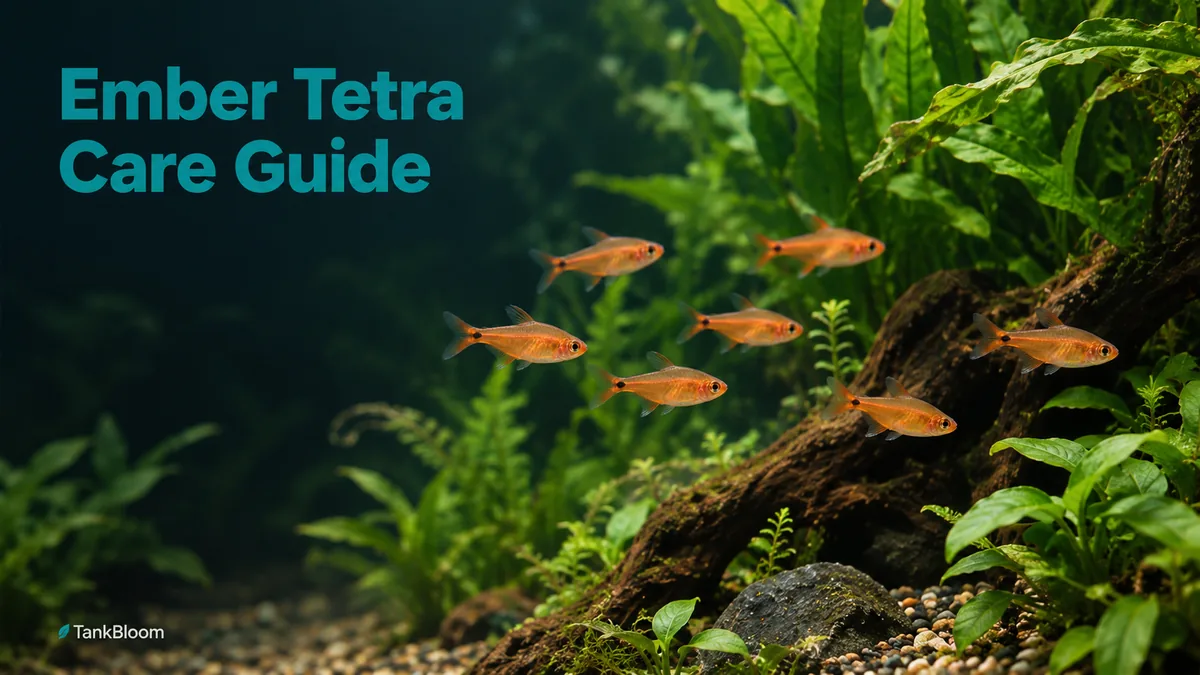
Ember tetras (Hyphessobrycon amandae) are small, peaceful freshwater fish that thrive in stable, well-maintained aquariums with suitable groups, gentle filtration, shelter, and appropriately sized food.
- Tank size: Around 10 gallons can be a practical starting point for a carefully planned species-focused setup; a larger tank offers more flexibility.
- Group size: Aim for approximately 8–10 ember tetras or more when the aquarium has enough space and capacity.
- Temperature: A practical range is approximately 72–82°F (22–28°C).
- Food: Offer small prepared foods and suitable frozen or live foods, such as crushed flakes, nano pellets, and baby brine shrimp.
- Tank mates: Choose peaceful fish with compatible needs, and remember that tiny shrimp offspring may be eaten.
- Most important: Establish the aquarium’s biological filter and check water quality before introducing fish.
These are practical starting points, not universal limits. Tank dimensions, water conditions, filtration, and other inhabitants all affect what is suitable.

Ember Tetra Quick Facts
| Feature | Details |
|---|---|
| Scientific name | Hyphessobrycon amandae |
| Adult size | About 0.8 inches (2 cm) standard length |
| Lifespan | Often reported as 2–4 years in aquarium guides; an estimate, not a guarantee |
| Temperament | Generally peaceful and social |
| Group size | Around 8–10 or more when space permits |
| Starting tank | Around 10 gallons for a carefully planned setup |
| Temperature | Approximately 72–82°F (22–28°C) |
| Diet | Small prepared foods and suitable frozen or live foods |
Standard length measures the body without the tail fin, which explains why measurements from different references may not match exactly. The lifespan figure is less firmly established than the species’ size and water-parameter information, so it should not be treated as a guarantee.
The specialist reference Seriously Fish recommends an aquarium footprint of at least 18 × 12 inches and lists an approximate volume of 11 U.S. gallons. Aquarium Co-Op also discusses smaller nano-tank setups, illustrating why tank suitability should be evaluated in context rather than by volume alone.
Are Ember Tetras Good for Beginners?

Yes. Ember tetras can be a good choice for beginners who can maintain a stable freshwater aquarium and provide for a suitable group.
Their peaceful temperament and small size make them attractive for planted aquariums and carefully planned community tanks. They also look striking against green plants and darker backgrounds.
However, small does not mean maintenance-free. Ember tetras have tiny mouths, may struggle to compete with larger fish at feeding time, and still need suitable water quality, swimming space, and compatible companions.
They are a sensible choice if you want a colorful, peaceful aquarium and are prepared to monitor water quality. They are less suitable if you want a fish that can be added immediately to an uncycled tank or kept alone in a tiny decorative bowl.
What Tank Size and Group Do Ember Tetras Need?
Ember tetras need enough room to move comfortably and live in a suitable group of their own species. Aquarium volume, footprint, filtration, and the number of other inhabitants all influence how well a particular setup will work.
How many ember tetras should you keep together?
Aim for approximately 8–10 ember tetras as a starting group, provided the aquarium can accommodate them responsibly. A larger group may be appropriate in a larger aquarium.
Ember tetras are social, shoaling fish. They often move together in a loose group rather than maintaining a tight, synchronized formation at all times. Seeing them spread out while exploring a planted aquarium is not automatically a sign that something is wrong.
Keeping only one or two removes much of their normal social environment. At the same time, adding more fish than the aquarium can support is not a good solution.
Plan the group around the tank’s usable space and total stocking. If you want several different species, account for each species’ social requirements rather than treating the aquarium’s volume as unlimited.
Can ember tetras live in a 5-, 10-, or 20-gallon tank?
A 5-gallon tank can work in some carefully managed nano setups, but it is not the best default recommendation for a beginner. Around 10 gallons is a more practical starting point for a carefully planned species-focused aquarium, while 20 gallons generally offers greater flexibility.
| Tank size | Assessment | What to consider |
|---|---|---|
| 5 gallons | Not the beginner default | Limited space and less margin for water-quality problems |
| 10 gallons | Practical starting point | Check footprint, group size, filtration, and other inhabitants |
| 20 gallons | More flexible | More swimming space and greater community-tank options |
These are planning categories, not universal stocking limits. The specialist footprint recommendation of 18 × 12 inches corresponds to roughly 11 gallons only when the aquarium’s height is also specified appropriately. Do not assume that every tank sold as a 10-gallon aquarium automatically meets that footprint recommendation.
How many ember tetras can you keep in a 10-gallon tank? A group of approximately 8–10 is a reasonable planning target for a suitable, species-focused setup, provided the aquarium’s dimensions, filtration, and water quality support it. If the tank already contains other fish, reassess the complete stocking plan before adding them.
For a beginner, I would prioritize a suitable footprint and an adequate same-species group over squeezing several types of nano fish into the smallest possible tank. A larger aquarium also gives you more room to manage water quality and plan compatible additions.
What Water Conditions Do Ember Tetras Need?
Ember tetras do best in warm, stable freshwater with suitable pH and hardness. Published recommendations differ slightly, so use a credible range as a guide rather than repeatedly changing your aquarium to match one exact number.
Temperature, pH, and water hardness
| Parameter | Guidance | Important detail |
|---|---|---|
| Temperature | 72–82°F | Keep stable and avoid sudden changes |
| pH | Published ranges vary | Choose suitable, stable conditions |
| GH | Verify the species-specific range | Measures general mineral hardness |
| Ammonia | 0 ppm | Investigate any detectable reading |
| Nitrite | 0 ppm | Investigate any detectable reading |
| Nitrate | Keep controlled | Monitor accumulation and maintain appropriately |
The temperature and pH ranges above summarize recommendations from established aquarium-care references, which do not use identical ranges. These values are guidance, not precise universal survival limits.
General hardness (GH) and carbonate hardness (KH) are also different measurements. GH relates mainly to dissolved calcium and magnesium, while KH describes the water’s acid-neutralizing capacity. Do not use one as a substitute for the other when evaluating your aquarium.
Why water stability and testing matter
A tank can look clear and still have unsafe water. Fish waste and decomposing food release ammonia, which biological filtration helps convert through the nitrogen cycle into nitrite and then nitrate.
Before adding ember tetras, establish a functioning biological filter. In a properly cycled aquarium, ammonia and nitrite should read zero, while nitrate should be controlled through suitable maintenance.
Test the aquarium when it is new, after a substantial stocking change, or when fish behave unusually. If readings are unsuitable, investigate the cause rather than assuming that one water change or chemical adjustment will permanently fix the problem.
For beginners, the important lesson is straightforward: maintain suitable, stable water and verify it with testing instead of relying on appearance alone.
How Should You Set Up an Ember Tetra Aquarium?
A planted or well-sheltered aquarium with gentle filtration and open swimming space is a good starting point. You do not need an elaborate aquascape, but the layout should provide cover without leaving the fish with nowhere to swim.
Plants, shelter, and swimming space
Live plants are useful because they create shelter and help the aquarium feel less exposed. Floating plants, driftwood, and carefully arranged decorations can add further cover.
A dark substrate or background can also make the fish’s orange-red coloration stand out, although neither is essential.
The key is balance. An aquarium packed so tightly with decorations that the fish have little open water is no better than a bare tank with nowhere to retreat. Arrange the plants and hardscape so the fish can move freely while still having sheltered areas.
Do not assume that plants alone guarantee better health or a longer lifespan. Water quality, feeding, stocking, and general care remain important.
Filtration, water flow, heating, and lighting
Choose filtration that maintains good water quality without creating a current the fish must constantly fight. A sponge filter can be a suitable option for a small, lightly stocked aquarium, while other filters can also work if their flow is appropriate.
Keep these points in mind:
- Filtration: The filter must handle the aquarium’s actual waste load, not just its nominal tank-size rating.
- Water movement: Gentle flow is appropriate, but the water should not be completely stagnant. Surface movement also supports gas exchange.
- Heating: Use a heater if needed to maintain the target temperature consistently. Room temperature can change throughout the day and across seasons.
- Lighting: Moderate aquarium lighting works well with many planted setups. Provide sheltered areas if the light is intense.
- Maintenance: Remove accumulating waste and uneaten food, and maintain the filter according to its needs without unnecessarily disrupting biological filtration.
The aim is a stable environment, not the most expensive equipment setup.
Is Your Aquarium Ready for Ember Tetras?
Before buying fish, check that the aquarium is ready to support them. This is especially important if you are setting up your first tank.
Use this checklist:
- The aquarium has completed the nitrogen cycle and its biological filter can process waste.
- Ammonia and nitrite readings are zero.
- Temperature and other water conditions are suitable and stable.
- The aquarium has enough usable space for the intended ember tetra group.
- Filtration and surface movement are appropriate.
- There is suitable cover and open swimming space.
- Any existing fish are compatible, and the complete stocking plan is realistic.
- You have food that is small enough for ember tetras to eat.
Do not use clear water or the passage of a fixed number of days as proof that a tank is cycled. The biological filter needs to be able to process waste, and testing provides evidence that the aquarium is ready.
If the aquarium is not ready, postpone the purchase. Adding fish first and trying to correct the conditions afterward creates avoidable risks.
What Do Ember Tetras Eat?
Ember tetras are omnivores. Offer a varied diet of appropriately sized prepared foods and suitable small frozen or live foods.
Their tiny mouths are the main practical consideration. A food can be nutritious and still be unsuitable if the fish cannot swallow it or reach it before larger tank mates consume it.
Suitable options include:
- High-quality flakes crushed into small particles.
- Nano pellets or other appropriately sized prepared foods.
- Baby brine shrimp.
- Small daphnia and other suitable tiny aquatic foods.
- Appropriate frozen foods formulated or sized for small fish.
Check food particle size before increasing the amount you feed. Ember tetras may struggle to eat food that is too large or that faster tank mates consume first.
Persistent gasping or sudden distress affecting several fish requires prompt investigation. Check water conditions and oxygenation rather than assuming that one symptom identifies a specific disease.
Feed small portions and watch the fish eat. Once or twice daily is a reasonable starting routine for many adult community fish, but adjust according to the food, the fish’s condition, and the amount consumed. Growing fry may require a different feeding schedule.
If larger tank mates are present, observe feeding closely. Ember tetras should not have to compete constantly for every meal. Uneaten food should not be left to accumulate because it adds to the aquarium’s waste load.
Which Fish and Shrimp Can Live With Ember Tetras?
Ember tetras generally suit peaceful community aquariums with similarly sized fish and compatible water requirements. However, no tank-mate list can guarantee success in every aquarium. Temperament, space, group requirements, and feeding competition all matter.
Before adding a species, use the fish compatibility checker as a preliminary screen, then verify temperature, adult size, social needs, and temperament. No tool can guarantee that fish will coexist peacefully in every aquarium.
| Tank mate | Compatibility | What to consider |
|---|---|---|
| Small rasboras | Often suitable | Check adult size, group needs, and water conditions |
| Other small tetras | Conditional | Each species needs its own appropriate group |
| Pygmy corydoras | Potentially suitable | Provide bottom space, a suitable group, and appropriate food |
| Betta fish | Conditional | Individual temperament and tank setup matter |
| Adult shrimp | Often compatible | Individual fish may still investigate small invertebrates |
| Shrimplets | At risk | Very small shrimp may be eaten |
| Large predators | Generally unsuitable | Risk of predation, intimidation, or competition |
Can ember tetras live with bettas?
They can coexist in some aquariums, but it is not a guaranteed combination. Some bettas tolerate small community fish, while others chase or attack them.
If you consider this pairing, prioritize adequate space, suitable cover, and a backup plan for separating the fish. Do not choose a betta solely for its color contrast with the tetras.
Are ember tetras safe with shrimp?
Adult dwarf shrimp often coexist with ember tetras, but newly hatched shrimp are more vulnerable. If breeding shrimp is your priority, dense plant cover and a suitable shrimp-focused setup can help, but they do not guarantee that every shrimplet will survive.
Are ember tetras fin nippers?
Ember tetras are generally described as peaceful, rather than persistent fin nippers. However, individual behavior can vary, and chasing or damaged fins should not automatically be dismissed as normal. Check the aquarium’s stocking, the behavior of other fish, and whether any particular fish is being harassed.
One further consideration: adding another schooling species does not eliminate the ember tetra’s own social needs. Each species must have suitable space and a group appropriate to its requirements.
What Is Normal Ember Tetra Behavior?
Ember tetras often move in loose groups, explore planted areas, and use shelter when they feel exposed. Their behavior can vary with the aquarium layout, the other fish present, and how recently they were introduced.
A fish that briefly hides after introduction is not necessarily sick. Similarly, ember tetras do not have to remain in a tight school every moment to be behaving normally.
Pay closer attention to persistent changes, especially when several signs appear together:
- Repeated hiding or unusual inactivity.
- A sustained loss of appetite.
- Noticeably faded coloration alongside other behavioral changes.
- Rapid breathing or persistent gasping.
- Loss of balance, visible injury, or a clear decline in condition.
Color alone is not a reliable diagnosis. Lighting, stress, acclimation, and individual differences can affect how a fish looks. What matters more is the overall pattern: whether the fish are eating, swimming normally, and responding as expected.
What Should You Watch After Adding Ember Tetras?
During the first week, monitor the fish and the aquarium rather than making constant adjustments. The goal is to identify problems early while allowing the fish to settle into suitable conditions.
Follow a consistent acclimation process appropriate to the supplier’s instructions and the difference between the transport water and your aquarium. Avoid pouring store or shipping water directly into the aquarium where possible.
Check that the group is eating, that the fish are not being harassed by tank mates, and that temperature and water quality remain stable.
Why are my ember tetras pale, hiding, or not eating?
These signs have several possible causes. Start with the basic conditions and recent changes rather than assuming that a particular disease is responsible.
| Observation | What to check first |
|---|---|
| Pale coloration | Recent introduction, lighting, water conditions, and overall behavior |
| Persistent hiding | Cover, group size, aggression, and recent changes |
| Refusing food | Food particle size, competition, water quality, and other symptoms |
| Surface gasping | Oxygenation, temperature, ammonia, nitrite, and filter function |
| Bloated abdomen | Persistent swelling, appetite, swimming, and other symptoms |
| Several fish affected | Water quality, recent maintenance, new additions, and possible contaminants |
Persistent gasping or sudden distress affecting several fish requires prompt investigation. Check water conditions, temperature, filter function, and oxygenation. These symptoms can have multiple causes, so do not assume that one observation identifies a specific disease.
If several fish are affected suddenly, check water conditions immediately and take appropriate corrective action. Do not wait for the symptoms to become more severe. Seek help from an aquatic veterinarian or a suitably qualified fish-health specialist if serious signs persist or the cause remains unclear.
A bloated abdomen also has multiple possible explanations. It can reflect feeding or reproductive condition, but persistent swelling accompanied by lethargy, loss of appetite, or difficulty swimming warrants closer investigation. Do not diagnose a specific disease from appearance alone.
Do not respond to every symptom by adding medication. First establish what has changed, test the water, and look for a pattern that can guide the next step.
How Can You Tell Male and Female Ember Tetras Apart, and Do They Breed?
Sexing ember tetras can be difficult because the differences are subtle. Females may have fuller bodies, particularly when carrying developing eggs, while males can appear slimmer. Body shape alone is not definitive.
Ember tetras are egg-scattering fish, not livebearers. During reproduction, eggs are released and fertilized externally. The adults do not provide parental care and may eat eggs or fry, so successful breeding often requires suitable cover and protection for the eggs and young.
A fuller abdomen should not automatically be described as pregnancy. It may reflect eggs, recent feeding, or another condition, and unusual swelling accompanied by other symptoms deserves closer attention.
For most owners, breeding is a secondary consideration. Establishing stable water conditions, providing appropriate food, and maintaining a healthy group should come first. Detailed spawning setups and fry-rearing techniques are separate subjects and are not necessary for routine ember tetra care.
Are Ember Tetras Right for Your Aquarium?
Ember tetras can be an excellent choice for a peaceful freshwater aquarium if you can provide a suitable group, stable water conditions, appropriate food, and compatible tank mates. Their small size makes them attractive for planted tanks, but it does not remove the need for careful stocking and maintenance.
Before purchasing them, check the aquarium’s dimensions, confirm that the biological filter is ready, and make sure you have room for the group without compromising the needs of other inhabitants.
The most important rule is simple: choose the aquarium and stocking plan around the fish’s needs, rather than trying to fit the fish into whatever space is available.

Ethan Caldwell
Freshwater Fish Care Writer
Ethan writes about freshwater fish care, aquarium setup, water quality, and choosing compatible tank mates.
View Author Profile
2 Comments
Pingback: Community Fish Tank: Peaceful Fish, Setup & Stocking Guide - tankbloom.com
Pingback: Best Betta Fish Tank Mates: Fish, Snails & Shrimp - tankbloom.com