



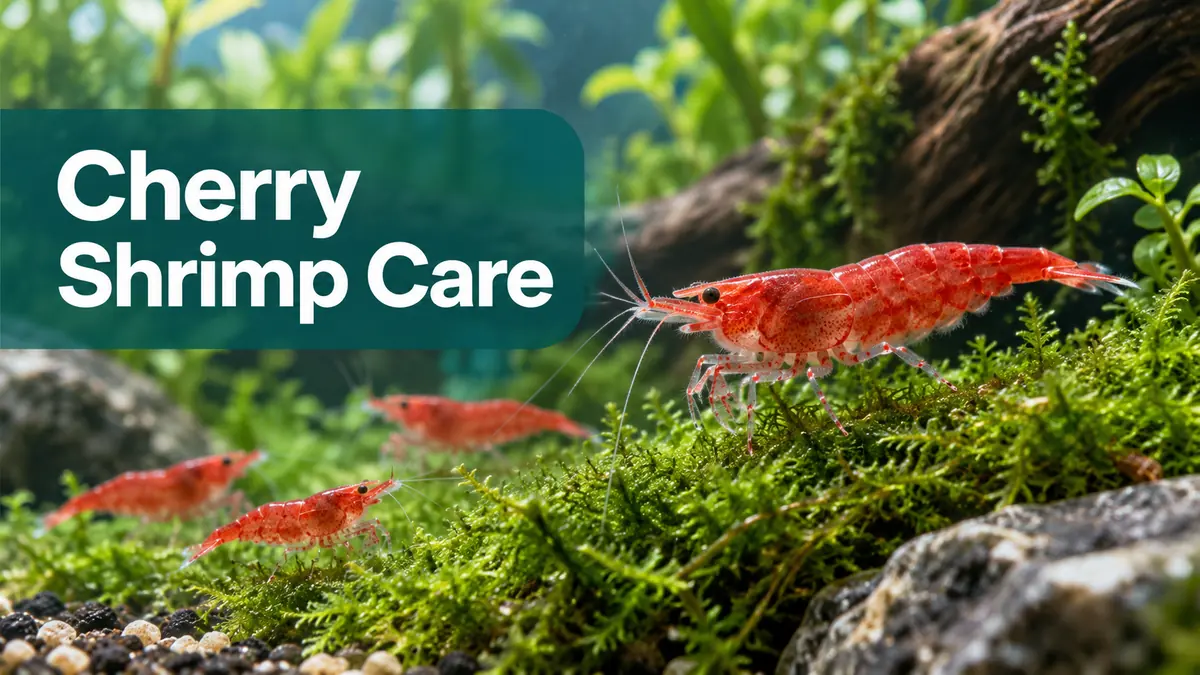
Cherry shrimp are small freshwater shrimp known for their bright colors, peaceful behavior and ability to thrive in planted aquariums. They are popular with beginners, but keeping a healthy colony requires more than clean-looking water. Stable water conditions, suitable food, adequate minerals and protection from predators all matter.
Cherry shrimp are commonly identified as Neocaridina davidi. The familiar red variety is one of several color forms produced through selective breeding. These shrimp graze on biofilm, algae and organic material, making them useful inhabitants of planted tanks, although they cannot replace routine aquarium maintenance.
The most reliable approach is straightforward: start with a cycled aquarium, maintain suitable water conditions, feed modestly and investigate problems before making major changes.
Cherry Shrimp Quick Facts
| Feature | Details |
|---|---|
| Scientific name | Neocaridina davidi |
| Adult size | About 1.1–1.5 inches (3–4 cm); varies by individual. |
| Lifespan | Often reported as around 1–2 years in aquarium care guidance. |
| Diet | Biofilm, algae, detritus and suitable supplemental foods. |
| Temperature | About 68–78°F (20–26°C) as a common husbandry range. |
| Behavior | Generally peaceful, but vulnerable to predatory fish. |
| Reproduction | Females carry eggs beneath the abdomen; young hatch as miniature shrimp. |
The numerical care ranges in this guide are practical starting points, not universal biological limits. A healthy, established colony does not necessarily need its water adjusted to match every number in a table.
What Are Cherry Shrimp?
Cherry shrimp are small freshwater crustaceans in the family Atyidae. Their scientific name is Neocaridina davidi. The wild-type shrimp generally have subdued, variable coloration, while selective breeding has produced red, orange, yellow, blue and patterned forms.
The red variety is commonly called the red cherry shrimp. Names such as Fire Red, Blue Dream and Yellow Sakura generally refer to color forms or trade grades rather than separate species.
These shrimp spend much of their time grazing across plants, wood, substrate and other surfaces. They consume biofilm, algae and suitable organic material, but they also produce waste and need appropriate aquarium conditions.
Their small size makes them suitable for planted aquariums. However, their vulnerability to predators means that tank-mate selection deserves careful consideration.
How to Set Up a Cherry Shrimp Tank
A suitable aquarium needs biological filtration, stable water conditions and enough surfaces for grazing and shelter. Expensive equipment is not necessary, but the tank should be properly established before shrimp are introduced.

What Tank Size Do Cherry Shrimp Need?
A 5-gallon aquarium can support a small cherry shrimp colony when it is mature, properly filtered and consistently maintained. A 10-gallon aquarium generally provides more room and a greater buffer against sudden changes in water conditions.
There is no universal shrimp-per-gallon formula. The number an aquarium can support depends on filtration, surface area, feeding, maintenance and whether other animals share the tank.
For a beginner, consider this practical starting example:
- 5-gallon shrimp-only aquarium: A modest group of around 10 healthy shrimp is a reasonable starting point in a fully cycled, well-maintained tank.
- 10-gallon shrimp-only aquarium: A similar starter group provides more room for the colony to grow, with additional water volume to help buffer environmental changes.
- Community aquarium: Start more cautiously because fish may eat shrimp, and the combined population increases the system’s demands.
These are starting examples, not fixed stocking limits. Increase the population only when water quality, food availability and maintenance remain under control.
Do Cherry Shrimp Need a Filter, Heater and Live Plants?
Filtration is important for maintaining water quality. A sponge filter is a popular option because it provides biological filtration while reducing the risk of small shrimp being drawn into an exposed intake. A suitable pre-filter sponge can offer similar protection on other filter types.
A heater is not always necessary. If room temperatures remain within a suitable range throughout the day and night, additional heating may be unnecessary. Where temperatures fluctuate significantly, a reliable heater and thermometer can help maintain consistency.
Live plants are beneficial but not mandatory. Mosses, fine-leaved plants and other aquatic vegetation provide shelter and surfaces where biofilm can develop. Driftwood and other aquarium-safe decorations can also increase grazing opportunities.
A practical setup includes:
- A fully cycled aquarium.
- Reliable filtration with a protected intake.
- A thermometer and suitable temperature control.
- Plants, moss or other safe grazing surfaces.
- A secure lid to reduce the risk of escape.
- A maintenance routine that avoids unnecessary environmental swings.
What Substrate Is Best for Cherry Shrimp?
Cherry shrimp can be kept over a variety of suitable aquarium substrates. An inert gravel or sand substrate is a straightforward choice when it is compatible with the aquarium’s water chemistry and planted setup.
Some active substrates can alter pH or carbonate hardness. This does not make them inherently unsuitable, but their effects should be considered before use. A substrate designed for a particular planted-tank setup may not be the best choice if it pushes water conditions away from those preferred by an established shrimp colony.
Choose the substrate based on the aquarium’s overall needs rather than assuming shrimp require a special product.
Cherry Shrimp Water Parameters
Water chemistry is one of the most important parts of cherry shrimp care. A colony may survive across a range of conditions, but survival alone does not establish that those conditions are ideal for growth or breeding.
The following values are commonly used as starting targets in aquarium husbandry. They are not a single scientifically established optimum for every population or breeding line.
| Parameter | Practical guidance |
|---|---|
| Temperature | 68–78°F (20–26°C) is a commonly used starting range. |
| pH | Approximately 6.5–8.0; avoid abrupt changes. |
| GH | About 6–8 dGH as a practical starting target. |
| KH | About 2–8 dKH as a practical starting target. |
| TDS | Track changes over time; one ppm target does not establish mineral suitability. |
| Ammonia | 0 ppm in an established aquarium. |
| Nitrite | 0 ppm in an established aquarium. |
| Nitrate | Keep controlled through appropriate feeding, stocking and maintenance. |
These are husbandry starting points, not universal biological limits. Avoid changing an established, healthy aquarium simply to match a chart.
What Temperature Is Best for Cherry Shrimp?
A temperature around 68–78°F (20–26°C) is a commonly used starting range for many home aquariums. Individual husbandry recommendations vary, and temperature can affect activity, growth and reproduction.
Warmer water can increase metabolic activity, but it also holds less dissolved oxygen. Cooler conditions may slow activity and reproduction. The warmest tolerated temperature is not automatically the best choice for every colony.
Use a thermometer to check the actual aquarium temperature. When performing a water change, make sure the replacement water is reasonably close to the tank’s temperature.
What Do pH, GH, KH and TDS Mean?
These measurements describe different aspects of water chemistry. Understanding their differences is more useful than trying to optimize one number in isolation.
- pH: Measures how acidic or alkaline the water is.
- GH: Measures general hardness, primarily associated with dissolved calcium and magnesium.
- KH: Describes carbonate and bicarbonate buffering, which helps resist changes in pH.
- TDS: Estimates the total concentration of dissolved substances. It does not identify which minerals or chemicals are present.
GH matters because shrimp need minerals for normal physiological functions and exoskeleton development. KH affects buffering, while pH describes acidity or alkalinity.
TDS can help track changes over time, but two aquariums with the same TDS reading can contain different combinations of dissolved substances. A TDS meter cannot replace GH and KH testing.
Do not add calcium or mineral products simply because one reading differs from a chart. Test the water, review its composition and make adjustments only when there is a clear reason.
How Do You Keep Water Quality Stable?
An established aquarium needs biological filtration, suitable water changes and routine testing. Ammonia and nitrite should remain at zero. Nitrate should be controlled through appropriate stocking, feeding, filtration and maintenance.
Use a water conditioner suitable for the source water when chlorine or chloramine is present.
When changing water:
- Prepare replacement water with an appropriate conditioner.
- Check that its temperature is reasonably close to the aquarium’s.
- Consider differences in GH, KH and TDS when source water changes substantially.
- Avoid abrupt chemistry changes.
- Monitor shrimp behavior and water quality afterward.
Stability does not mean leaving the water unchanged indefinitely. It means maintaining good conditions without introducing unnecessary, abrupt swings.
How Should You Acclimate Cherry Shrimp?
Acclimation helps reduce the risk of sudden environmental changes when shrimp enter a new aquarium.
The appropriate method depends on transport time and the difference between the transport water and the aquarium. Follow the supplier’s instructions and avoid keeping shrimp in opened shipping water for unnecessarily long periods.
A cautious process is to:
- Check the aquarium temperature and water quality before introducing the shrimp.
- Equalize temperature using an appropriate method.
- Consider the difference in water chemistry before choosing how to acclimate.
- Avoid sudden changes in temperature or mineral conditions.
- Transfer the shrimp without pouring transport water into the aquarium.
Do not use one rigid acclimation duration for every shipment. Transport conditions and water chemistry can differ substantially.
What Do Cherry Shrimp Eat?
Cherry shrimp are opportunistic omnivores. They graze on biofilm, algae and organic material while searching for food particles on plants, wood, substrate and other surfaces.
A planted aquarium provides natural grazing opportunities, but these may not supply everything a colony needs. Supplemental feeding is often necessary, especially in a clean aquarium or a growing colony.
Suitable food options include:
- Foods formulated for freshwater shrimp or aquatic invertebrates.
- Appropriate sinking foods.
- Algae-based foods.
- Small amounts of suitable blanched vegetables.
- Other nutritionally appropriate foods designed for aquarium invertebrates.
Variety can help, but more food is not automatically better. Uneaten food decomposes and can increase the aquarium’s waste load.
Do Cherry Shrimp Eat Algae?
Yes. Cherry shrimp graze on some algae and biofilm, along with other organic material. However, they are not a reliable solution for every aquarium algae problem.
They may consume soft growth and microorganisms on surfaces, but they will not necessarily remove all visible algae. Their feeding behavior also does not address the underlying causes of excessive growth, such as unsuitable lighting or nutrient imbalances.
Cherry shrimp may consume decaying plant material. If a plant appears damaged, inspect the affected area before assuming the shrimp are responsible. Softened or deteriorating leaves may be easier to consume than healthy tissue.
If algae becomes excessive, identify the growth and investigate the aquarium’s lighting, nutrient levels and maintenance routine. Adding more shrimp is not a substitute for correcting the underlying problem.
How Often Should You Feed Cherry Shrimp?
Feeding frequency depends on colony size, natural food availability and the type of food offered. There is no single schedule that works for every aquarium.
Start with small portions and observe how quickly the shrimp consume them. Remove uneaten food before it decomposes, then adjust future portions based on what remains.
Watch for both extremes:
- Overfeeding: Leftover food can decompose, increase waste and contribute to water-quality problems.
- Insufficient food: A clean aquarium may not provide enough natural grazing for a growing colony.
Do not judge feeding needs by the appearance of the tank alone. A tank with little visible algae may still have biofilm, while a heavily planted aquarium may still require supplemental food.
The goal is to provide enough suitable nutrition without allowing uneaten food to accumulate.
Molting and Cherry Shrimp Health
Cherry shrimp grow by shedding their exoskeleton. This process is called molting, and it is a normal part of their development.
After a molt, the new exoskeleton needs time to harden. During this period, shrimp may be more vulnerable to injury and predation. A shed shell lying in the aquarium is not automatically evidence of a dead shrimp.
What Does a Normal Molt Look Like?
A shed exoskeleton may resemble a complete, pale or translucent shrimp. It can be mistaken for a dead animal, particularly by new keepers.
Shrimp may consume their discarded exoskeleton, recovering some of the nutrients it contains. Removing every molt immediately is generally unnecessary unless it is trapped in a problematic location or there is another specific reason to remove it.
Observe the living shrimp rather than judging the situation from the shed shell alone. Normal movement, feeding and subsequent activity provide more useful context than a single observation.

Why Do Cherry Shrimp Have Molting Problems?
Molting problems can have several possible causes. Water chemistry, mineral availability, nutrition, environmental stress and abrupt changes may all be relevant.
Do not assume every unsuccessful molt is caused by a lack of calcium. Adding supplements without testing the water can create further imbalance and may fail to address the actual problem.
If a shrimp appears to struggle with molting, review:
- Recent changes in temperature or water chemistry.
- GH and the availability of suitable minerals.
- Feeding and overall nutritional conditions.
- Recent water changes or acclimation.
- Other signs of stress, injury or poor health.
A pale line or separation near the junction of the head and abdomen is sometimes called the “white ring of death” in aquarium hobby discussions. It is not a definitive diagnosis by itself.
Focus on identifying environmental problems and maintaining suitable conditions. Avoid handling the shrimp or making several major changes while trying to determine the cause.
Why Are My Cherry Shrimp Dying?
Unexpected deaths deserve a systematic investigation. A shrimp dying alone does not establish a particular cause, and several environmental problems can produce similar symptoms.
The first priority is to check the aquarium rather than immediately adding minerals, medication or other products.
What Should You Check First?
Start with the conditions that can cause immediate or widespread harm.
| Observation | Possible cause | First check |
|---|---|---|
| Several deaths | Water-quality issue or contamination. | Test ammonia and nitrite; review recent changes. |
| Deaths after water change | Temperature or chemistry shift; untreated water. | Check conditioner use, temperature and source water. |
| Inactivity or poor appetite | Environmental stress or other health problem. | Test water and review recent changes. |
| Molting problems | Several possible environmental or nutritional factors. | Check GH, feeding and water stability. |
| Shrimp disappearing | Predation or hiding. | Inspect tank mates and hiding places. |
Check ammonia and nitrite first. Review temperature, recent water changes, acclimation and any new products or medications. If contamination is plausible, investigate the water source, fertilizers, cleaning products and possible pesticide exposure.
Copper toxicity depends on concentration and water chemistry. Avoid copper-based medications or products around shrimp unless their safety for the intended use has been established.
If multiple shrimp are affected, prioritize identifying the environmental problem. Avoid adding several treatments at once, because doing so can introduce new risks and make the original cause harder to identify.
Why Do Shrimp Die After a Water Change?
Water changes can expose shrimp to differences in temperature, pH, hardness or dissolved substances. Untreated chlorine or chloramine can also be harmful.
A water change is not inherently dangerous. Regular maintenance is important; the concern is the quality of the replacement water and how much its conditions differ from those in the aquarium.
Before the next water change, review the preparation process:
- Confirm that the water conditioner is appropriate for the source water.
- Compare replacement-water temperature with the aquarium.
- Consider significant differences in GH, KH and TDS.
- Review whether the water source or treatment method recently changed.
- Avoid abrupt adjustments intended to correct several parameters simultaneously.
If deaths have already occurred, test the water and investigate the most plausible recent changes before repeating the same process.
Cherry Shrimp Breeding and Baby Shrimp
Cherry shrimp can reproduce in a suitable freshwater aquarium without requiring a separate larval-rearing stage. Females carry fertilized eggs beneath the abdomen until the young hatch.
Successful breeding depends on appropriate water conditions, nutrition and juvenile survival. A colony may survive without reproducing consistently if its environment or food supply is unsuitable.
How Can You Tell Male and Female Cherry Shrimp Apart?
Females are often larger and more strongly colored than males. Their abdomen is usually broader and more rounded, which helps accommodate the eggs they carry.
Males are often smaller and less intensely colored, although appearance varies with genetics and breeding line. Size and color are useful clues, not absolute proof of sex.
A mature female may develop a visible saddle behind the head. This is the developing ovaries containing eggs, not a clutch of eggs being carried beneath the abdomen.
Once a female carries eggs under her abdomen, she is described as a berried female.
What Does a Berried Female Look Like?
A berried female carries a cluster of eggs beneath her abdomen, attached to her swimming legs. She moves these legs to circulate water around the eggs and help keep them clean.
The eggs may be yellowish, greenish or another pale shade, depending on the individual and developmental stage. Their appearance can vary, so color alone is not a reliable way to determine whether eggs are developing normally.
A female carrying eggs may fan them regularly. Avoid unnecessary handling, which can stress the shrimp and potentially interfere with normal behavior.
The presence of eggs indicates that reproduction is underway, but it does not guarantee that every egg will hatch or that every juvenile will survive.
How Long Do Cherry Shrimp Eggs Take to Hatch?
Cherry shrimp eggs commonly take around two to three weeks to hatch. A published species profile reports an incubation period of approximately 16–19 days under the referenced conditions.
Treat that duration as a reference rather than a guarantee. Temperature and other conditions can affect development. Do not increase temperature abruptly to accelerate hatching.
The young hatch as miniature shrimp rather than passing through the free-swimming larval stage seen in many other shrimp species. This makes aquarium breeding relatively straightforward, provided the environment supports the newly hatched animals.
How Do You Keep Baby Shrimp Alive?
Newly hatched shrimp are tiny and vulnerable. They need stable water conditions, suitable grazing surfaces and protection from equipment and predators.
Biofilm on plants, moss, wood and other surfaces provides valuable natural food. Fine foods designed for shrimp juveniles may also be useful when natural grazing is insufficient.
To support juvenile survival:
- Maintain stable water chemistry and temperature.
- Provide plants, moss or other surfaces where biofilm can grow.
- Protect filter intakes with a suitable sponge or pre-filter.
- Avoid fish and other tank mates that are likely to eat shrimplets.
- Feed appropriately without allowing food to accumulate.
- Monitor the population as the colony grows.
A breeding-focused aquarium may have better juvenile survival than a community display tank, even if adult shrimp appear to coexist peacefully with fish. The difference is often predation on the smallest shrimp.
Cherry Shrimp Size and Lifespan
Adult cherry shrimp commonly reach around 1.1–1.5 inches (3–4 cm), although individual size varies. Females are generally larger than males.
A lifespan of around one to two years is commonly reported in aquarium care guidance, but it should be treated as an estimate rather than a guaranteed biological range. Genetics, temperature, water quality, nutrition and the conditions in which the shrimp were raised can all influence longevity.
To support healthy growth and a reasonable lifespan:
- Maintain suitable, stable water conditions.
- Provide appropriate food and adequate minerals.
- Avoid overcrowding and unnecessary stress.
- Keep ammonia and nitrite at zero.
- Monitor feeding, molting and general activity.
A shrimp that is smaller than expected is not automatically unhealthy. Consider its age, genetics, food availability and history before drawing conclusions.
Cherry Shrimp Colors and Grades
Selective breeding has produced a wide range of color forms. Common varieties include red, orange, yellow, blue and patterned shrimp.
| Color or name | General appearance |
|---|---|
| Red cherry | Red body with varying color coverage. |
| Fire Red | Red form selected for stronger, more complete color coverage. |
| Orange | Orange to reddish-orange coloration. |
| Yellow | Yellow or golden coloration. |
| Blue Dream / Blue Velvet | Blue-toned color forms. |
| Rili | Patterned coloration with contrasting opaque and translucent areas. |
Trade names and grading systems are not always standardized between sellers. The same label may describe somewhat different appearances in different breeding lines.
A higher grade generally refers to appearance, color intensity or coverage. It does not automatically mean the shrimp is healthier, hardier or easier to keep.
Color can also vary with genetics, background, lighting and the animal’s condition. If a shrimp becomes noticeably paler, consider these factors alongside water quality and stress rather than assuming that color loss always indicates a disease.
Choose healthy animals from a reputable source and prioritize suitable care conditions over the highest color grade.
Cherry Shrimp Tank Mates and Compatibility
Cherry shrimp can coexist with some peaceful aquarium inhabitants, but compatibility is never guaranteed. The main concerns are predation, harassment and differences in environmental requirements.
A shrimp-only aquarium is generally the more predictable option for breeding. In a community aquarium, even fish that ignore adult shrimp may eat newly hatched shrimp. Dense planting and moss can provide cover, but they do not eliminate predation.
Can Cherry Shrimp Live With Bettas?
Some bettas tolerate shrimp, while others may chase, injure or eat them. Individual behavior varies, so there is no guarantee that a particular betta will be safe.
A heavily planted aquarium can provide cover, but it cannot remove the risk. If the priority is building a breeding colony, keeping shrimp in a dedicated aquarium generally offers greater control over juvenile survival.
Observe any new combination carefully and separate the animals if harassment or predation occurs.
Which Other Tank Mates Are Suitable?
Potential companions include peaceful fish and some freshwater invertebrates when their water requirements are compatible. However, suitability depends on the specific species and individual behavior.
When choosing tank mates:
- Avoid known shrimp predators.
- Consider the risk to both adults and shrimplets.
- Check that temperature and water-chemistry requirements overlap.
- Provide enough space, filtration and hiding places.
- Monitor new combinations rather than assuming compatibility from a species label.
Amano shrimp and ghost shrimp are different from cherry shrimp, even though they may share some aquarium conditions. Their size, behavior and feeding needs differ, so compatibility should be assessed individually.
For a breeding colony, a shrimp-only aquarium is often the more predictable choice. For a community display, accept that some juvenile losses may occur even when adult shrimp appear healthy.
Cherry Shrimp Care Checklist
Use this checklist to review the essentials:
- The aquarium is fully cycled and properly filtered.
- Temperature and water chemistry remain suitable and stable.
- Ammonia and nitrite remain at zero.
- GH, KH and pH are appropriate for the colony.
- Suitable natural grazing and supplemental food are available.
- Uneaten food is removed before it decomposes.
- Filter intakes are safe for small shrimp.
- Tank mates are unlikely to cause unacceptable predation.
- Molting, feeding and activity are observed regularly.
- Aquarium shrimp are never released into natural waterways.
Cherry shrimp are rewarding aquarium inhabitants when their needs are understood. The most reliable approach is to maintain suitable water conditions, provide appropriate food, protect young shrimp and investigate changes before making major adjustments.
A healthy colony does not require constant intervention. It requires a suitable environment, consistent maintenance and careful observation.
Sources
- University of Florida IFAS Extension. Cherry Shrimp Neocaridina davidi (Bouvier 1904). Species identity, anatomy, size, feeding, color forms, reproduction, egg incubation and molting.
- U.S. Geological Survey. Nonindigenous Aquatic Species: Neocaridina davidi. Taxonomy, feeding ecology, introduced populations and ecological impacts.
- U.S. Fish and Wildlife Service. Ecological Risk Screening Summary: Cherry Shrimp (Neocaridina davidi). Information about the species’ introduction history and ecological risk.

6 Comments
Pingback: Ember Tetra Care Guide: Tank Size, Food & Tank Mates - tankbloom.com
Pingback: Best Betta Fish Tank Mates: Fish, Snails & Shrimp - tankbloom.com
Pingback: Java Fern: Planting, Growing, and Propagation - tankbloom.com
Pingback: Aquarium Filtration Guide: Types, Media, & Flow Rate Explained - tankbloom.com
Pingback: Aquarium Water Parameters: Chart & Water Quality - tankbloom.com
Pingback: Mystery Snail Care Guide: Tank Setup, Diet and Behavior - tankbloom.com