



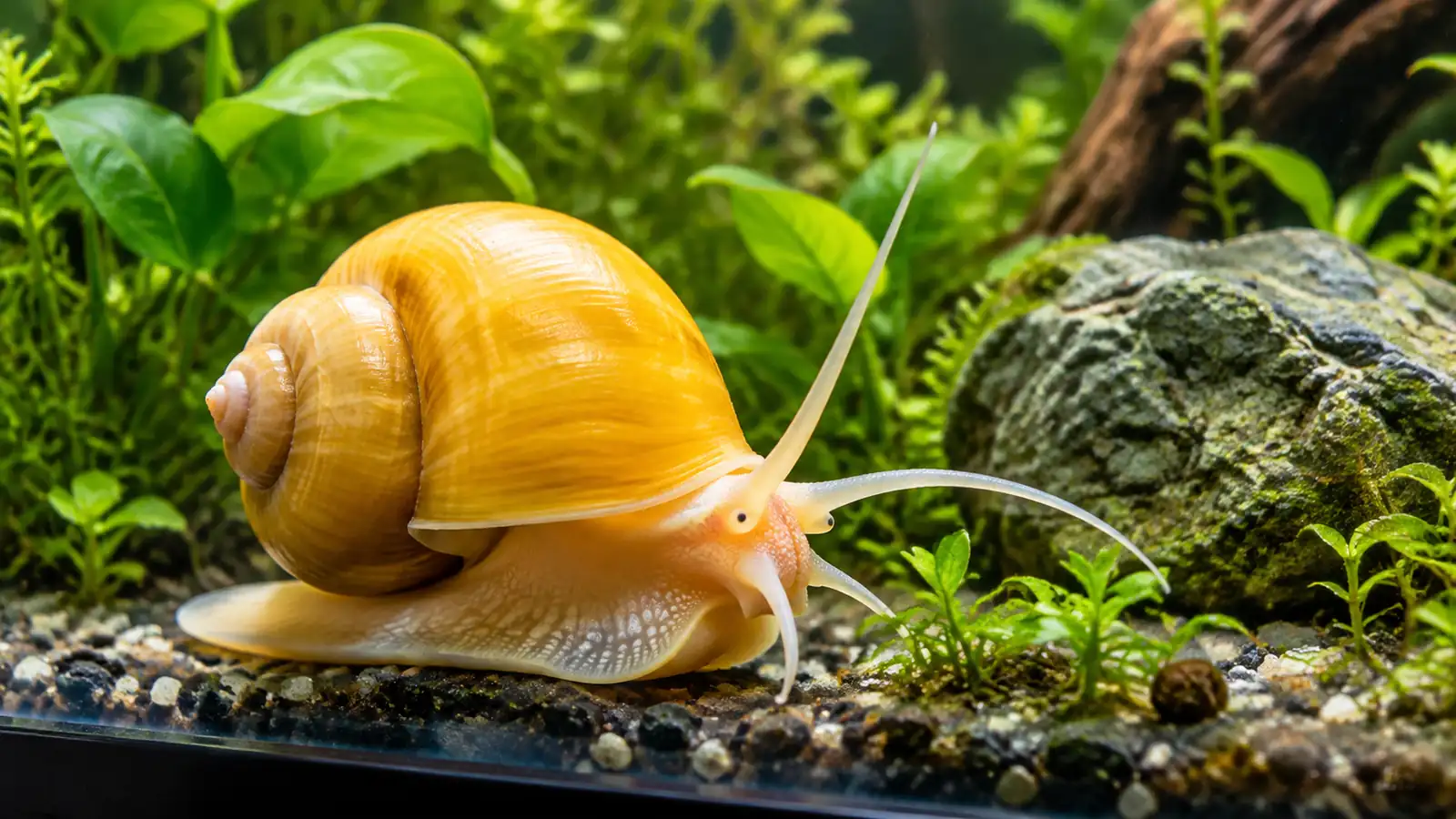
Mystery snails are popular freshwater aquarium animals known for their colorful shells, active behavior and scavenging habits. They can be rewarding additions to a community tank, but they need suitable water conditions, regular feeding and enough minerals to maintain healthy shells.
Good care starts with a cycled aquarium, stable water chemistry, an appropriate diet and compatible tank mates. These snails may eat algae and leftover food, but they still produce waste and need routine maintenance.
This guide covers identification, tank setup, feeding, shell health, behavior, lifespan, colors and breeding.
Mystery snails need a cycled freshwater aquarium, stable water conditions, suitable supplemental food and adequate minerals for shell health. They can graze on algae, but they still need regular care and aquarium maintenance.
Quick Facts
| Common name | Mystery snail |
|---|---|
| Scientific name | Often identified as Pomacea diffusa in the aquarium trade |
| Adult size | Commonly around 2 inches (5 cm); individual size varies |
| Typical lifespan | Often reported as 1–2 years in aquarium care guides |
| Diet | Algae, biofilm, decaying plant matter and suitable supplemental foods |
| Temperature | Common starting target: 70–78°F (21–26°C) |
| Water chemistry | Stable pH and adequate mineral availability |
| Behavior | Peaceful scavenger that can breathe air at the surface |
| Reproduction | Egg clutches are laid above the waterline |
These figures are starting points, not guarantees or universal biological limits. Recommendations differ among aquarium sources, and the animal’s identity should be confirmed where possible.
What Is a Mystery Snail?
A mystery snail is a freshwater apple snail commonly kept in home aquariums. It has a rounded shell, a muscular foot and long sensory tentacles. Aquarium varieties come in colors such as gold, blue, ivory, purple, brown and black.
The scientific naming used in the aquarium trade can be confusing. Many specimens are identified as Pomacea diffusa, while Pomacea bridgesii remains a common name in hobby literature. The U.S. Fish and Wildlife Service species assessment explains the historical confusion surrounding these names.
The snail has an operculum, a firm structure that closes the shell opening when the animal withdraws inside. It also has gills and a lung-like respiratory structure, allowing it to obtain oxygen from water and access air at the surface.
Its scavenging behavior makes it an interesting aquarium inhabitant. It may graze on algae and biofilm, eat leftover food and consume decaying plant matter. However, it cannot replace filtration, water changes or regular tank maintenance.
The common name can also refer to unrelated freshwater snails. The Chinese mystery snail, Cipangopaludina chinensis, is a different species with a documented invasive history in parts of the United States.
Tank Setup and Water Parameters
A suitable aquarium provides stable water conditions, effective filtration, enough room for movement and access to the surface. Mineral availability deserves particular attention because the shell is made primarily of calcium carbonate.
What Tank Size Is Suitable?
A 5-gallon aquarium is a commonly cited starting point for one specimen, and some aquarium guides suggest that volume for a pair. However, tank suitability depends on more than the number of animals.
Consider these factors when choosing an aquarium:
- Adult size: These snails commonly reach around 2 inches, so they need room to move and feed.
- Filtration: The filter must handle waste from the entire aquarium population.
- Stocking: Fish and other invertebrates contribute to the total bioload.
- Food availability: Enough suitable food should be available without leaving excessive waste.
- Water stability: Larger water volumes are generally less vulnerable to sudden changes in temperature and chemistry.
A larger, well-filtered aquarium is often easier to maintain than a very small one, especially when fish share the tank.
There is no universal gallons-per-snail formula that guarantees suitable conditions. Use the Aquarium Volume Calculator to check your tank’s volume, then consider filtration, tank mates and maintenance needs separately.
Recommended Temperature, pH, GH and KH
These freshwater snails are generally kept in moderately warm water with adequate dissolved minerals. A commonly used temperature target is 70–78°F (21–26°C), with a pH around 7.2 or higher. These are husbandry recommendations, not universal limits for every animal sold under the common name.
| Parameter | Guidance |
|---|---|
| Temperature | Common starting target: 70–78°F (21–26°C). Keep it stable. |
| pH | Around 7.2 or higher is commonly recommended. Avoid abrupt changes. |
| GH | Mineral-rich water is important. Around 8 dGH or higher is a commonly used starting target. |
| KH | Maintain adequate buffering to help prevent sudden pH changes. Confirm an appropriate target for your setup. |
| Ammonia | 0 ppm |
| Nitrite | 0 ppm |
| Nitrate | Keep controlled through appropriate feeding, filtration and water changes. |
GH measures general hardness, KH relates to carbonate buffering, and pH measures acidity or alkalinity. They are different measurements and should not be treated as interchangeable.
Filtration, a Lid and Safe Aquarium Conditions
Effective filtration and routine maintenance are essential because these animals produce waste. The aquarium should be fully cycled, with ammonia and nitrite at zero before introduction.
Choose a filter that provides adequate filtration without creating a current that makes movement or feeding difficult. Protect the intake if small snails or hatchlings could become trapped.
A secure lid helps prevent escapes through gaps around equipment. Leave a suitable air gap above the waterline because females deposit egg clutches above the water.
A heater may be necessary if the room cannot maintain a suitable, stable temperature. Monitor the aquarium with a reliable thermometer rather than assuming the room temperature reflects the water temperature.
How to Introduce One to a New Aquarium
Before introduction, confirm that the aquarium is cycled and its temperature and chemistry are suitable.
- Test the water and check the temperature.
- Acclimate the animal gradually, avoiding sudden changes in temperature or chemistry.
- Avoid untreated tap water and medications that are unsafe for aquatic invertebrates.
- Observe movement and feeding after introduction.
If the new aquarium’s chemistry differs substantially from the water the animal arrived in, take extra care to avoid abrupt changes.
Food and Feeding
These snails are scavengers. They graze on algae and biofilm, explore surfaces for food and consume suitable organic matter. In a clean aquarium, natural grazing may not provide enough nutrition, so supplemental feeding is often necessary.
What Do Mystery Snails Eat?
Suitable foods can include:
- Sinking foods formulated for aquatic snails or invertebrates.
- Appropriate algae-based foods.
- Blanched vegetables such as zucchini or leafy greens.
- Other nutritionally suitable foods designed for freshwater invertebrates.
Choose foods appropriate for the animal and offer amounts the aquarium can handle. Not every vegetable or algae-based food provides a complete diet.
Calcium-rich foods may contribute to mineral intake, but diet alone may not correct shell problems if the water chemistry is unsuitable.
How Often Should You Feed Them?
There is no single portion size that works for every individual. Feeding needs depend on body size, the amount of natural food available and whether other aquarium animals leave suitable food behind.
Start with a small amount of suitable food. Observe whether it is eaten, then adjust future portions according to what remains. Remove uneaten food before it decomposes.
Excess food can increase waste and harm water quality, especially in small aquariums. On the other hand, a spotless tank may not provide enough natural food for a snail to thrive.
Do not assume the animal is well fed simply because it moves around or grazes on the glass. Ensure suitable food is available and monitor its condition over time.
Do They Eat Algae or Healthy Plants?
These animals graze on algae and biofilm, but they are not guaranteed algae-control solutions. Some growth may remain untouched, and grazing does not address the underlying causes of algae problems.
They commonly scavenge decaying plant matter. If a plant appears damaged, inspect the affected area before assuming healthy tissue is being eaten. Softened or deteriorating leaves may be easier to consume.
Some delicate or floating plants may still be disturbed or eaten. Newly planted vegetation can also be uprooted as the snail moves through loose substrate.
If algae becomes a problem, identify the growth and investigate lighting, nutrients and maintenance. Adding more snails is not a reliable quick fix. Address the underlying causes of algae growth instead.

They commonly scavenge decaying plant matter. If a snail appears to be eating a plant, inspect the damaged area before assuming it is consuming healthy tissue. Softened or deteriorating leaves may be easier to eat than healthy growth.
Some delicate or floating plants may still be disturbed or consumed. Mystery snails can also uproot newly planted vegetation as they move through loose substrate.
If algae is a problem, identify the growth and investigate lighting, nutrients and maintenance. Adding more snails is not a reliable quick fix.
Mystery Snail Shell Health and Calcium Needs
A healthy shell protects the snail’s body. Shell condition is influenced by mineral availability, water chemistry, nutrition and physical damage.
Mystery snails need calcium to build and maintain their calcium-carbonate shells. Water that lacks sufficient minerals can make shell maintenance more difficult, while unfavorable water chemistry can contribute to deterioration.

What Causes Shell Erosion or Pitting?
Shell erosion may appear as pits, rough patches, thinning or areas where the outer surface has deteriorated. These signs do not always have the same cause.
Possible factors include:
- Low mineral availability.
- Unsuitable or unstable water chemistry.
- Physical damage.
- Previous periods of poor care.
- Age-related wear or damage that occurred before purchase.
Start by testing the aquarium water. Check pH, GH and KH, review recent changes and consider whether the snail receives an appropriate diet.
Do not assume that a white patch automatically means calcium deficiency. Some discoloration reflects existing damage or differences in shell growth. Improved conditions may support healthier new growth, but they cannot necessarily restore shell material that has already been lost.
Does a Mystery Snail Need Extra Calcium?
Additional calcium may be appropriate when the diet or water provides insufficient minerals. Suitable invertebrate foods and carefully selected mineral supplements can help address a genuine shortfall.
However, adding calcium without understanding the water conditions can create further problems. Different supplements affect water chemistry in different ways.
A sensible investigation sequence is:
- Test GH, KH and pH.
- Review the snail’s diet.
- Check for abrupt changes in water chemistry.
- Correct any identified deficiency gradually.
- Monitor subsequent shell growth and overall behavior.
The goal is to provide stable, suitable conditions, not to chase a single number or add supplements whenever a shell looks imperfect.
Mystery Snail Behavior: What Is Normal?
Mystery snails often climb aquarium glass, explore decorations and move between feeding areas. They may also extend a long siphon near the water surface.
These behaviors can look unusual to a new owner, but they do not automatically indicate a problem. Look at the snail’s overall behavior and the aquarium conditions before drawing conclusions.
Why Does a Mystery Snail Extend Its Siphon?
The siphon is a flexible structure that allows the snail to draw air into its respiratory system. You may see it extend while the snail remains partly submerged.

Mystery snails also have gills, which allow them to obtain oxygen from water. Their ability to use aquatic and aerial respiration helps explain why they sometimes visit the surface.
Occasional siphon use is normal. Consider it alongside other signs, including appetite, movement and the condition of the aquarium.
Why Is My Mystery Snail Floating, Climbing or Not Moving?
Mystery snails can float when air is retained in their respiratory system. They may also climb above the waterline or remain inactive for a period.
One observation alone is not enough to determine whether a snail is healthy or unwell.
| Observation | What to Consider | Next Step |
|---|---|---|
| Occasional floating | Air may be retained in the respiratory system. | Observe whether the snail resumes normal activity. |
| Climbing above the waterline | This can be normal behavior, but escape is possible. | Check the lid and aquarium conditions. |
| Temporary inactivity | Resting behavior is possible. | Observe for changes in appetite or movement. |
| Reduced appetite | Food availability or water conditions may be unsuitable. | Test the water and review feeding. |
| Persistent inactivity with other warning signs | Water-quality problems or illness may be involved. | Test the water and investigate further. |
If the snail has stopped eating or moving, check the aquarium temperature and water quality. Ammonia and nitrite should be zero. Consider recent changes in maintenance, feeding, tank mates or medication.
A strong, persistent foul odor from a snail is a serious warning sign. Do not diagnose death from floating or inactivity alone.
Can Mystery Snails Live Out of Water?
Mystery snails can access air and may travel above the waterline, but they are aquatic animals and should not be kept outside water as a normal practice.
If a snail leaves the aquarium, check for gaps in the lid and make sure it can return to the water safely. Review the tank conditions if the behavior is persistent.
Mystery Snail Size, Growth and Lifespan
Mystery snails commonly grow to around 2 inches (5 cm), although adult size varies. Many aquarium care guides report a typical lifespan of approximately one to two years, but this is a general expectation rather than a guarantee.
Individual size and lifespan depend on the animal’s biology and history, as well as its environment and care. A snail that grows slowly or remains smaller than expected should not automatically be considered unhealthy.
To support healthy growth:
- Maintain stable water conditions.
- Provide suitable food and adequate minerals.
- Avoid overcrowding.
- Keep ammonia and nitrite at zero.
- Monitor shell condition and feeding behavior.
If you buy a juvenile, plan for its adult size rather than choosing a tank based on the size of the snail at purchase.
Mystery Snail Colors and Appearance

Mystery snails are sold in a range of shell colors. Common aquarium-trade labels include gold, blue, ivory, magenta, purple, chestnut and black.
| Color label | General appearance |
|---|---|
| Gold | Yellow to golden shell |
| Blue | Blue-gray or muted blue shell |
| Ivory | Pale cream or off-white shell |
| Magenta | Pinkish or reddish-purple appearance |
| Purple | Purple-toned shell |
| Chestnut | Brown shell |
| Black | Dark brown to nearly black shell |
Color names are aquarium-trade descriptions and may vary between sellers. Color alone does not establish health or genetic identity.
Breeding and Egg Clutches
Mystery snails have separate sexes. Females lay egg clutches above the waterline, often on aquarium glass or another solid surface near the top of the tank.
This matters to owners who want to prevent an unexpected increase in snail numbers.
How Can You Tell Males and Females Apart?
Sex identification can be difficult when the animal is moving or its body is hidden inside the shell. Experienced keepers may identify anatomical differences when it is positioned appropriately, but shell color or shape alone is not enough to determine sex reliably.
If breeding prevention matters, do not assume two snails are the same sex simply because they look alike.
Where Are the Eggs Laid?
Egg clutches typically appear above the waterline. They may look like compact masses of small eggs attached to glass or another surface.
If you do not want more snails, inspect the upper aquarium glass periodically. A female may lay eggs after mating previously, even if no male is currently present. Keeping one snail does not guarantee that egg clutches will never appear.

If you do not want additional snails, inspect the upper aquarium glass periodically. A female may lay eggs after mating previously, even if no male is currently in the aquarium. Keeping one snail does not guarantee that egg clutches will never appear.
How Can You Prevent Unwanted Breeding?
If you do not want additional snails, inspect the aquarium for egg clutches and manage them responsibly. Never release eggs, snails or aquarium water into natural waterways.
The Minnesota Department of Natural Resources’ Chinese mystery snail guidance explains the invasive-species concerns associated with releasing unwanted aquarium animals. Although it concerns a different species, the responsible-ownership principle applies broadly. Check local rules for appropriate disposal.
If you plan to breed these snails, research the needs of eggs and hatchlings before allowing a clutch to develop. Young snails need suitable food, stable water conditions and protection from aquarium equipment that could trap or injure them.
Compatible Tank Mates
These snails are generally peaceful, but not every aquarium animal is a suitable companion. Compatibility depends on the other species’ behavior, shared water requirements and the aquarium setup.
Potential companions may include peaceful community fish and freshwater shrimp when their environmental needs overlap. However, some fish nip at snail tentacles, while others may injure or eat snails.
Use these guidelines when evaluating tank mates:
- Avoid known snail-eating fish and animals that can crush or consume snails.
- Be cautious with fish that repeatedly nip at long tentacles.
- Consider whether tank mates need similar temperatures, pH and hardness.
- Make sure the aquarium has enough room and filtration for the combined bioload.
- Observe new combinations closely and separate animals if harassment occurs.
A betta may coexist with a mystery snail in some aquariums, but individual bettas vary. Do not assume every betta will tolerate one.
The same caution applies to shrimp and other invertebrates. Shared water requirements and peaceful behavior improve the chances of compatibility, but they do not guarantee it.
These snails are also commonly kept in planted aquariums. They often graze and scavenge, but may disturb delicate plants or consume some floating vegetation. If plant damage appears, review the food supply and observe what is actually being eaten.
Mystery Snail Care Checklist
Before adding a mystery snail or reviewing its care, check that:
- Maintain a cycled, properly filtered aquarium.
- Keep temperature and water chemistry stable.
- Provide suitable food and remove uneaten portions.
- Maintain adequate minerals for shell health.
- Choose compatible tank mates.
- Prevent escapes and never release aquarium animals into waterways.
Mystery snails can be rewarding aquarium inhabitants when their needs are understood. Consistent water quality, appropriate feeding and careful observation are more useful than relying on a snail to clean the tank or adding supplements without identifying a problem.
The best approach is to monitor the whole aquarium, investigate changes before acting and make adjustments gradually.

1 Comment
Pingback: Best Betta Fish Tank Mates: Fish, Snails & Shrimp - tankbloom.com