



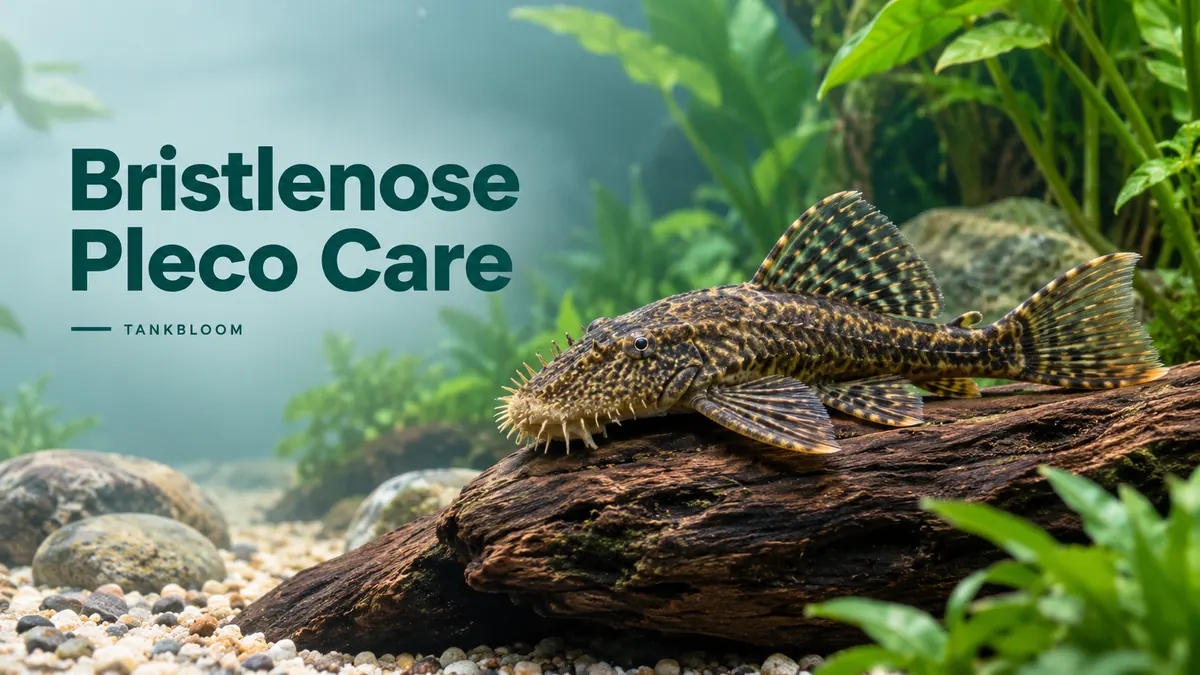
The bristlenose pleco is a popular freshwater aquarium fish known for its distinctive facial bristles, armored body, and natural grazing behavior. Compared with many larger plecos, it is a more manageable choice for home aquariums, but it still needs appropriate space, stable water quality, a varied diet, and suitable places to hide.
Successful bristlenose pleco care starts with planning for the adult fish rather than relying on its reputation as an algae eater. These bottom-dwelling catfish produce waste, may defend their preferred shelters, and can become underfed when aquarists assume that naturally occurring algae provides everything they need. A suitable aquarium brings together adequate floor space, biological filtration, shelter, and regular feeding.
Key Takeaways
- Plan for adult size: Many commonly sold bristlenose plecos reach approximately 4–6 inches, although size varies.
- Choose a suitable aquarium: A 20-gallon long tank is a practical starting point for many single-fish setups.
- Maintain stable water: Use established biological filtration and aim for 0 ppm ammonia and nitrite.
- Feed a varied diet: Algae and biofilm should not be the only food sources.
- Provide shelter: Suitable caves, driftwood, and other structures support natural behavior.
- Think long term: Plan for adult requirements and several years of care.
What Is a Bristlenose Pleco?

The bristlenose pleco is a freshwater suckermouth catfish associated with the genus Ancistrus and the armored catfish family Loricariidae. It uses its specialized mouth to attach to surfaces and graze on algae, biofilm, and other food material.
Its flattened body, armored plates, and distinctive snout make it easy to recognize. Mature males typically develop prominent fleshy bristles across the snout, sometimes extending farther up the head. Females generally have fewer or smaller bristles, especially when compared with mature males.
One important identification detail is that bristlenose pleco is a common trade name, not a guarantee of one precisely identified species. Several Ancistrus species and selectively bred varieties are sold under similar names. Unless the fish has been reliably identified, care recommendations should be treated as general guidance for commonly kept bristlenose forms rather than as species-specific rules.
Bristlenose plecos are bottom-oriented fish, but they do not remain exclusively on the substrate. They may attach to driftwood, rocks, aquarium glass, and other surfaces while grazing or resting.
Common Bristlenose Pleco Varieties
Aquarium shops commonly offer several color and fin varieties:
- Standard brown: Usually mottled brown or gray with lighter markings.
- Albino: Pale cream or yellowish coloration, often with pink or reddish eyes.
- Longfin: Extended fins that create a more flowing appearance.
- Calico: Irregular patches or mixtures of contrasting colors.
- Super red: A selectively bred orange-red color form.
These are common trade descriptions, and their use can vary between sellers. Color and fin differences alone do not establish a different species. Most commonly sold varieties have broadly similar basic care needs, although fin length, individual condition, and the fish’s exact identity can affect practical husbandry decisions.
How Big Do Bristlenose Plecos Get, and How Long Do They Live?
Many commonly sold bristlenose plecos reach approximately 4–6 inches (10–15 cm) as adults. Actual size varies with species, genetics, and individual growth, so this range should not be treated as a universal maximum.
Their relatively manageable size is one reason aquarists consider them instead of larger plecos. Nevertheless, a fish that looks small in a store can become substantially larger as it matures. Its adult body size, bottom-dwelling behavior, and waste production all matter when planning an aquarium.
A lifespan of around 5–10 years is commonly reported in aquarium care references, with some individuals reportedly living longer. Treat this as an approximate planning range rather than a guarantee. Lifespan estimates vary, and a common trade name may cover more than one fish form.
| Care factor | Practical expectation |
|---|---|
| Adult size | Often around 4–6 inches (10–15 cm) |
| Lifespan | Approximately 5–10 years is a commonly reported estimate |
| Growth | Plan for adult housing rather than the juvenile’s current size |
| Long-term needs | Stable water, appropriate food, shelter, filtration, and maintenance |
The most useful approach is to plan for the adult fish from the beginning. An aquarium that seems spacious for a small juvenile may offer insufficient bottom area or shelter once the fish matures or additional fish are introduced.
What Size Tank Does a Bristlenose Pleco Need?
This is a practical recommendation rather than a universal biological minimum. Some specialist species profiles list a footprint of approximately 24 × 12 inches (60 × 30 cm) as sufficient for a single specimen of the common trade form. That reference should not automatically be applied to every species, community setup, or stocking plan.

Why Aquarium Footprint Matters
Bristlenose plecos spend much of their time grazing, resting, and sheltering near surfaces. Consequently, the usable bottom area matters alongside the aquarium’s total water volume.
A long, reasonably wide aquarium generally provides more useful floor space than a tall, narrow tank with the same nominal capacity. More floor area also makes it easier to position driftwood, provide separate retreats, and reduce competition over preferred shelters.
If you need to calculate the tank’s volume from its measurements, the Aquarium Calculator can help; remember that volume alone does not establish whether the footprint is suitable.
When evaluating an aquarium, consider:
- The tank’s length and width, not just its gallon rating.
- The adult size and number of other fish.
- Whether other bottom-dwelling species will compete for food or shelter.
- How much usable space is occupied by hardscape and equipment.
- Whether the filter can process the aquarium’s waste load effectively.
A larger tank does not automatically make every combination suitable, but it can provide more room to arrange the habitat and maintain stable water quality.
Essential Aquarium Setup
Reliable filtration: Choose a filter with enough biological capacity for the aquarium’s stocking level. Provide good oxygenation and appropriate water movement without creating conditions that prevent the fish from using its preferred resting areas.
Caves and retreats: Provide safe hiding places with entrances large enough for the fish to use comfortably. Multiple shelters can help reduce competition when other bottom-dwelling fish are present.
Driftwood and grazing surfaces: Aquarium-safe driftwood and smooth hardscape create surfaces for biofilm to develop and provide natural-looking cover. Wood can be a useful part of the habitat, but it should not replace a complete diet.
Suitable substrate: Sand or smooth, rounded gravel can work well. Avoid sharp decorations and unstable structures that could injure the fish or collapse.
Open floor space: Leave room for the pleco to move between grazing areas and retreats. Filling every available area with ornaments can reduce the habitat’s practical usefulness.
Before adding a bristlenose pleco, make sure the aquarium is fully cycled and the biological filter is functioning. A mature, stable aquarium is preferable to a newly filled tank that has not yet developed sufficient biological filtration.
What Water Parameters Does a Bristlenose Pleco Need?
Bristlenose plecos need clean, oxygenated freshwater with stable conditions. The ranges below are a working reference for the commonly sold bristlenose trade form, not universal targets for every Ancistrus species. If the fish has been reliably identified, prioritize species-specific requirements.
| Water measurement | Working guidance | What matters most |
|---|---|---|
| Temperature | About 70–79°F (21–26°C) | Keep it stable and appropriate for the identified fish |
| pH | Approximately 5.5–7.5 in the cited trade-form profile | Avoid abrupt changes or repeated adjustments to chase a number |
| General hardness (GH) | Approximately 1–15 dGH in the cited trade-form profile | Consider the fish’s identity and established water conditions |
| Ammonia | 0 ppm | Detectable ammonia requires prompt attention |
| Nitrite | 0 ppm | Detectable nitrite indicates a water-quality problem |
| Nitrate | Keep low and monitor its trend | Control accumulation through maintenance and appropriate stocking |
Temperature, pH, and Hardness
Use a reliable thermometer to monitor temperature. If a heater is needed, choose one appropriate for the aquarium’s water volume and room conditions. The Aquarium Heater Calculator can help estimate a suitable heater size for your setup.
Do not repeatedly adjust pH just to reach an exact number if the aquarium is already stable and the fish is suited to those conditions. Sudden changes can be more harmful than a small difference from a generic target.
General hardness describes the concentration of dissolved minerals, mainly calcium and magnesium, in the water. If the fish’s exact species is known, use species-specific guidance to assess whether the aquarium’s hardness is suitable. Do not interpret a broad range as a requirement to aim for its midpoint.
Filtration and the Nitrogen Cycle
A biological filter supports beneficial microorganisms that process toxic fish waste. The aquarium should be cycled before the pleco is introduced, and testing should confirm that ammonia and nitrite remain at 0 ppm.
Bristlenose plecos are not exempt from water-quality problems simply because they are often described as hardy. They produce waste, and an aquarium with insufficient biological filtration can deteriorate even when the fish initially appears active.
Monitor nitrate, remove accumulated debris, and perform partial water changes as needed. The appropriate schedule depends on stocking, feeding, filtration, plants, and test results rather than a universal percentage that fits every aquarium.
What Do Bristlenose Plecos Eat?
These fish are best approached as omnivorous grazers with a substantial plant-based component to their diet. Offer appropriate prepared foods and supplement them with suitable vegetables and occasional alternative foods.
| Food category | Role in the diet | Practical guidance |
|---|---|---|
| Sinking algae wafers or suitable bottom-feeder foods | Convenient prepared food | Choose a nutritionally appropriate product and follow its feeding guidance |
| Blanched zucchini or other suitable vegetables | Plant-based variety | Offer small portions and remove leftovers |
| Other suitable leafy greens | Additional dietary variety | Introduce modest portions and observe acceptance |
| Appropriate protein-containing foods | Dietary variety | Use as part of a varied diet rather than relying exclusively on rich foods |
| Natural algae and biofilm | Natural grazing material | Useful, but not a dependable complete diet on its own |

How Often Should You Feed a Bristlenose Pleco?
Offer small, appropriate portions and observe whether the fish actually eats them. The amount and frequency depend on its size, the prepared food, natural grazing opportunities, and the presence of competing fish.
A small feeding of suitable prepared food each day can be a practical starting routine for many setups, with vegetable or other food variety introduced as appropriate. This is not a fixed prescription for every aquarium; adjust according to the product’s instructions, the fish’s condition, available grazing, and how much food remains uneaten.
In community tanks, faster fish may consume food before the pleco reaches it. Feeding near a sheltered area or when competition is lower can help ensure the pleco gets its share.
Remove uneaten food before it decomposes and contributes to the aquarium’s waste load. If the fish appears underfed, first check whether the food is reaching it, whether the diet is suitable, and whether water quality is stable.
Do Bristlenose Plecos Eat All Aquarium Algae?
No. They graze on certain algae and biofilm, but they should not be expected to eliminate every algae type or solve the underlying cause of an algae problem.
Algae growth can be influenced by lighting, nutrients, feeding, maintenance, and the aquarium’s biological balance. Adding a pleco does not replace appropriate cleaning, water changes, or correcting an excessive-nutrient or lighting-related algae problem.
Driftwood is useful for shelter and grazing surfaces, but claims about its exact nutritional necessity should not be generalized across every fish sold under the bristlenose name. Provide a complete, appropriate diet regardless of how much wood or algae is present.
What Is a Bristlenose Pleco’s Behavior Like?
Bristlenose plecos are bottom-oriented fish that spend time grazing, resting against surfaces, and sheltering in caves or beneath driftwood. They may become more active around dusk or during quieter periods, although activity patterns vary among individuals and aquarium conditions.
A fish hiding during the day is not necessarily unhealthy. A sheltered resting place is a normal part of its habitat. However, persistent hiding accompanied by a loss of appetite, rapid breathing, visible injury, or a sudden change in activity deserves attention.
Territorial behavior is especially important when keeping mature males together. A male may defend a preferred cave or spawning site against another pleco. Competition can result in repeated chasing, injuries, and restricted access to shelter or food.
Provide suitable retreats when appropriate, monitor interactions, and be prepared to separate fish if aggression persists. Adding more decorations alone will not necessarily resolve a serious compatibility problem.
Which Fish Can Live With a Bristlenose Pleco?
Evaluate potential tank mates individually. Consider adult size, temperament, temperature requirements, feeding habits, and whether the fish compete for the same bottom area.
Before adding another species, ask:
- Will both animals have enough room as adults?
- Do they need compatible water conditions?
- Could one fish injure, harass, or outcompete the other?
- Are there enough retreats and feeding areas?
- Can the aquarium’s filtration and maintenance routine support the additional waste?
Other bottom-dwelling fish require particular consideration because they may use the same substrate area or compete for food. Corydoras, for example, have different foraging behaviors, but the shared bottom area still needs to be spacious enough for both groups.
Keeping multiple bristlenose plecos also requires planning. A male and female may breed, while mature males may compete for caves. Sexing young fish can be difficult, so do not buy several juveniles on the assumption that they will form a compatible group.
A species being described as peaceful is only one part of the decision. Aquarium dimensions, shelter, stocking, and individual behavior determine whether a specific combination is suitable.
How Can You Tell Male and Female Bristlenose Plecos Apart?

The most recognizable difference between mature male and female bristlenose plecos is the development of facial bristles. Males usually develop more prominent growths that can extend farther up the snout, while females tend to have fewer or smaller bristles, often concentrated around the edge of the mouth.
| Feature | Mature male | Mature female |
|---|---|---|
| Snout bristles | Usually more prominent and may extend farther up the head | Usually fewer or smaller, often concentrated around the mouth edge |
| Identification | Often easier to identify once mature | Can be harder to distinguish, particularly in younger fish |
| Breeding behavior | May defend a preferred cave or spawning site | May lay eggs when paired with a mature male under suitable conditions |
These are typical differences rather than an infallible test. Age, individual variation, and the particular bristlenose form affect how obvious the features are. Young fish may not have developed enough bristles to be sexed confidently.
If you intend to keep more than one pleco, plan the aquarium before purchasing them. An incorrect sex identification can lead to unexpected breeding or territorial conflict.
Can Bristlenose Plecos Breed in a Home Aquarium?
Bristlenose plecos can breed in home aquariums when suitable conditions are present. Many commonly kept forms use caves or sheltered cavities as spawning sites, and the male generally guards the eggs in the cave.
Breeding requires more than placing a male and female together. The fish need suitable adult housing, stable water conditions, appropriate food, and a secure spawning area. The resulting offspring also need adequate space and a plan for feeding and future placement.
Before attempting to breed them, consider whether the aquarium can support the adults and any surviving juveniles. A successful spawn can produce more fish than a small home aquarium can accommodate long term.
If breeding is not your goal, do not assume a male-female pairing is automatically preferable to keeping a single fish. A solitary bristlenose pleco does not need a companion of its own species simply for social reasons.
Common Bristlenose Pleco Care Mistakes to Avoid
Several preventable mistakes can undermine an otherwise suitable aquarium:
- Choosing a tank based only on current size: Plan for the adult fish and its long-term needs.
- Assuming algae is enough food: Provide suitable prepared foods and dietary variety.
- Underestimating waste production: Match filtration and maintenance to the actual stocking and feeding routine.
- Providing too few retreats: Include appropriate hiding places, especially when territorial competition is possible.
- Ignoring water testing: Test during aquarium establishment, after significant changes, and whenever behavior suggests a problem.
- Treating the pleco as a cleaning tool: Grazing does not eliminate the need for maintenance or control of excess nutrients and lighting.
- Assuming every bristlenose is the same species: Verify identification when possible and avoid applying a highly specific recommendation to an unidentified fish without qualification.
Is a Bristlenose Pleco Right for Your Aquarium?
A bristlenose pleco can be a rewarding addition to a freshwater aquarium if you can meet its needs throughout adulthood. Before purchasing one, consider whether your setup can provide:
Before You Choose a Bristlenose Pleco
- An appropriately sized aquarium with adequate bottom space.
- A fully cycled filter and stable water quality.
- A varied, suitable diet rather than algae alone.
- Safe driftwood, grazing surfaces, and suitable hiding places.
- Compatible tank mates and a plan for territorial behavior.
- Time for regular maintenance and long-term care.
When choosing a fish, look for an individual with a proportionate body, intact fins, and normal swimming or attachment behavior. Avoid fish with obvious injuries, persistent abnormal breathing, or a severely sunken appearance. These signs warrant caution but do not establish a specific diagnosis on their own.
Quarantine new fish in a suitable separate setup when possible, and confirm that they are feeding and settling normally before introducing them to an established community aquarium.
The best bristlenose pleco setup is not simply the one with the most algae or the largest filter. It is an aquarium where space, shelter, food, water quality, and stocking work together to meet the fish’s needs.
Sources and Further Reading
Species identification, aquarium requirements, water parameters, diet, behavior, and breeding information for the commonly traded bristlenose form.

Ethan Caldwell
Freshwater Fish Care Writer
Ethan writes about freshwater fish care, aquarium setup, water quality, and choosing compatible tank mates.
View Author Profile
1 Comment
Pingback: 10 Best Aquarium Fish for Beginners: Freshwater Guide - tankbloom.com