



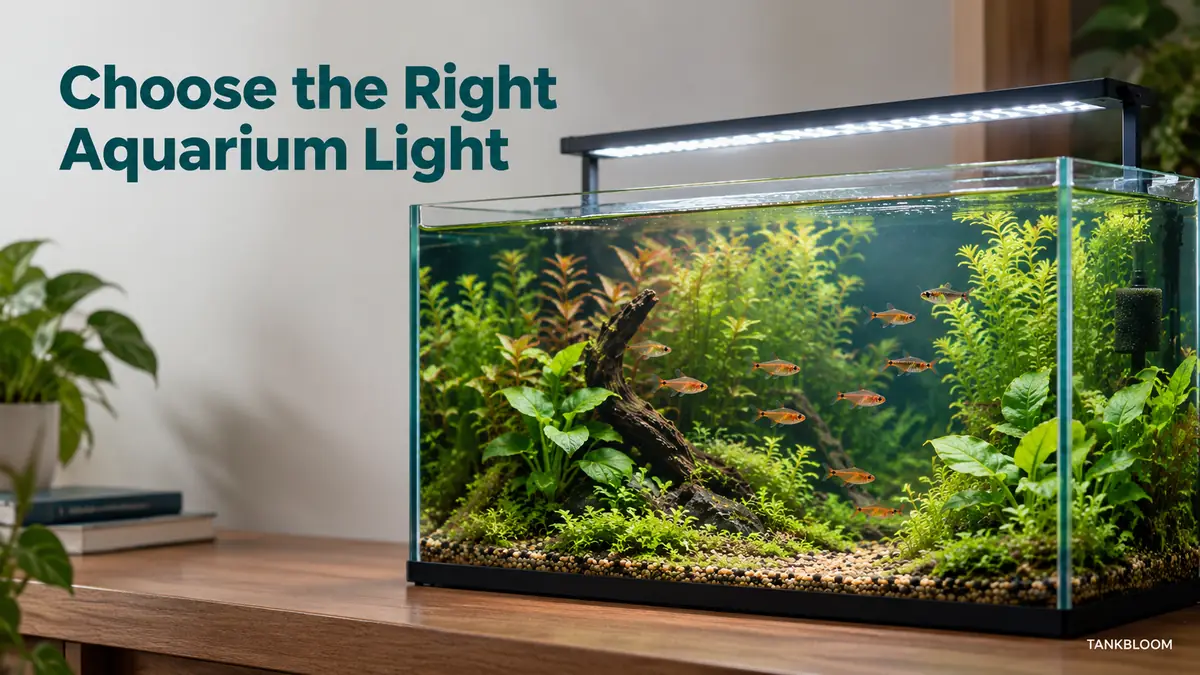
Choosing the right aquarium light depends on what lives in your tank, how deep the aquarium is, and whether you want to grow live plants. A basic LED fixture may be enough for a fish-only aquarium, while a planted tank may need more carefully matched light intensity and coverage. Before buying, consider the fixture’s output, spectrum, distribution, and controls—not just its wattage or appearance.
Key Takeaways
- Fish-only aquariums: Prioritize comfortable viewing, suitable coverage, and a consistent day–night cycle.
- Planted aquariums: Match light intensity and distribution to the plants you want to grow.
- Before buying: Check tank dimensions, water depth, coverage, mounting options, and fixture compatibility.
- Lighting schedule: Start with a manageable daily photoperiod and adjust it gradually as your aquarium develops.
- Algae problems: Lighting can contribute to algae growth, but nutrients, plant health, and other conditions matter too.
How to Choose the Right Aquarium Light
Start by identifying your aquarium’s purpose. Then consider the tank’s dimensions, the needs of its inhabitants, and how much light must reach the areas where plants will grow.
Choose a Light Based on Your Aquarium Type
Different aquariums need different lighting setups. A tank designed primarily to display fish does not require the same light output as a densely planted aquascape.
| Aquarium Type | Main Priority | What to Look For |
|---|---|---|
| Fish-only | Clear viewing and a regular day–night cycle | Basic LED, suitable coverage, and a timer |
| Low-tech planted | Supporting undemanding aquatic plants | Appropriate output, even coverage, and adjustable brightness |
| Demanding planted | Meeting the needs of more light-demanding plants | Suitable PPFD, reliable coverage, and adjustable output |
| Mixed community | Balancing plant growth with fish behavior | Appropriate intensity, shaded areas, and consistent scheduling |
These categories are starting points, not fixed rules. Plant species, aquarium depth, floating plants, substrate, nutrients, and carbon availability can all affect the lighting requirements.
For example, Java fern, Anubias, and many mosses can grow in relatively modest lighting. A planted aquarium with carpeting plants may need a different setup, particularly when the goal is dense, compact growth.
Match the Light to Your Tank’s Length, Depth, and Coverage
Aquarium capacity alone cannot tell you which light to buy. Two tanks with the same water volume can have different dimensions and very different lighting needs.

Consider three factors:
- Length: The fixture should illuminate the areas where you want plants to grow rather than leaving large sections dim.
- Depth: Light generally becomes less available as it travels farther from the source, so deeper aquariums can require more capable lighting.
- Distribution: A bright spot directly beneath a fixture does not guarantee even coverage at the edges or near the substrate.
Floating plants, tall decorations, driftwood, and dense foliage can also create shade. A fixture that works well in a shallow tank may not deliver the same results in a deeper aquarium.
When comparing lights, look for performance information at a distance similar to your actual plant positions. A brightness claim without measurement distance or coverage details may not tell you how well the fixture will perform in your aquarium.
Aquarium Light Buying Checklist
- Identify whether your aquarium is fish-only, low-tech planted, or more demanding.
- Measure the tank’s length and depth.
- Identify which plants need light and where they will grow.
- Check fixture coverage, mounting, and compatibility with your lid or aquarium rim.
- Compare useful specifications, controls, and overall cost.
- Review the manufacturer’s installation and moisture-protection instructions.
The goal is not to buy the brightest light available. It is to choose a fixture that meets your aquarium’s actual needs without unnecessary expense.
2. What Are the Different Types of Aquarium Lights?
LED fixtures are a practical starting point for most modern freshwater aquariums. However, the best format depends on your tank design, lighting needs, and whether you are replacing an existing fixture.
LED Aquarium Lights
LED aquarium lights are available in a wide range of sizes and output levels. Many models offer adjustable brightness, timers, or programmable settings.
Potential advantages include:
- A choice of output levels for fish-only and planted aquariums.
- Dimming and scheduling options on many models.
- Slim designs that fit a variety of aquarium sizes.
- The potential for efficient operation, depending on the fixture and the alternative being compared.
Not all LED lights provide the same performance. A decorative light designed mainly for viewing fish is not automatically suitable for a demanding planted aquarium.
Check the fixture’s coverage and available performance data rather than assuming that all LEDs are interchangeable.
Integrated Hood Lights and Clip-On Fixtures
Integrated hood lights are convenient for standard aquariums because the fixture is designed to fit a particular hood or lid.
Clip-on and rim-mounted fixtures offer more flexibility and can suit nano aquariums, open-top tanks, and smaller planted setups.
Before choosing either type, check that it fits securely, covers the required area, and is designed for the moisture and splash conditions around your aquarium.
Fluorescent and Older Lighting Options
Fluorescent fixtures may still be useful when maintaining an older aquarium setup. Their suitability depends on the fixture, bulb type, output, and availability of replacements.
Incandescent lighting is less common in modern aquarium setups because it is generally less energy-efficient than comparable modern options.
If you are replacing an older fixture, compare coverage, useful light output, compatibility, and energy use instead of assuming that matching the previous wattage will produce the same result.
3. Aquarium Light Specifications Explained
The most useful specifications depend on what you want the light to accomplish. For a fish-only aquarium, comfortable viewing may be the main concern. For planted tanks, the light reaching the leaves becomes more important.
| Specification | What It Tells You | What It Does Not Tell You |
|---|---|---|
| PAR | The wavelength range commonly associated with photosynthesis | How much light reaches a particular plant |
| PPFD | Photon flux within the PAR range reaching an area per second | Whether every plant will thrive under those conditions |
| Lumens | Visible light output weighted to human visual sensitivity | Direct plant-growing performance |
| Watts | Electrical power consumed | How much useful light reaches the plants |
| Kelvin (K) | Correlated color temperature or general appearance | Light intensity or plant suitability |
| Spectrum | How light energy is distributed across wavelengths | Whether sufficient light reaches plants at their growing positions |
PAR and PPFD: Understanding Light for Plants
PAR stands for photosynthetically active radiation. It describes the wavelength range commonly considered relevant to photosynthesis, generally 400–700 nanometers.
PPFD stands for photosynthetic photon flux density. It measures how many photons in that range reach a given area per second, commonly expressed in micromoles per square meter per second (µmol/m²/s).
In practical terms, PPFD helps you understand how much photosynthetically active light reaches a particular location in your aquarium.
Light availability changes with distance, fixture design, water depth, and coverage. A measurement directly beneath a light may differ substantially from one near the aquarium’s corners or substrate. This is why plant position matters when evaluating lighting performance.

Tropica’s aquarium lighting guide provides additional guidance on light requirements and their role in planted aquariums.
You do not necessarily need a PAR meter for a beginner aquarium. It becomes more useful when comparing fixtures, growing demanding plants, or investigating differences in growth across the same tank.
Lumens and Watts: What They Tell You
Lumens measure visible light output according to how the human eye perceives different wavelengths. Watts measure electrical power consumption.
Neither value alone tells you exactly how well a fixture will support aquatic plants.
A higher-wattage light is not automatically better than a lower-wattage LED. Likewise, a fixture that appears brighter to your eyes may not deliver the right amount of usable light to plants near the substrate.
For a planted aquarium, prioritize plant requirements, coverage, and reliable performance information. For a fish-only aquarium, you may not need detailed plant-light measurements at all.
Kelvin, Spectrum, and Full-Spectrum Lighting
Kelvin describes a light’s correlated color temperature. Lower values generally appear warmer or more yellow, while higher values tend to appear cooler or bluer.
Spectrum describes how the light’s energy is distributed across different wavelengths. A fixture marketed as full spectrum may provide a broad range of visible light, but the label alone does not guarantee adequate output for a demanding planted aquarium.
Choose a color appearance you like, then evaluate the fixture’s performance separately. The best-looking light is not necessarily the most suitable for every plant.
4. How Long Should an Aquarium Light Be On Each Day?
There is no single lighting duration that works for every aquarium. The appropriate schedule depends on plant requirements, light intensity, tank maturity, and the balance of the aquarium’s other growing conditions.
For a newly planted freshwater aquarium, starting at around six hours of light per day is a reasonable approach. Observe plant growth and algae before extending the schedule. This is a starting point, not a universal rule.
Some established planted setups may benefit from longer periods, but more hours do not automatically produce healthier plants.
Set a Consistent Lighting Schedule
A timer makes the schedule predictable and prevents accidental extra hours of illumination.
To establish a routine:
- Choose a manageable daily lighting period.
- Keep the start and end times consistent.
- Observe plant growth and algae over time.
- Adjust one factor at a time.
- Allow enough time to evaluate the response before making another change.
Avoid repeatedly changing brightness and duration over a few days. Plant growth responds to several environmental factors, and rapid changes can make it harder to identify what is helping or causing a problem.
Should Aquarium Lights Be Turned Off at Night?
Yes. A regular period of darkness should be part of a normal freshwater aquarium’s schedule. Many aquarium fish benefit from a predictable day–night cycle, and continuous bright illumination is unnecessary for ordinary freshwater aquarium care.
A dedicated blue or moonlight setting is optional rather than essential. If you use one, keep it dim and consider the needs and behavior of the fish in your tank.
Are Timers and Sunrise/Sunset Features Worth Using?
A basic timer is useful because it provides consistent scheduling without relying on memory.
Sunrise and sunset simulations, programmable colors, and app controls can add convenience or visual appeal, but they are optional. For many aquariums, a reliable fixture with suitable output and a consistent schedule is more valuable than a long list of advanced controls.
Can Aquarium Lighting Cause Algae or Poor Plant Growth?
Yes, inappropriate lighting can contribute to algae problems or poor plant growth. However, lighting is only one part of the aquarium environment. Nutrient availability, carbon dioxide, water conditions, plant species, and tank maturity can also affect the outcome.
Too Much Light and Algae Growth
Excessive intensity or an overly long lighting period can contribute to an imbalance, particularly when plants are not growing well enough to use the available resources.
However, algae does not automatically mean that your light is too strong. Before changing the fixture, consider:
- How long the light is on each day.
- Whether the brightness is appropriate for your plants.
- Whether plants are growing actively or struggling.
- Whether nutrients are available in suitable amounts.
- Whether the aquarium is newly established or undergoing other changes.
A planted tank with stronger lighting can still experience algae problems if its other conditions are poorly balanced.
Why Are My Aquarium Plants Not Growing Well?
Different symptoms can point toward different causes. Yellow leaves, stretched stems, slow growth, and deteriorating older leaves do not all indicate the same problem.
Consider the plant’s location and growth pattern before changing anything.
- Plants stretching toward the surface: Check light availability and whether nearby plants or floating foliage create shade.
- Carpeting plants growing poorly: Check the species’ requirements, light reaching the substrate, and whether carbon and nutrients are adequate.
- Yellowing or deteriorating leaves: Consider nutrient availability, water conditions, and whether the plant is adapting to a new environment.
- Different growth across the tank: Compare coverage, depth, and shading before assuming the entire fixture is inadequate.
These are clues, not definitive diagnoses. The same symptom can have several causes, so consider the plant species and overall aquarium conditions before deciding what to change.
How to Troubleshoot Lighting Problems Before Replacing Your Light
Use a structured approach rather than buying a new fixture immediately.
| Symptom | What to Check First | Practical Next Step |
|---|---|---|
| Algae is increasing | Lighting duration, intensity, nutrients, and plant growth | Adjust one factor at a time and observe the response. |
| Plants are struggling | Species requirements, light reaching leaves, nutrients, and carbon availability | Identify the likely limiting condition before changing the light. |
| Dark areas appear in the tank | Fixture placement, light spread, and obstructions | Reposition the light or assess whether coverage is sufficient. |
| Fish avoid a brightly lit area | Species behavior, available shade, and other stressors | Provide suitable cover and observe behavior. |
If algae is the main concern, try adjusting the schedule or dimming the fixture if possible. Keep other conditions stable while assessing the response. If the problem continues, examine nutrient management, plant health, and water conditions rather than repeatedly reducing the light.
6. When Is a Basic Aquarium Light Enough, and When Should You Spend More?
Spend more on an aquarium light when the additional performance or features solve a real problem in your setup. A premium fixture is not automatically necessary for a healthy aquarium.
A basic light may be enough if you keep a fish-only aquarium, want attractive viewing, or grow undemanding plants with modest lighting requirements.
A more capable fixture may be worthwhile if you want to grow demanding plants, have a deep aquarium, need better coverage near the substrate, or want adjustable output as your plants establish.
| Feature | When It Is Useful |
|---|---|
| Dimming | Adjusting output to suit plants or reduce excessive intensity |
| Built-in timer | Maintaining a consistent schedule without a separate timer |
| Programmable controls | Managing different settings or lighting periods |
| Better coverage | Addressing dark edges or demanding plants at depth |
| Reliable performance data | Comparing fixtures for a planted aquarium with specific requirements |
A useful rule is to pay for performance before convenience. A simple fixture that provides suitable light across your aquarium can be a better choice than an expensive model with features you will rarely use.
Reef aquariums have different coral-lighting requirements, so this freshwater-focused guide should not be used as a complete reef-lighting specification.
7. How to Install, Position, and Maintain Your Aquarium Light
Correct installation helps achieve useful coverage while protecting the fixture and surrounding equipment.
Position the Light for Appropriate Coverage
Place the fixture according to its design and the manufacturer’s instructions. Check whether it illuminates the planted areas, whether tall decorations create shadows, and whether the edges receive enough light for the plants placed there.
If you have demanding plants, consider their actual location rather than judging the setup only by how bright it looks from above.
Keep the Fixture Clean and Follow Its Instructions
Dust, water spots, and residue can affect the fixture’s condition and, depending on their location, light transmission. Clean it using the method approved by the manufacturer.
Do not immerse a fixture unless it is specifically rated for that use. Follow the instructions for mounting, ventilation, cleaning, and replacement parts.
Follow Basic Electrical Safety Precautions
Keep plugs and electrical connections dry, use equipment suitable for aquarium conditions, and follow the manufacturer’s instructions. A drip loop helps prevent water from travelling along a power cord into an outlet or connection.
Disconnect equipment safely before cleaning or servicing it. Never handle electrical plugs with wet hands.
8. Frequently Asked Questions About Aquarium Lights
Can You Use a Regular LED Light for an Aquarium?
Potentially, yes. A regular LED may be suitable for viewing a fish-only aquarium if the fixture is appropriate for the environment and provides the coverage you want. For live plants, suitability depends on the amount and distribution of usable light reaching the plants.
Can Direct Sunlight Replace an Aquarium Light?
Direct sunlight is not a reliable substitute for controlled aquarium lighting. Its intensity and duration vary with the season, weather, and window position. It can also contribute to unwanted temperature changes and algae problems. A suitable aquarium light gives you more control over the daily schedule.
Can an Aquarium Light Heat the Water?
Yes, depending on the fixture, its placement, the aquarium cover, and the surrounding conditions. Many LED lights have different heat profiles from older lighting technologies, but their effect on water temperature is not always zero. Monitor temperature if the aquarium is in a warm room or the fixture is close to the water.
Can Aquarium Lights Be Too Bright for Fish?
They can be inappropriate for some fish if the lighting is intense and the aquarium offers nowhere to retreat. Species behavior, habitat, plant cover, and the overall environment matter. Provide suitable shade and hiding places where appropriate, and observe whether the fish behave normally.
Final Thoughts
Choosing an aquarium light becomes easier when you start with the needs of your tank rather than the number of features on a product page. For fish-only aquariums, reliable viewing light and a consistent day–night cycle may be enough. For planted tanks, light availability, coverage, and plant requirements become more important.
Treat lighting as part of the whole aquarium system. If plants struggle or algae increases, check the schedule, intensity, coverage, nutrients, and other growing conditions before replacing the fixture. A well-matched light, used consistently and adjusted thoughtfully, is more useful than simply choosing the brightest option.

9 Comments
Pingback: Aquarium Fertilizer: How to Choose and Use It for Healthy Plants - tankbloom.com
Pingback: Aquarium CO₂ Systems: Setup, Types & Safety | TankBloom - tankbloom.com
Pingback: Why Are My Aquarium Plants Melting? Causes and Fixes - tankbloom.com
Pingback: Types of Aquarium Algae: How to Identify Them - tankbloom.com
Pingback: Cherry Shrimp: Tank, Water Parameters, Feeding & Breeding - tankbloom.com
Pingback: Java Fern: Planting, Growing, and Propagation - tankbloom.com
Pingback: Planted Aquarium for Beginners: Step-by-Step Setup Guide - tankbloom.com
Pingback: Why is my fish tank cloudy? Causes and safe fixes - tankbloom.com
Pingback: How to Get Rid of Algae in a Fish Tank - tankbloom.com