



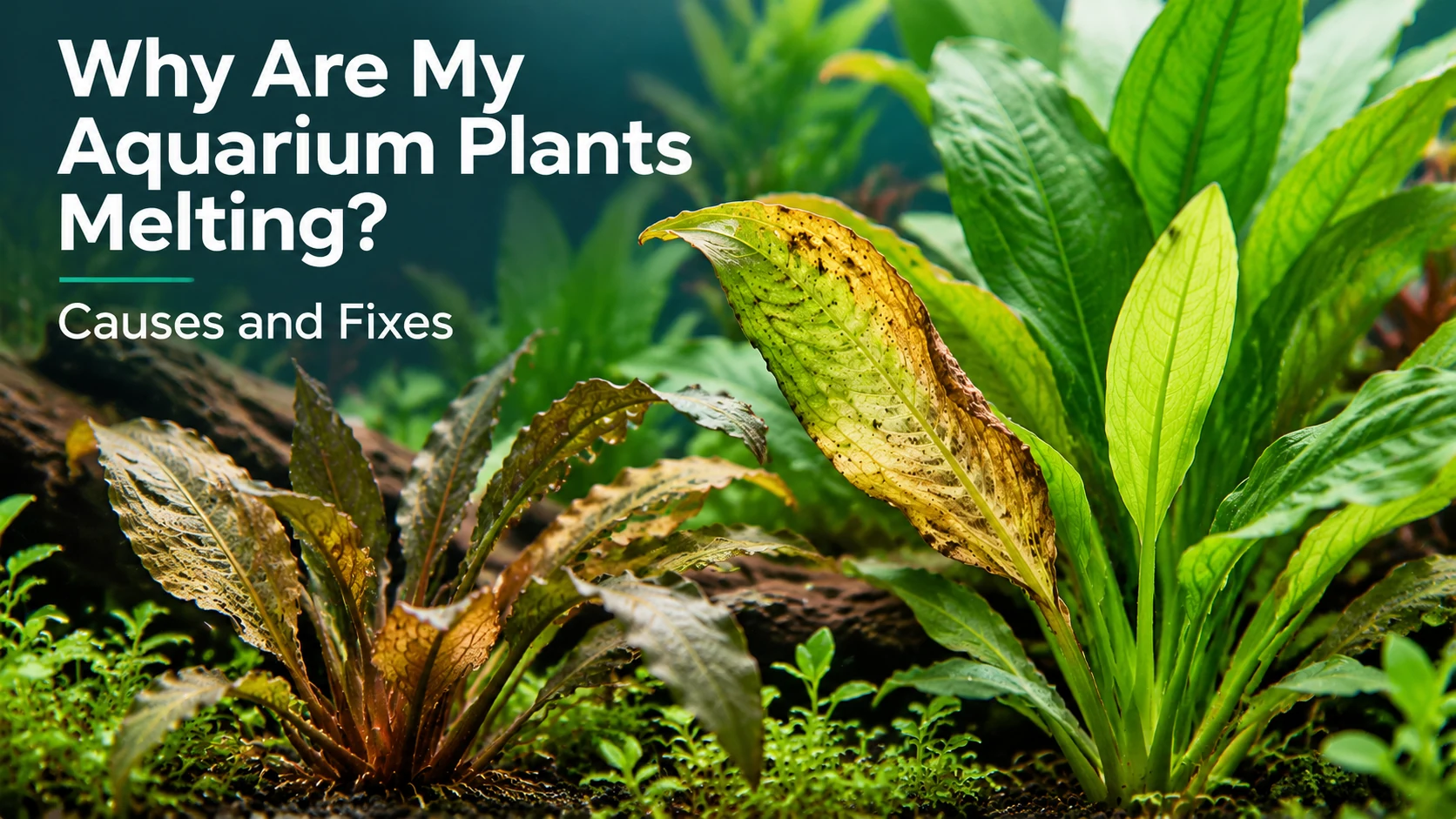
Seeing your aquarium plants turn brown, become transparent, or fall apart can be worrying. But melting does not always mean a plant is dying. Some plants lose their old leaves when they adjust to life underwater. Others struggle because of poor planting, unsuitable lighting, or changing water conditions.
Before pulling a plant out or adding more fertilizer, look at when the problem started and which parts are affected. A newly planted Cryptocoryne losing old leaves is different from an established plant whose stem or rhizome is rotting.
Aquarium Plant Melting: Symptoms and Possible Causes
Use this chart to narrow down what might be happening in your aquarium.
| Symptom | Possible explanation | What to check |
|---|---|---|
| Older leaves deteriorate after planting | Adjustment to underwater growth | Look for healthy new leaves and an intact growing structure. |
| Leaves turn translucent or soft | Melt, damaged tissue, or possible rot | Check whether damage extends beyond the leaves. |
| An established plant suddenly declines | Environmental change or physical damage | Review recent maintenance, lighting, and water conditions. |
| Leaves disappear, but the base remains firm | Recovery may still be possible | Preserve healthy tissue and monitor new growth. |
| The rhizome, crown, or stem base deteriorates | Possible serious tissue damage | Inspect the affected structure and remove clearly dead material where appropriate. |
| Several plant species decline together | A shared aquarium condition may be involved | Check water quality, lighting, CO₂ if used, and nutrient supply. |
These signs help narrow down the possibilities, but none proves a specific cause on its own. A plant can lose its leaves and survive. The condition of its remaining healthy tissue matters, too.
Is It Normal for Aquarium Plants to Melt?
Yes. Melting can be part of a plant’s adjustment to a new environment, particularly after it moves from growing above water to growing underwater. However, not every plant melts after planting, and persistent damage deserves attention.
Why new aquarium plants may melt
Some aquatic plants are grown emersed, meaning their leaves develop in air rather than underwater. Once submerged, those leaves may struggle to adapt and gradually deteriorate.
The plant can then produce new leaves suited to underwater growth. This is especially familiar with Cryptocoryne plants, although the response varies between species.
Moving a plant between aquariums can also expose it to different lighting, water conditions, and planting arrangements.
Look for signs of recovery rather than judging the plant by its old leaves alone. If new leaves emerge and the plant’s base remains healthy, it may simply be adjusting. If the damage keeps spreading, investigate other causes.
When melting is a warning sign
An established plant that suddenly starts melting deserves a closer look. The same applies when several different plants begin declining around the same time.
Check the affected plant’s roots, crown, rhizome, or stem base, depending on its type. Firm, intact tissue is generally encouraging. Soft, decomposing tissue is more concerning, although its condition alone cannot tell you whether the entire plant will survive.
Think about what changed before the problem appeared. Did you move the plant, change the lighting, alter your CO₂ routine, or carry out major maintenance? These details can help you find the cause.
What Causes Aquarium Plants to Melt?
Several problems can produce similar symptoms. Start with the plant’s recent history and the location of the damage before changing your care routine.
1. Transition from emersed to submerged growth
This is a common reason newly purchased plants lose leaves. Foliage that developed above water may deteriorate after planting, even when the plant is otherwise healthy.
Cryptocoryne plants are well known for this response. Some sword plants and other aquatic species may also lose older leaves after being moved.
What to do: Remove leaves that are clearly dead or decomposing. Leave healthy tissue in place and avoid repeatedly uprooting the plant to inspect its roots.
2. Changes in water conditions
Plants can struggle after substantial changes in their environment. Water chemistry, temperature, maintenance routines, or exposure to unsuitable substances may all be relevant.
If the melting began after a water change, aquarium reset, or treatment, start by checking what changed. The timing is a useful clue, but it does not automatically prove the cause.
Check relevant water parameters and make sure replacement water and any treatments are suitable for the aquarium.
If fish or shrimp are also behaving unusually or showing signs of distress, check for a water-quality or contamination problem promptly. Do not assume it is just plant melt.
3. Incorrect planting depth
Planting mistakes can damage some species or interfere with healthy growth.
Amazon swords and many Cryptocoryne plants grow from a central crown. Their roots belong in the substrate, but the crown should remain exposed.
Anubias and Java fern are different. They grow from a thick horizontal stem called a rhizome. Their roots can sit in the substrate, but burying the rhizome can cause it to deteriorate. These plants can also be attached to rocks or driftwood.
Bulb plants have their own planting requirements, while stem plants are usually planted with their lower stem sections in the substrate.
Check the plant’s growth structure before changing its position. Correct the planting depth if necessary, but avoid repeatedly moving a plant that is already establishing itself.
4. Lighting that does not suit the plant
Too much or too little light for a particular species can interfere with healthy growth. Changing the lighting abruptly can also make an existing problem harder to diagnose.
However, damaged leaves alone do not prove that lighting is the cause.
Check your light intensity, daily lighting period, and the needs of your plants. If you recently changed the settings, consider whether the timing matches the decline. Adjust the light according to the likely problem rather than making several changes at once.
5. CO₂ problems
Carbon is essential for plant growth. In aquariums that use injected CO₂, inconsistent delivery or poor distribution can limit growth.
Not every aquarium needs injected CO₂. Many plants grow well in lower-tech setups when the lighting, nutrients, and other conditions suit their needs.
If you use injected CO₂, check the equipment, delivery schedule, and water circulation. Do not simply increase the dose. Excessive CO₂ can harm fish and other livestock.
If you do not use injected CO₂, check whether your plants are suited to your setup before considering additional equipment.
Do not increase CO₂ or fertilizer just because leaves are melting. Check the plant’s condition and the aquarium’s recent changes first. Excessive CO₂ can harm livestock, and extra fertilizer will not correct every cause of plant damage.
6. Nutrient deficiencies or imbalanced fertilization
Aquarium plants need nitrogen, phosphorus, potassium, magnesium, iron, and other nutrients. An inadequate or imbalanced supply can affect their growth and leaf health.
The difficulty is that nutrient problems can look similar to other forms of stress. Yellow leaves, holes, and brown patches do not automatically identify a particular deficiency.
Review your existing fertilizer routine and nutrient inputs before adding anything new. Consider relevant water tests and the needs of the plants you keep.
A liquid fertilizer may help when the water column lacks nutrients. Root tabs may suit plants that feed heavily through their roots. Neither is a universal cure for melting.
For help identifying possible nutrient problems, see TankBloom’s aquarium plant nutrient deficiency chart. Use it to narrow down the possibilities rather than treating leaf appearance as proof of a deficiency.
7. Physical damage or rotting tissue
Older leaves naturally deteriorate, and handling or livestock activity can damage foliage. Sometimes the problem affects only a few leaves while the rest of the plant remains healthy.
Damage to a stem or growing point is different. If the affected section can no longer support new growth, the plant may struggle to recover.
Inspect where the damage starts and how far it has spread. A few damaged leaves may need nothing more than careful trimming. Deterioration around the plant’s base deserves closer attention.
How to Stop Aquarium Plants from Melting
Once you have a likely explanation, focus on correcting that problem rather than changing everything at once.
- Inspect the damage. Check whether it affects older leaves, new growth, stems, roots, or the plant’s crown or rhizome.
- Remove dead material. Trim leaves that are fully decomposed or falling apart, but keep healthy foliage where possible.
- Check recent changes. Review planting, lighting, water conditions, maintenance, and CO₂ use.
- Correct the likely cause. Fix planting depth or adjust unsuitable growing conditions. If several species are affected, investigate the aquarium’s shared conditions.
- Review nutrients carefully. Change fertilizer only when there is a reasonable basis for doing so.
- Watch what happens next. If the damage continues, reconsider the original explanation instead of automatically adding more fertilizer or equipment.
Try not to change several major variables simultaneously. Otherwise, you may fix one problem while creating another, and it becomes harder to tell what actually helped.
Should You Remove or Trim Melting Aquarium Plants?
Not necessarily. A plant can lose many leaves and still recover if enough healthy tissue remains.
When to trim damaged leaves
Remove leaves that are completely dead, decomposing, or detaching easily. This clears away deteriorating material, but it will not correct the underlying problem.
Avoid cutting off every imperfect leaf when some foliage is still healthy.
When to inspect the plant’s base
Check the plant’s crown, rhizome, bulb, or stem base if the deterioration continues.
A firm, healthy structure is encouraging, but it does not guarantee recovery. Soft, breaking-down tissue is more concerning, especially when the damage is spreading.
Remove clearly dead material with clean tools where appropriate. Preserve healthy tissue and avoid treating every plant in the same way. A rhizome plant, a rooted rosette, a bulb plant, and a stem cutting have different growth structures.
Which Aquarium Plants Are Prone to Melting?
Some plants are particularly known for losing leaves after changes in their growing conditions. Their recovery depends on the species and the condition of the remaining plant.
Cryptocoryne and crypt melt
Cryptocoryne plants can lose many of their leaves after being moved or exposed to different growing conditions. This is commonly called crypt melt.
If the crown and roots remain healthy, leave the plant in place where practical and watch for new growth. Repeatedly moving it can add unnecessary stress.
Amazon sword and other Echinodorus plants
Amazon swords and related Echinodorus plants may lose older leaves after planting or relocation. Their roots and central crown are important to continued growth.
Keep the roots in the substrate without burying the crown. If the plant continues declining, check its planting depth and growing conditions before assuming it needs more fertilizer.
Vallisneria and stem plants
Vallisneria grows from a basal crown and can spread through runners. Stem plants grow along their stems from nodes. Their growth patterns are different, so the same damage may require different responses.
Check whether the problem affects individual leaves or extends into the stem or growing point. Preserve healthy sections where possible.
Anubias and Java fern
Anubias and Java fern grow from rhizomes. Their roots may sit in the substrate or attach to hardscape, but the rhizome should remain exposed.
If leaves deteriorate while the rhizome remains healthy, the plant may still recover. If the rhizome itself becomes soft and breaks down, inspect it carefully and remove clearly dead material where appropriate.
Will Melted Aquarium Plants Grow Back?
Some will. Recovery depends on the species, the extent of the damage, and whether viable roots and growing structures remain.
A plant may produce new leaves after losing much of its older foliage. But if its essential growing tissue has completely deteriorated, recovery may not be possible.
Look for healthy new leaves and signs that the damage has stopped spreading. Existing damaged leaves usually will not return to their original condition.
There is no single recovery timeline that applies to every plant. Some establish relatively quickly, while others take longer. If the plant continues deteriorating, investigate the cause again rather than assuming that more waiting will solve the problem.
How to Prevent Aquarium Plant Melt
A few sensible habits can reduce avoidable plant stress:
- Choose plants suited to your lighting, substrate, and maintenance routine.
- Learn how each species should be planted, especially whether its crown or rhizome needs to remain exposed.
- Handle new plants carefully and avoid unnecessary uprooting.
- Keep lighting and injected CO₂ routines appropriate for the plants you keep.
- Check water conditions when several species decline together.
- Follow a suitable fertilizer routine instead of adding supplements whenever a leaf looks unhealthy.
- Observe new growth after planting or making substantial changes to the aquarium.
The aim is not to prevent every damaged leaf. It is to provide suitable growing conditions and recognize when a plant’s decline needs attention.
Diagnose Before You Intervene
Aquarium plants melting can be part of normal adaptation, but persistent damage should not be ignored. Check the plant’s history, the affected tissue, and its growing structure before deciding what to remove or change.
Trim what is clearly dead, preserve healthy parts, and address the likely cause. You will get further by making informed changes than by repeatedly adjusting fertilizer, lighting, and CO₂ without knowing what went wrong.

4 Comments
Pingback: Planted Aquarium for Beginners: Step-by-Step Setup Guide - tankbloom.com
Pingback: Java Fern: Planting, Growing, and Propagation - tankbloom.com
Pingback: Aquarium Light: How to Choose the Right Light for Your Tank - tankbloom.com
Pingback: Aquarium Plant Deficiency Chart: Spot & Fix - tankbloom.com