



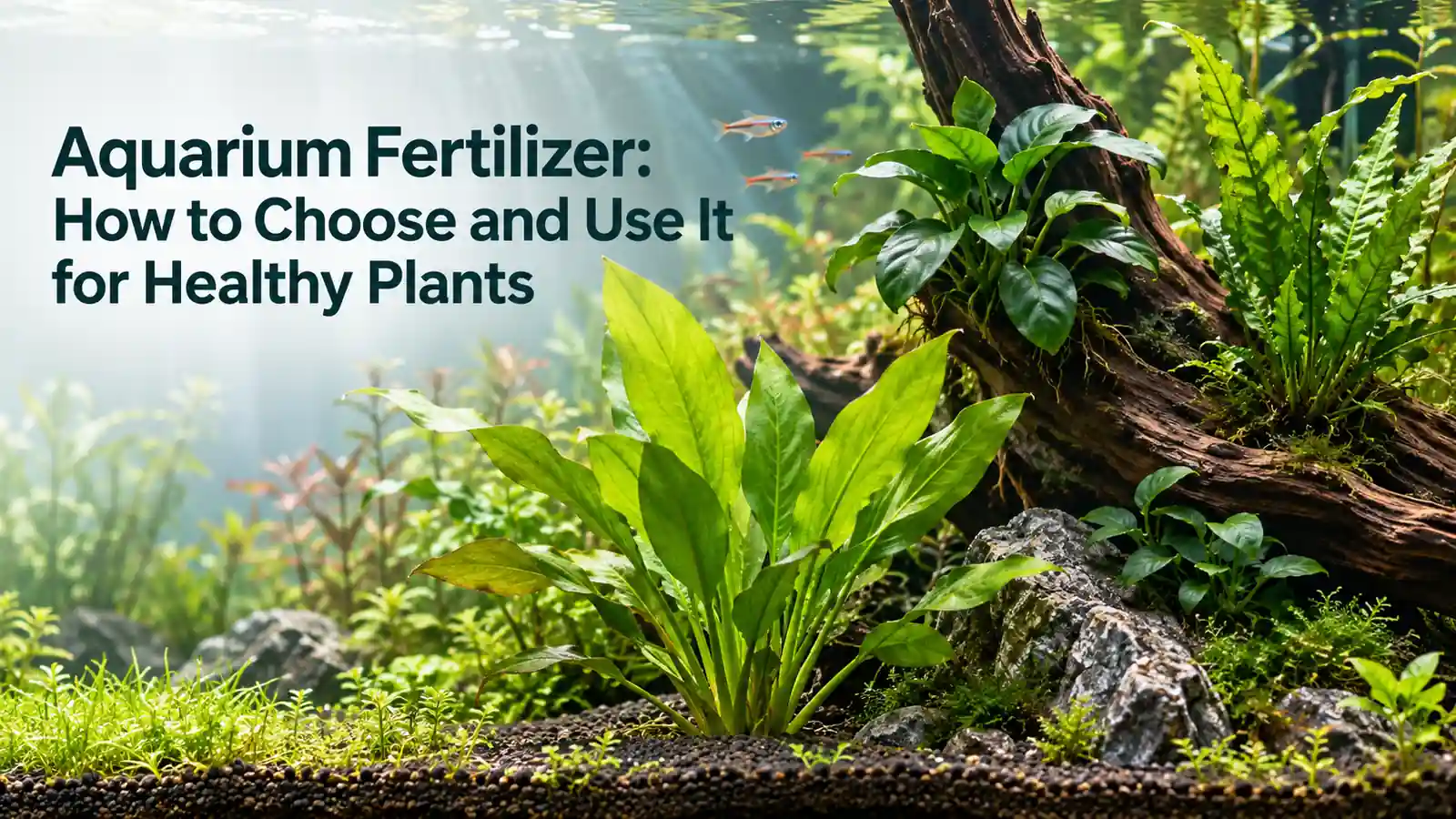
Aquarium fertilizer supplies nutrients that live aquatic plants may not receive in sufficient amounts from fish waste, tap water, or the substrate. The right aquarium fertilizer depends on your plants, substrate, lighting, carbon dioxide (CO₂) availability, and existing nutrient supply. Liquid fertilizer delivers nutrients through the water, while root tabs add nutrients to the substrate. Some aquariums benefit from both, but the best approach is to match the fertilizer to your plants rather than add more nutrients without a clear reason.
Key Takeaways
What to know before fertilizing your aquarium
Match the method to the plant
Use liquid fertilizer for water-column nutrition and root tabs when root-zone nutrition is needed.
Check nutrients before dosing
Substrate, tap water, fish waste, lighting, and CO₂ all affect plant growth.
Measure, don’t guess
Follow the product label and calculate using the correct water-volume basis.
Diagnose symptoms first
Yellow leaves and algae can have multiple causes; more fertilizer is not always the solution.
Do Aquarium Plants Need Fertilizer?
Many aquarium plants benefit from additional nutrients, but the amount needed varies from tank to tank. Fish food, fish waste, tap water, and substrate can all contribute nutrients. Their combined supply may be enough for some plants, while a densely planted aquarium may need additional fertilization to maintain healthy growth.
Plants require macronutrients in relatively large amounts and micronutrients in smaller amounts. The macronutrients include nitrogen, phosphorus, potassium, calcium, magnesium, and sulfur. Micronutrients include iron, manganese, boron, zinc, and other elements needed in smaller quantities.
A nutrient shortage can limit plant growth, but adding fertilizer is not always the answer. Lighting, CO₂ availability, root health, water conditions, and plant adaptation also influence how well plants grow.
Consider two common setups:
- Low-tech aquarium: A few slow-growing Anubias plants and Java fern may need a relatively simple fertilizer routine, depending on the nutrients already available.
- High-growth planted aquarium: A densely planted tank with stronger lighting and injected CO₂ may use nutrients more quickly and require a more consistent fertilization plan.
Neither setup has a universal dose. The plant species, existing nutrient supply, and fertilizer formulation all matter.
Can Fish Waste Provide Enough Nutrients?
Fish waste and decomposing food can contribute nitrogen and phosphorus, while tap water and substrate may supply other nutrients. The amounts vary with stocking, feeding, water changes, and the source water.
A well-stocked aquarium might already have substantial nitrogen and phosphorus but still lack other nutrients. Another aquarium might have relatively little fish waste and depend more on added fertilizer.
This is why copying another aquarist’s dosing routine can be misleading. Assess your own plants and conditions before deciding whether additional nutrients are needed.
Aquarium Fertilizer Types: Liquid Fertilizer vs. Root Tabs
Liquid fertilizer and root tabs deliver nutrients in different ways. Understanding that difference makes choosing a suitable product much easier.

| Fertilizer type | How it works | When to use it | Main limitation |
|---|---|---|---|
| All-in-one liquid | Supplies nutrients through the water | General planted-tank nutrition | Formula may not meet every tank’s needs |
| Specialized liquid | Supplies selected nutrients | When targeted supplementation is appropriate | Requires more nutrient knowledge |
| Root tabs | Release nutrients in the substrate | Rooted plants in inert sand or gravel | Do not replace every need for water-column nutrition |
| Dry fertilizer | Allows measured individual nutrients | Experienced aquarists seeking dosing control | Requires accurate measurement |
Liquid Aquarium Fertilizer
Liquid aquarium fertilizer adds nutrients to the water column, where aquatic plants can absorb them through their leaves, stems, and other tissues. Many plants can also absorb nutrients through their roots, so these methods are not mutually exclusive.
An all-in-one liquid fertilizer combines several nutrients in one formula. This can simplify maintenance because you do not need to buy and dose a separate product for every nutrient.
Check the product’s nutrient analysis before buying. All-in-one does not mean every formula contains the same nutrients or concentrations. Some products provide a broad combination of macronutrients and micronutrients, while others focus mainly on trace elements.
Liquid fertilizer can be useful for plants attached to rocks or driftwood, floating plants, and many stem plants. The best choice still depends on the plant species and the aquarium’s conditions.
Aquarium Root Tabs
Root tabs are fertilizer tablets or capsules placed inside the substrate. They release nutrients near the roots of plants that benefit from root-zone nutrition.
They can be useful for rooted plants such as Amazon swords and many Cryptocoryne varieties, particularly when they grow in inert sand or gravel that supplies little plant nutrition.
Place root tabs according to the manufacturer’s directions, keeping them covered within the substrate as instructed. Placement, quantity, and replacement intervals vary by product, so do not assume that every root tab follows the same schedule.
Root tabs are not a universal replacement for liquid fertilizer. Plants attached to hardscape or floating at the surface may benefit more from nutrients available in the water.
Should You Use Liquid Fertilizer and Root Tabs Together?
Sometimes. A tank containing rooted plants and plants that grow attached to hardscape may benefit from both methods.
For example, an Amazon sword growing in inert gravel may benefit from root-zone nutrition, while Anubias attached to driftwood can obtain nutrients from the water column.
Use both methods when they address different needs in your aquarium, not simply because more fertilizer seems better.
Which Fertilizer Method Fits Your Plants?
Match the delivery method to the way your plants grow.
Liquid Fertilizer
Consider it for attached plants, floaters, and water-column nutrition.
Root Tabs
Consider them for rooted plants in nutrient-poor sand or gravel.
Which Fertilizer Should You Choose?
Use this quick guide to narrow your options before comparing products.
| Your aquarium | Approach to consider | Check first |
|---|---|---|
| Few slow-growing plants | Simple liquid fertilizer routine, if needed | Existing nutrient supply |
| Rooted plants in inert substrate | Consider root tabs | Root-zone nutrition |
| Densely planted, fast-growing tank | Consistent liquid fertilizer program | Lighting, CO₂, and nutrient demand |
| Plants in nutrient-rich aquasoil | Assess substrate nutrition first | Substrate condition and plant response |
| Plants showing poor growth | Diagnose before changing fertilizer | Roots, lighting, water, and nutrients |
These are starting points, not prescriptions. A product should match the aquarium’s needs and provide the nutrients that may be missing.
How to Choose the Best Aquarium Fertilizer for Your Tank
The best aquarium fertilizer is the one that fits your plants and supplies nutrients your aquarium actually needs. A popular product may work well in one setup but be unnecessary or incomplete in another.
1. Choose Based on Plant Type
Different aquatic plants use the water column and substrate in different ways.
- Anubias and Java fern: These plants are commonly attached to rocks or driftwood. Keep their rhizomes exposed rather than burying them in the substrate, and consider the nutrients available in the water.
- Amazon swords: These rooted plants can benefit from nutrient-rich substrate or appropriately used root tabs.
- Cryptocoryne: Many species grow from the substrate and may benefit from root-zone nutrition.
- Floating plants: Because they do not grow roots into the aquarium substrate, nutrients available in the water are especially important.
These are useful starting points rather than rigid rules. Many aquatic plants can absorb nutrients through more than one route, and the best approach depends on the species and growing conditions.
2. Consider Your Substrate
Your substrate can change how much additional fertilizer your plants need.
Nutrient-rich aquasoil can provide nutrients to rooted plants, particularly during early growth. Its nutrient content and useful lifespan depend on the product and how the aquarium is maintained.
Inert sand and gravel mainly provide a place for plants to anchor. They may contain little available plant nutrition, making root tabs worth considering for plants that feed heavily through their roots.
An inert substrate does not mean every plant automatically needs root tabs. Plants can obtain nutrients from the water, and some species depend less on substrate nutrition than others.
The key question is whether your substrate and water together provide enough nutrition for the plants growing in your aquarium.
3. Match Fertilizer to Lighting and CO₂
Fertilizer works as part of a growing system. Plants also need suitable lighting and access to carbon, along with other conditions that support healthy growth.
A low-light aquarium with slow-growing plants may use nutrients slowly. A densely planted aquarium with stronger lighting and injected CO₂ may support faster growth and use nutrients more quickly.
If growth is limited by unsuitable lighting, inconsistent CO₂ delivery, or unhealthy roots, adding more fertilizer alone may not solve the problem.
Assess the whole setup before changing the dosing routine. A change that improves one part of the system may not help if another factor is limiting plant growth.
4. Check the Nutrient Formula
Read the product label before buying. Check which nutrients the fertilizer provides and whether its intended use matches your aquarium.
Nitrogen, phosphorus, and potassium are commonly called NPK. They are important macronutrients, but they are not the entire set of nutrients plants require. Calcium, magnesium, and sulfur are also macronutrients. Iron and manganese are examples of micronutrients.
You do not need to buy a separate product for every nutrient as a beginner. A suitable all-in-one formula may be easier to manage. Separate products can provide more control when there is a clear reason to use them.
Avoid choosing a fertilizer simply because it advertises more nutrients or a higher concentration. A stronger formula is not automatically a better fit for your tank.
How to Dose Aquarium Fertilizer Safely
A suitable fertilizer can still cause problems if it is used incorrectly. Follow the manufacturer’s instructions, calculate the dose using the correct water-volume basis, and avoid changing several parts of the aquarium at once.
1. Calculate the Water Volume Used by the Label
The advertised capacity of an aquarium may differ from its actual water volume because substrate, rocks, driftwood, and other decorations take up space.
First, check whether the product’s label bases its dose on aquarium capacity or a specified amount of water. Use the same volume basis when calculating your dose.
Know Your Aquarium’s Actual Volume
TankBloom’s Aquarium Volume Calculator can help estimate your tank’s volume. Remember that decorations and substrate reduce the water it can hold.
Calculate Aquarium VolumeTankBloom’s Aquarium Volume Calculator can help estimate the tank’s volume. Remember that the estimate may need adjusting for the space occupied by decorations and substrate.
2. Follow the Product Label
Fertilizers differ in concentration, nutrient composition, and recommended application frequency. Never assume that the dose for one product applies to another.
When a label specifies a dose proportional to a stated water volume, you can use this formula:
Required dose = Label dose × Actual water volume ÷ Label water volume
For example, suppose a fictional fertilizer label specifies 5 mL for every 10 US gallons of water. If the aquarium contains 20 US gallons of water, the proportional calculation is:
5 mL × 20 ÷ 10 = 10 mL.
This example demonstrates the arithmetic only. It is not a recommendation for any real fertilizer. Follow the actual product’s directions, including its stated dose basis and frequency.
Measure carefully instead of estimating by eye, especially when working with concentrated products.
3. How Often Should You Fertilize Aquarium Plants?
There is no single schedule that suits every aquarium fertilizer. Some products specify weekly dosing, while others recommend smaller or more frequent applications.
Follow the manufacturer’s directions and observe how your plants respond. Consider plant growth, existing nutrient supply, and maintenance when deciding whether a change is needed.
Use a consistent routine so you can evaluate the results:
- Check the product label and recommended frequency.
- Calculate the dose using the correct volume basis.
- Apply the fertilizer as directed.
- Observe new growth and overall plant condition.
- Make gradual adjustments only when there is a clear reason.
A dosing calculator can help with arithmetic, but water volume alone cannot determine the correct nutrient requirements of every aquarium.
Is Aquarium Fertilizer Safe for Fish and Shrimp?
Aquarium plant fertilizer can be used in a planted tank with livestock when the product is suitable for that use and applied according to its instructions. Safety depends on the formulation, concentration, dose, exposure, and the animals in the aquarium.
Before using a product, check:
- Whether it is designed for your type of aquarium.
- The manufacturer’s dosage and application instructions.
- Any warnings for shrimp, snails, or other invertebrates.
- Whether the formulation is appropriate for the livestock you keep.
Do not assume every fertilizer is shrimp-safe simply because it is sold for aquarium plants. Copper and other trace elements have important roles in plant nutrition, but their effects on aquatic animals depend on concentration and exposure. A copper-free label alone does not prove that a product is safe in every situation.
Avoid using ordinary garden fertilizer or houseplant fertilizer sticks unless the formulation has been specifically verified as suitable for aquarium use. Products intended for land plants may have unsuitable concentrations, ingredients, or release behavior in an aquatic environment.
What If You Accidentally Add Too Much Fertilizer?
If you overdose fertilizer:
- Stop further dosing. Do not add more fertilizer until you understand the situation.
- Check the product instructions. Follow any specific overdose guidance from the manufacturer.
- Assess the aquarium. Check water quality and watch the fish and other livestock for signs of distress.
- Respond to distress promptly. If fish are gasping or behaving abnormally, increase aeration, check water quality, and seek appropriate aquarium or aquatic-veterinary guidance.
- Consider a partial water change when appropriate. Use properly conditioned, temperature-matched water and follow product-specific advice. Do not add another chemical simply to counteract the fertilizer without knowing what is wrong.
The correct response depends on the product, the amount added, and the aquarium’s condition. Do not assume that every overdose requires the same treatment.
Why Are My Aquarium Plants Still Struggling After Fertilizing?
Adding fertilizer does not guarantee healthy growth. Plants may struggle because nutrients are unavailable, growing conditions are unsuitable, or another problem has been mistaken for a nutrient deficiency.
| Plant symptom | Possible explanations | What to check |
|---|---|---|
| Older leaves yellow | Possible shortage of a mobile nutrient or other stress | Recent growth, roots, and water conditions |
| New leaves look pale | Possible micronutrient issue or growth problem | Fertilizer formula and new growth |
| Slow growth | Light, CO₂, nutrients, or adaptation | Whole growing setup |
| Holes or damaged leaves | Nutrient imbalance, tissue damage, or other stress | Plant species and affected leaves |
| Increasing algae | Light, nutrients, carbon, or maintenance imbalance | Lighting duration, dosing, and plant growth |
Treat these observations as clues, not diagnoses. Similar symptoms can arise from different causes, and adding more fertilizer without checking the setup may not help.
For example, pale new leaves do not identify a specific missing nutrient on their own. Check the plant’s recent growth, the fertilizer formulation, and the wider growing conditions before adding a separate supplement.
The aquarium plant nutrient deficiency chart can help you compare possible symptoms, but treat it as a reference rather than a definitive diagnosis.
Algae growth also deserves a careful look. Its presence does not automatically mean fertilizer is excessive. Light, nutrient availability, carbon supply, plant growth, and maintenance interact, so look for a pattern before making a large change.
If a plant is deteriorating quickly, check water conditions and livestock behavior as well as plant nutrition. A fertilizer adjustment should not distract from a wider aquarium problem.
A Practical Starting Plan for Aquarium Fertilizer
You do not need a complicated nutrient program to get started. Use this four-step plan:
- Assess the setup. Identify your plants, substrate, lighting, CO₂ availability, and existing nutrient sources.
- Choose a suitable method. Consider liquid fertilizer, root tabs, or both, depending on your plants and substrate.
- Dose according to the label. Use the correct water-volume basis and the product’s own instructions.
- Observe before changing the routine. Look at new growth and investigate other causes if problems continue.
The best aquarium fertilizer is not necessarily the strongest or most expensive option. It is the one that supplies the nutrients your plants need, fits your aquarium’s conditions, and can be used consistently and safely.
Further Reading
Explore these guides to better understand aquatic plant nutrition and planted aquarium care.
- Fertilizing the Planted Aquarium Learn about plant nutrients, water-column fertilization, lighting, and factors that influence fertilizer requirements.
- Purdue Extension: Planting Your Aquarium Explore aquatic plant types, planting methods, substrate, and the basics of setting up a planted aquarium.

3 Comments
Pingback: Java Fern: Planting, Growing, and Propagation - tankbloom.com
Pingback: Aquarium Light: How to Choose the Right Light for Your Tank - tankbloom.com
Pingback: Planted Aquarium for Beginners: Step-by-Step Setup Guide - tankbloom.com